


Fire Extinguishing. Continued
Description
This section is from the book "The Engineer's And Mechanic's Encyclopaedia", by Luke Hebert. Also available from Amazon: Engineer's And Mechanic's Encyclopaedia.
Fire Extinguishing. Continued
The only successful mode of using a fire-engine, is to take the director or branch-pipe into the building, as near as possible to the fire, and be sure that the stream of water strikes directly upon the burning materials; this cannot be too often or too anxiously inculcated on every person using a fire-engine. Every other method not having this for its fundamental principle, will, in nine cases out often, utterly fail. When the water is thrown into the building hap-hazard from the street, it is impossible to y if any of it touches the parts on fire or not, unless the flames appear at the windows. On taking the hose and branch pipe inside the building, besides the advantage of the water striking directly upon the fire, there is a great saving in the article of water itself; the whole quantity thrown by the engine is usefully and advantageously applied, and no more is thrown into the building than is absolutely necessary to extinguish the fire. If, on entering an apartment, the flames are found to cover a considerable space, the thumb should be placed partly over the aperture of the nozle, which will spread the stream of water according to the pressure applied, so as to wash a large surface at once.
In encountering fires at close quarters in this manner, much inconvenience arises from the smoke and heat; to avoid the former, by far the most annoying and dangerous of the two, it becomes necessary to kneel or lie down, so that the fire may be clearly seen and the water thrown upon it. While in a recumbent posture, a person will generally be able to respire air comparatively pure, though standing upright, suffocation would be inevitable: the purest air is always the lowest.
Mr. Roberts, a miner, invented a "hood and mouth-piece," which enabled the wearer to enter premises when on fire, through the most dense smoke, and rescue human life and property, or apply the most eligible means for extinguishing the flames. Mr. Roberts's apparatus is shown in the accompanying engraving, which is a side view, as it appears on the wearer. It consists of a leather cap or hood a, which entirely covers the head and face, with strong glasses before the eyes. The lower part of the hood is padded with soft cotton, covered with wash leather, which being drawn tight round the neck by a strap and buckle, excludes the surrounding air. The upper part of the proboscis b is of sufficient capacity to include the nose and mouth of the wearer, and forms the channel through which he respires. A trumpet-mouthed orifice is formed at c, provided with a good cork stopper, which is secured by a small brass chain; the use of this appendage is to afford a ready relief to the lungs, without taking off the hood when the wearer goes to the door or window of a building on fire, for the purpose of respiring a purer atmosphere, or to consult with persons on the outside.
Below this part is attached, by means of an union joint, a flexible tube d, about two feet six inches long, and terminating in a funnel five inches in diameter, in which is contained a sponge saturated with water. The flexible pipe is kept distended by a spiral coil of wire, and the straps e e are for the purpose of buttoning it to the dress of the wearer, so as not to encumber him, or impede his exertions. The operation of the apparatus is as follows: - The gaseous and other noxious matters which exist in the apartment, are, by the act of inspiration, obliged to pass through the funnel of the tube, where they are absorbed and neutralized by the liquid contained in the sponge, and the air is sent up to the lungs in a pure sate. The efficacy of the apparatus has been repeatedly proved, in the presence of numerous scientific individuals, amidst the most dense smoke, arising from the combustion of wool, wet hay, wood shavings, etc, besides large quantities of sulphur, in temperatures varying from 90 to 240° of Fahr.

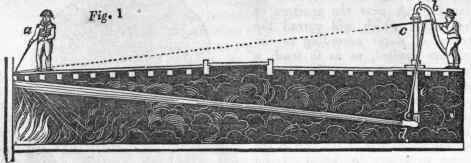
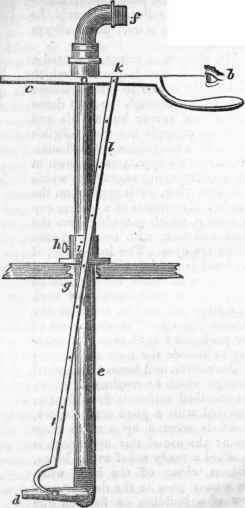
To obviate, in some measure, the necessity for entering the apartment in which the fire is raging, Mr. George Dodd invented and patented an ingenious contrivance, consisting of a peculiar arrangement of levers and joints connected with the hose of a fire-engine, by which the operator may direct a jet of water to any unseen part of the interior of a ship or house on fire. This will at once be understood on reference to the above engraving, Fig. 1, wherein a person at a is pointing to the spot where the fire is situated; the operator b then directs the lever c he holds, so as to point to that part; this movement causes the nozle d to point to the same place, and, consequently, the utmost effect in extinguishing the fire is produced, which is, of course, greatly accelerated by excluding the admission of fresh air. The annexed Fig. 2 exhibits a part of the above on a larger scale, showing more exactly the construction of the apparatus by which these effects are produced; c is the branch pipe of a fire-engine, of a peculiar form, the hose being screwed on at f.
If there is no bull's eye in that part of the deck where it becomes necessary to insert the apparatus, the carpenter would be directed to strike out a hole, as shown at g, through which the branch would be let down to the required position, when it would be made fast by turning the screw h in the ferule i, the aperture below being entirely covered by a large hunch at the bottom of the ferule, as represented. The lever c moves upon a fulcrum, or centre-pin, at the upper end of the branch pipe e, not affixed to the pipe itself, but to another ferule fixed thereon. To this lever is attached, by another centre-pin k, the long bar 11, which is connected by a pivot-joint to the nose pipe d. It will now be seen, that as the distance between the two joints in the nose pipe is the same as the distance between the two joints in the lever c, a corresponding motion will be produced when operated upon in any direction, upward, downward, horizontally, or obliquely; and as the connecting rod l is perforated with a number of holes, it may be attached in any part of its length to the lever c, so that the jet may play close under the deck, or far from it.
There are several other modifications of the apparatus to suit different circumstances, but the above explains the principle of action of the whole, which appears calculated to prove useful in stopping fires on ship-board.
Fig. 2.
Continue to:


My Books

