


Shingling Or Blooming
Description
This section is from the book "The Engineer's And Mechanic's Encyclopaedia", by Luke Hebert. Also available from Amazon: Engineer's And Mechanic's Encyclopaedia.
Shingling Or Blooming
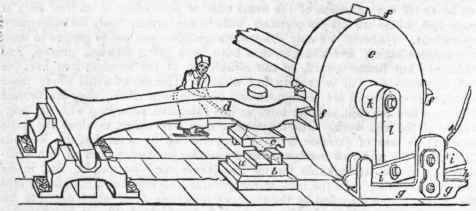
The "underhand" having drawn a ball out of the furnace, his superior, the "shingler," takes it up by a pair of tongs and heaves it on to the depressed part a of an anvil b, which with its block (sunk in the ground, and resting upon solid masonry) weighs several tons, at the same time another shingler, whose turn it is, (there being two shinglers to each hammer,) draws out of the furnace a stout flat bar, one of the two before mentioned, the end of which has been brought to a welding heat, and holding the cooled end wrapped round with a piece of nail bagging, he lays the heated end upon the ball under the hammer c, the first blow of the latter forces the bar into the ball flush with its surface, and they are thus instantly welded together, and form as it were, one piece; the bar thus becoming a long handle, by which the shingler can move and turn the ball about upon the anvil between every blow of the hammer. This hammer with its helve d weighs between four and five tons, and makes upon an average about 150 blows per minute; it is actuated by the revolution of a cylinder e, in the circumference of which are fixed, at equal distances, four or more wipers or coggs f f which successively come into contact with the underneath side of the extremity of the hammer helve, and thereby lift it up after each blow about 18 or 20 inches, whence it falls simply by its own weight; which operates so effectively as to reduce by a very few blows, the shapeless ball into a bloom.
This bloom is a rough square bar, usually about 20 inches long, and 4 or 5 inches thick. By reference to the foregoing figure, it will be observed that the hammer head has not an uniform flat face, but is of a varied form, and has several projections which answer to the rounded ends of common sledge and hand hammers, termed panes; by placing the bloom under these projections crossways, the bloom is extended lengthways; and by placing the bloom so that a pane shall strike it lengthways, its breadth is increased, and the grooves or dents which are thus made are worked out by bringing the bloom under the flat parts of the hammer. The effect of the hammering is not confined to giving it a new form, out a large quantity of dross is thereby worked out, and the sparks and scales fly off with great force, so that the workmen are obliged to be protected with thick leather aprons, leggings, etc. It sometimes happens, through mismanagement on the part of the puddler, that a ball has not sufficiently " come round to nature," and it shows its indisposition to submit to the gentle correction of the hammer by hissing and bubbling.
This species of bloom is called a shadrach, and it is thrown back to the puddler, who has to pay a fine for having drawn it cut of the furnace before it was sufficiently purged of its impurities.
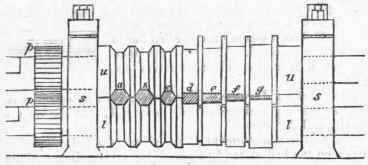
Shingling Ro!ls. - ln this early state of the manufacture of malleable iron, the office of the hammer just described is generally confined to giving the bloom only about fifteen or twenty blows, by which it is brought into a shape that will permit of its being, while still of a bright red heat, passed through the shingling rolls. The precise form of the grooves in these rolls is not material, and they differ in most works; the intention is to reduce the bloom as quickly as possible into a broad, flat bar, for a purpose that will presently be explained. In the annexed sketch, which we have made to illustrate the subject, two different kinds of grooves are introduced, both of which are employed. In the above figure, u u represent the upper roll; 11 the lower; s s are the standards through which the necks of the rolls pass, and are therein made to revolve in opposite directions by the action of the pinions p p in gear with each other, to the shaft of one of which the power is applied; and by a continuance of such shafting, connected by clutch boxes, motion is sometimes imparted to a series of pairs of rolls, arranged in one line.
In the preceding figure, the dark spaces between the rolls, respectively marked a b c d e f g, show the form given to the bars as they pass through those grooves. The bloom is supposed to be first put through a, and then through the others successively, until it is brought out at g in the form of a flat bar four or five inches broad, and half, or five-eighths of an inch thick. By the severe squeezing which the bar undergoes in passing through these rolls, an additional quantity of cinder or foreign matter is forced out of it; and it is worthy of remark that the grooves abc powerfully contribute to this effects The form of them is not designed to be an equilateral hexagon, but that of a square with the top and bottom corners taken off". In the horizontal line the angles are right angles, the bar will therefore in that direction be made wider than in its vertical breadth, where the angles are obtuse. Besides, there are usually between the rolls, where they are intended just to touch each other, little vacancies, into which the iron is compressed in its passage, and a burr is thus formed upon its angles; now, by turning the bar so as to present the right angles and burrs to the flat top and the flat bottom of the same, or the next pair of grooves, they are thereby crushed down, and the dross is thus more efficiently worked out of the metal, and by the time it arrives at g, in the form of a flat bar, it is considerably improved in its toughness and malleability.
Nevertheless, the iron is of an unmerchantable quality; it is still impure; is too easily broken; has a rough scaly surface, and its edges are imperfect.
Continue to:


My Books

