


Salts Employed In Making Iron
Description
This section is from the book "The Engineer's And Mechanic's Encyclopaedia", by Luke Hebert. Also available from Amazon: Engineer's And Mechanic's Encyclopaedia.
Salts Employed In Making Iron
A patent was taken out a few years ago, by Mr. Luckcock, an iron master of Edgebaston, near Birmingham, for the application of the muriate of soda, (common salt,) to the iron in the puddling furnace just as the metal is breaking down into fusion; the action of which was said to be productive of that toughness and malleability which had previously been only effected by laborious and expensive mechanical agency. The proportion of salt to the iron was about two per cent, by weight. How far experience has proved the advantage of this mode of seasoning the puddlers' balls, we are not informed; but it might be presumed to have been successful, from its having excited the rivalry of others, who have since taken out patents for salting iron; amongst these we may particularly notice Mr. Josias Lambert, of Liverpool Street, London, who appears to have availed himself of some hints out of an old fashioned receipt book. This gentleman adds (in his first patent, 1829,) potash to Mr. Luckcock's soda, in the proportion of one part of the former to two of the latter; and of this mixture he administers 15 pounds to the ton of ore in the blast furnace; in the refining furnace 121/2 lbs., and in the puddling furnace, 11 lbs. to the ton.
Mr. Lambert, in the succeeding year, 1830, took out another patent, entitled "an improvement in the process of manufacturing iron," etc. This improvement consisted in the addition to the former mixture of two parts of lime! thus making it two parts of "salt," one part potash, and two parts lime. But notwithstanding this powerful and novel auxiliary, he does not diminish the quantity of the mixture, but nearly doubles it After this explanation of the nature of these presumed discoveries, it will be unnecessary to enter more into detail, as respects the quantities of the fluxes to be used in the several successive processes of the iron manufacture. We should not indeed have noticed these two last patents at all, were it not from the circumstances that this species of iron cookery has been, and is probably, still conducted upon an extensive scale. Of the novelty of the scheme, every chemist must be aware, that all the substances mentioned have been unscrupulously used as convenient fluxes in the assay furnace for a century or more; and as respects the eligibility of their employment in the great laboratories of the present day, we have the scientific and practical authority of Mr. David Mushet, for observing that they are considered useless.
Fig. 3.
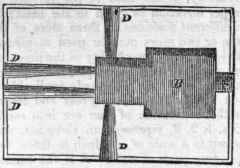
The Forge, Rolls, etc. - For the purpose of introducing some recent improvements connected with the previously described departments of the manufacture, we broke off our narration of the usual train of proceeding of an iron work at page 768, where we left the puddlers' balls in the furnace ready for subsequent operations. Hitherto, we may observe, imagination has had to picture to itself the intense action and changes that have been going forward, unseen, and unheard; but henceforward, to the completion of the wrought-iron bar, the rod, and the sheet, all is activity and motion. The departments where those articles are produced are contiguous and open to each other; they are termed the forge and the mill, and are more or less extensive, according with the magnitude of the iron work. The impression upon a spectator, to whom the scene is novel, is one of extreme interest, and one that he never forgets; he finds himself in the midst of machinery of a peculiar character, and of extraordinary magnitude, remarkable for its massiveness and its weight, and in its effects astonishing.
In the mill, at regular intervals of about a minute, he sees the distant gloom dispelled by the rising of a furnace door, which opens to his view a chamber full of dazzling light before which stands an invulnerable workman, who pulls from the midst of it a lump of iron, blazing like a meteor, and dashes it upon the ground. Almost as quick as thought, and before the furnace door can be closed again, the ignited mass of metal is eagerly snatched up by another workman, with a pair of tongs, who instantly applies it to the largest grooves of a pair of solid cylindrical " rolls," which are revolving with great velocity, and with such immense force, that the mass of iron is, as it were, shot through the rolls, and is so far altered in its figure, by the compression, as to be doubled in its length. Notwithstanding the rapidity with which the iron moves by the revolution of the rolls, it is uniformly seized as it comes out by another workman, who, with his assistant, tosses it back over the top roll, where it is again taken by the first workman, and passed through the next pair of grooves, smaller than the former; it is again seized by the workman on the opposite side, and treated as before; and thus it travels backward and forward, spontaneously illuminating its path by bright scintillations, through half a dozen or more successive grooves; all the while lengthening itself, perfecting its shape, and improving its quality, till it arrives at the end of its journey in about a minute after starting from its fiery chamber.
The spectator, who may have taken his stand at a convenient distance, and has scarcely been able to comprehend more than the possibility of what he has seen done, from the celerity of its execution, is probably obliged to move farther off by the scorching heat of the still bright red, long, finished bar which has reached him. This bar has, however, not passed its last channel before the effulgent furnace again opens its mouth, and another bright mass of metal is ready to follow the first; and thus, bar after bar is made till the contents of that particular furnace are discharged During this splendid operation, the spectator has perhaps scarcely looked around him; to see a fly wheel, of twenty feet in diameter, and of ten tons weight, cutting through the air at the rate of ninety revolutions per minute; (more than 60 miles per hour,) driving by means of a massive cog-wheel on its axis, numerous other wheels at different velocities, to communicate the requisite power and motion to various other mechanism contiguous and remote; to observe that through the medium of other gear of due proportions, the ponderous rolls are made to turn on their thick axes or "necks" twice as many times per minute as the great fly; to trace the cause of motion of the latter, through a stout pinion on its axis, driven by a great toothed wheel, which is turned by a crank attached to the lower extremity of the heavy vibratory connecting rod of a magnificent steam engine, which, in its own separate apartment or house, is quaffing its potent vapour in silence, and distributing its constantly renewed energies around to all that require it; not excepting the ponderous machine which we shall next describe, the effects of which are the reverse of those which are complained of in the trunkmaker's hammer.
Continue to:


My Books

