


Curves
Description
This section is from the book "Elementary Metal Work", by Charles Godfrey Leland. Also available from Amazon: Elementary Metal Work.
Curves
When the pupil can make a ring, he can proceed to form semicircles or C's. As these C's run into spirals at one or both ends, and are modified into more than one form, Fig. 11, b-f, they require more skill than the plain circle. To make these, hold the strip of iron, or other metal, with the flat pincers or pliers in the left hand, and with the round-nosed, or pipe-pliers, bend or curve the strip at one end into a volute or roll, which can then be enlarged or "undone" to the curve required. If needed, then work the other end of the strip in the same way. If there are any irregularities or warps in the metal they can be pinched and pressed out with the flat pliers.
It will be readily understood that there is a certain knack of manipulation or art of neatly forming the curve which clever pupils will readily perceive and acquire, and which those who are less apt must learn from them, or from a skilled teacher or by practice.
The next step is to form an S curve which is in fact making two semicircles or C's out of one piece. Its ends of course may be developed into varied forms, spirals, etc., Fig. 11, c.
An end, be it of a C, or S, or of a straight line, may also be bent back and riveted in a recurb or pear-shaped, turned-back curve. This forms a pretty finial or end-ornament. It may also be frequently applied as a crochet or side ornament on a frame or strap, Fig. 11, h.
Vase or Eye Curves (Fig. 12). These are very beautiful forms, which may frequently be introduced to advantage in designs. To make them, first double or bend the strip,with the round plier as before directed. Three or more may be joined so as to radiate from a centre.
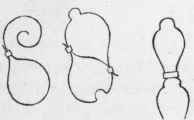
Fig. 12.
Angles (Fig. 13). These which are in straight lines and square corners have the same relation to curved figures as crystals have to vegetation or organic life. They may be obtuse, acute, and in fact carried so far as to allow the strip to be bent back flat on itself or doubled close. It is always well, when it is possible, before doing the latter, to heat the iron in a fire or a gas-lamp enough to render it flexible, which precaution may indeed be adopted at any time where the iron seems to be refractory or with a tendency to crack and break. Angles may be accurately formed on the square edge of the anvil.
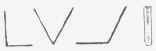
Fig. 13.
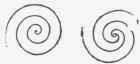
Fig. 14.
Concentric Spirals (Fig. 14). These are very pretty and effective, especially when they proceed from a closely twisted end.
Fig; 15.

Fig. 16.
These latter or close spirals are often very effective when employed as finials or ends, and were much used in the best mediaeval or Gothic iron-work, though they occur seldom in the modern rococo or baroque work which avoids everything which is in the least difficult, and seeks to make only that which can be turned out most rapidly. The true object of study for beginners should be to become thoroughly good artisans or artists, and not merely to learn how to make what will sell most readily at bazaars or fairs.
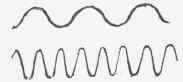
Wave-lines (Fig. 15). These may be rounded, that is semicircular, or pointed like saw teeth. They require care, though the process of bending them alternately with the round pliers is easy. They are much used for borders. Indented wave-lines, >are very pretty, they are made by first allowing a very long curve and making the indentation either with round nippers, or hammering with an iron rod in a groove.
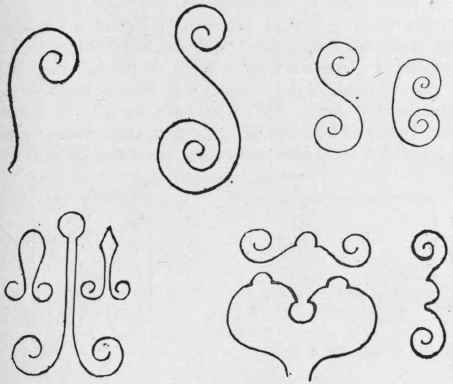
Fig. 17. Samples of Curvature.
Ogives or Ace of Spade curves (Fig. 16). These are not very common in bent work, yet they are easily enough made and are very effective in design when properly disposed.
Continue to:


My Books

