


Practical Geometry. Part 3
Description
This section is from the book "A Practical Workshop Companion For Tin, Sheet Iron, And Copper Plate Workers", by Leroy J. Blinn. Also available from Amazon: A Practical Workshop Companion For Tin, Sheet Iron, And Copper Plate Workers.
Practical Geometry. Part 3
To Describe A Parabola, The Dimensions Been Given
Let AB equal the length, and CD the breadth of the required parabola; divide CA, CB into any number of equal parts; also,
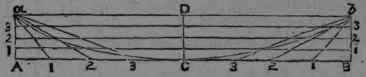
•divide the perpendiculars A a and B b into the same number of equal parts; then from a and b draw lines meeting each division on the line ACB, and a curve line drawn through each intersection will form the parabola required.
To Obtain By Measurement The Length Of Any Direct Line, Though Intercepted By Some Material Object
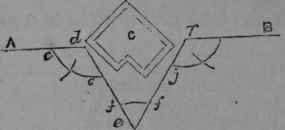
Suppose the distance between A and B is required but the right line is intercepted by the object C. On the point d, with any convenient radius, describe the arc c c, make the arc twice the radius in length, through which draw the line d c e, and on e describe another arc equal in length to once the radius, as e f f; draw the line e f r equal to e f d; on r describe the arc; j j, in length twice the radius; continue the line through r j, which will be a right line, and d e, or e r, equal, the distance between d r, by which the distance between A and B is obtained as required.
To Inscribe Any Regular Polygon In A Given Circle
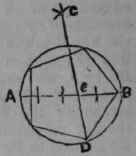
Divide any diameter, as AB, into so many equal parts as the polygon is required to have sides; from A and B as centres, with a radius equal to the diameter, describe arcs cutting each other in C; draw the line CD through the second point of division on the diameter e, and the line DB is one side of the polygon required.
To Construct A Square Upon A Given Right Line
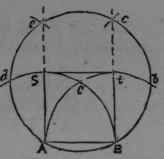
From A and B as centres, with the radius AB, describe the arcs Acb,Bcd, and from c, with an equal radius, describe the circle or portion of a circle cd, AB, bc; from bd cut the circle at e and c; draw the lines Ae,Bc, also the line st, which completes the square as required.
To Form A Square Equal In Area To A Given Triangle
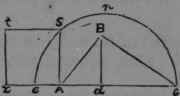
Let ABC be the given triangle; let. fall the perpendicular Bd, and make Ae half the height dB; bisect eC, and describe the semicircle enC; erect the perpendicular As, or side of the square, then A s t x is the square of equal area as required.
To Form A Square Equal In Area To A Given Rectangle
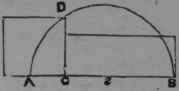
Let the line AB equal the length and breadth of the given rectangle; bisect the line in e, and describe the semicircle ADB; then from A with the breadth, or from B with the length, of the rectangle, cut the line AB at C, and erect the perpendicular CD, meeting the curve at D, and CD equal a side of the square required.
Continue to:


My Books

