


Soldering
Description
This section is from the book "Welding Theory, Practice, Apparatus And Tests Electric, Thermit And Hot-Flame Processes", by Richard N. Hart. Also available from Amazon: Welding: Theory, Practice, Apparatus And Tests, Electric, Thermit And Hot-Flame Processes.
Soldering
A solder is a metallic glue. There are almost an infinite number of solders, the most common being lead-tin solder for soldering the common commercial metals. The lead-tin proportion is varied to obtain solders with different melting points, strength, fluidity, and elasticity. Then other metals are added to the original lead-tin alloy, so that the properties of the solder are given a different range. The solder may be used for special metals and special purposes. Either the lead or tin or both may be dropped.
All solders have lower melting points than the metals they are intended to join; all solders must amalgamate with, or "wet," the metals they join. Most solders are weaker in tensile strength than the joined metals. For this reason soldered joints are not often intended to be specially strong. When metals are soldered in preference to being brazed or welded, it is because time and money can be saved and a satisfactory joint gotten.
Ordinary solder is half-tin half-lead, by weight. Hard solder is two parts lead to one part tin. Hard solder is more brittle, stronger, and has a higher melting point. On account of the present high price of tin, it is also cheaper. To ordinary solder, antimony is added to still further harden and stiffen the solder. Arsenic is sometimes added to make the melted solder flow freely. Bismuth and cadmium are sometimes added to bring the melting point down. For example, Wood's metal contains two tin, two lead, two cadmium, and eight bismuth, and melts at 70 deg. Cent. Bismuth is apt to make a solder brittle; while cadmium, like tin, helps to make the solder elastic or soft. Copper in small proportion will stiffen and strengthen solder, but it will raise the melting point sharply. Iron is seldom used in solders.
The data on the proportions of these metals in the solders is very inexact, and the exact properties of a given alloy are seldom known. The whole subject comes under the study of alloys, in which there is still much confusion and little accurate information. New alloys are being put on the market every day, some of them of known constitution, some unknown; many of them have properties claimed which they do not possess, and the practical men must find out for themselves which of the solder alloys are fit for the purposes they are advertised for. The future will see more accurate information at the call of the metal worker, who will be able to choose his solder with an eye to getting certain properties in the alloy and at the lowest cost.
The soldering bit is a copper-headed tool used to melt and manipulate the solder. The head is of various shapes, according to the work at hand, and is fairly bulky so that it will hold heat for a period of time (see Fig. 91). It is also pointed so as to be handy for working into seams and corners. The bit should be coated around the point with tin or the solder that is to be applied. This is so that when hot it will be coated with a skin of melted metal which will draw the solder with it. To tin the bit it is first filed or sand-papered free of scale, is fluxed with zinc chlorid, and then heated. It is then tinned by holding a tin stick against it and melting off some of the tin, which will adhere to the freshly fluxed surface. If the bit is at any time heated to redness while using, the tin will volatilize and the bit must be retinned.
An ingenious soldering bit, or iron, recently patented, is described in the Brass World for February, 1905. The body of the bit contains a small reservoir in which is placed the solder. The reservoir has an opening near the head of the bit, which is opened by pressing a lever on the handle of the bit. The reservoir is so designed that the solder will not spill out while the workman is using it.
■ Fluxes for ordinary plumbing soldering are sal ammoniac, borax, resin in alcohol, tallow, or zinc chlorid solution. There are a number of patent or secret fluxes on the market, and many metal workers make their own special preparations. The soldering flux is generally applied before heating and after the metals have been cleaned. Its office is to combine chemically with any oxid left after the mechanical cleaning and also to dissolve any grease. A well-fluxed surface is made of raw metal, ready to be wet by the solder.

Fig. 91. - Ordinary soldering iron.
Sal ammoniac may be powdered on or applied with a brush as a solution in water. Calcined borax is powdered on or its solution painted on. Zinc chlorid is made by dissolving zinc to saturation in dilute hydrochloric acid. It is considered the best flux for plumbing.
Some solders are known as self-fluxing. They contain a metal which oxidizes when heated or which is a solvent for the oxid on the surface to be soldered. For example, Richards' aluminum solder is applied without flux. It contains phosphorus, which acts as a flux with oxid of aluminum. Self-fluxing solders should become popular in the future, when they are better known.
Soldering commonly requires much less heat than welding or brazing. The solders have melting points one-half to one-fourth as high, and the joints do not need to be annealed or cooled slowly. Hence a mouth blowpipe with a candle flame (Fig. 92) or a foot pump with a gas flame will give all the heat needed. In soldering large joints, where the heat is conducted away rapidly by the body of the metal, a gasoline or kerosene torch is used for preheating, and the solder is melted in a tinner's soldering furnace. For soldering jewelry and filigree an ordinary blowpipe is used. No special precaution need be taken with the flame, except to keep it hot enough to consume all of its carbon..
I will not try to describe any special soldering process. There are too many metals that can be soldered, and too many ways to solder them, and too many special solders for a given joint. In general, the process of soldering includes: the mechanical cleaning of the surfaces of the metals to be soldered; the heating to a point where the solder will unite with the clean surfaces; the fluxing of the surfaces, before or after heating, so that the metal surfaces will be really clean; the application of the solder with the bit; and the finishing of the joint.

Fig. 92. - Ordinary mouth blowpipe.
In cleaning the metals, remove the rust and grease with a file, scraper, and a rag or alkali solution. If the flux is a liquid, it is best to first heat the metal a little and then paint on the liquid, which will eat away the oxid film, and will keep the clean surface covered until the solder is applied. If the flux is borax or resin in solution, first apply cold.
The solder is then melted on to the hot clean metal with a torch, or by pressing the hot bit against the solder stick and running it on to the metal. The bit is used to manipulate the solder over the surfaces and to give it the proper shape as it cools.
Among the precautions necessary are to be sure the metals are clean wherever the solder is intended to bind. This can only be done by careful fluxing. Then the metals, must be hot enough, but not too hot. If too hot, they will be liable to oxidize in spite of the flux, should the flux be prepared for a low temperature only. Also, if the metals are too hot, they will make the solder highly liquid. The bit must not be heated too strongly or the tinning will be driven off and the bit will then be no more capable of guiding and shaping the melted solder than would a stick of wood.
Many soldering runs, such as are found in the manufacture of fruit cans, are now done by automatic machinery; the cleaning, fluxing, and soldering being done in an endless chain, and the machine turning out the finished soldered job in a tenth the time it would take by hand, and making a neater, evener job. The soldering is done by dipping the fluxed metal in a bath of molten solder.
The following solders are used for lead, zinc, copper, brass, iron; and with the addition of cadmium or bismuth, for tin and britannia.
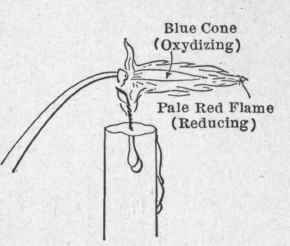
Fig. 93. - How to hold the blowpipe in a candle flame.
Melting Points Of Lead-Tin Solders 1
Name | Lead | Tin | Melting point deg. Cent. |
Tin................... | 1 | 1 | 228 |
Soft solder .......................... | 1 | 2 | 171 |
Medium.............. | 1 | I | 188 |
Hard solder ............... | 2 | I | 227 |
Lead................. | I | 320 |
For soldering gold, Gee2 gives a table of solders with melting points of 983 deg. to 1020 deg. Cent, composed of about 1 part copper to 2 to 5 parts silver, and a small addition of zinc. In making up gold solders, it is quite as important to know what metals should not be used. Because gold is very easily ruined by certain metals, lead, tin, arsenic, and antimony should not be used in solders. Antimony is specially injurious, and bismuth in very small proportion will rob gold of its properties.
For silver the hardest solder is 4 parts silver to 1 part copper. A softer solder is 4 silver, 1 copper, and 1 zinc. About 5 per cent, tin makes a quick-running solder. Arsenic in varying amount is also added to soften the solder.
For platinum the solder was commonly gold of ordinary purity, melted on with a strong blowpipe. Since the introduction of the oxy-hydrogen flame, platinum is seldom soldered and almost all joints are welds.
Aluminum has been much experimented on recently (see page 21). There are a number of aluminum solders on the market. One of the best known, Richard's alloy, is composed of 22 tin, 11 zinc, 1 aluminum, 1 phosphor-tin. This is a self-fluxing alloy, due to the action of phosphorus on the aluminum oxid. Aluminum solders are pronounced in general to be unsatisfactory, because aluminum is electropositive to all other metals, and electrolytic action of a destructive nature is apt to set in some time after the joint is made, especially if the joint is exposed to water. Tin is harmful to aluminum and should not be used in its solders. It is claimed that tin will permeate into the aluminum in time and make it rotten and brittle.
1 Brass World, Nov., 1905.
2 "The Goldsmith's Handbook," Geo. E. Gee, 1903.
Continue to:


My Books

