


Lesson IX. Applique
Description
This section is from the book "Educational Needlecraft", by Margaret Swanson And Ann MacBeth. Also available from Amazon: Educational Needlecraft.
Lesson IX. Applique
Age: 14-18 Years; 18-24 Years
Applique work, as being an addition of applied patches of another material combined with stitchery, requires special consideration. It must, first of all, be borne in mind that the chief object in applying a patch is to save time in covering surface which would incur laborious stitching. Therefore applique work is only suited for designs of fairly large size, which demand broad simple effects of colour.
The choice of materials must be carefully considered, and as a general rule it is best to apply patches of the same material as the ground of the work : linen on linen, silk on silk, and woollen on woollen stuffs, so that the patch may be of the same consistency and elasticity as the background and will therefore wear better with it. Silk patches on linen or wool almost invariably fray away from the background. Velvet patches may be applied to silk or to a mixture of silk and wool, but are not suitable for other materials. No material can be applied in patches to a velvet ground with success.
Linen is distinctly the best material for applique work, and washes and wears excellently.
The method of working it is as follows.
Carefully trace the shape of the applied patches with the warp and weft corresponding to that of the background they are to cover. Cut these out and tack or overcast them firmly into place. It is even permissible to paste these on if the work will not require to be washed. The best stitch to use round these patches is a close satin stitch about J inch wide. Button-hole stitch may also be used, or two rows of couching with a thick thread. This outline of stitching must always be akin in colour and tone to the applied patch, so that it will be distinct from the colour of the background.
Diag. 206.
Diag. 208.
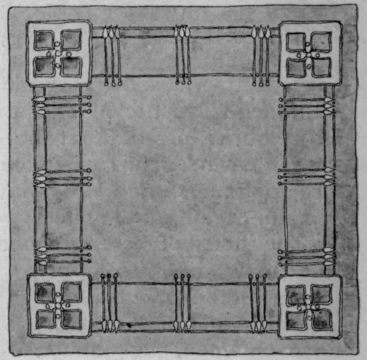
Diag. 207.
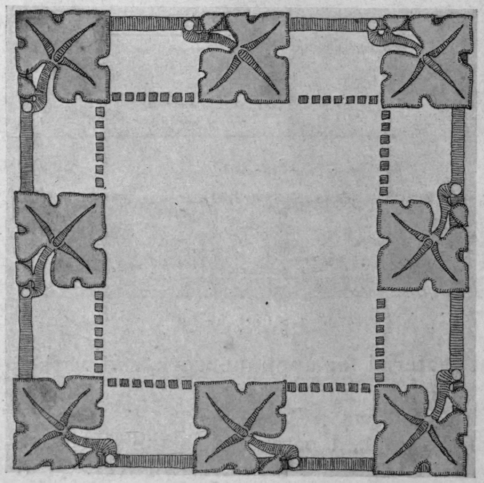
Diag. 209.
Always set the needle into the patch and bring it out at the edge when stitching it on, or there will be a tendency to give the patch a blistered appearance.
If the tacking threads are close enough to the edge of the material they will be covered by the stitching and need not be withdrawn.
The shapes used for applied patches must as far as possible be simple in outline, without any superfluous serrations or narrow bands. Stems, except in very large designs, can be better and more quickly executed by stitchery alone.
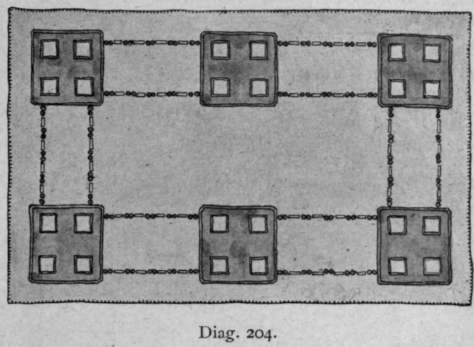
Diag. 204 is an excellent example of straight line in applique; the square patches have square holes cut out of them, and all the raw edges are covered with satin stitch.
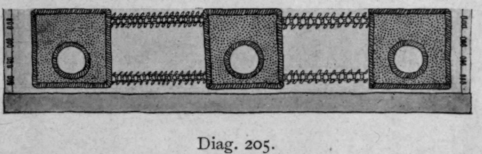
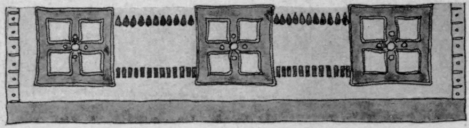
Diag. 205 is another square patch with a round hole. Diags. 206 and 207 square patches again, connected with lines of spots in satin stitch or with straight lines of couching.
Diag. 213.
Diag. 214.

Diag. 215.
Diag. 216.
Diag. 217.
Diag. 218.
Diag. 219.
Diag. 220.
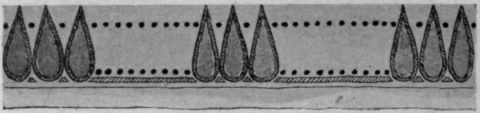
Diag. 221.
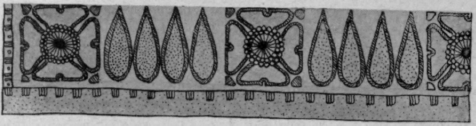
Diag. 222.
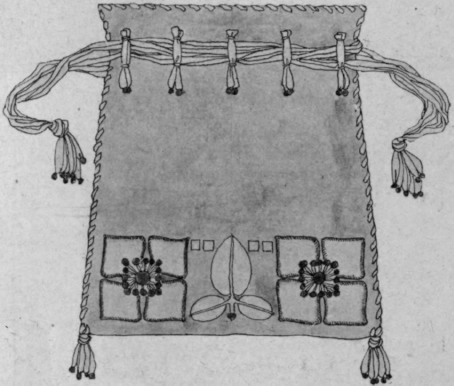
Diag. 223.
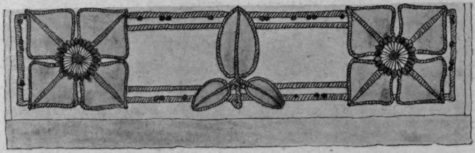
Diag. 224.
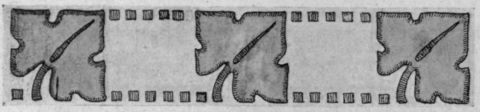
Diags. 208 and 209 give a simple square leaf-shaped patch with connecting lines of stem or spots.
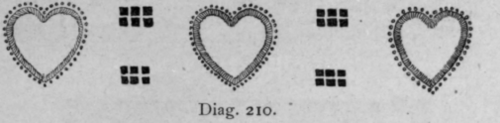
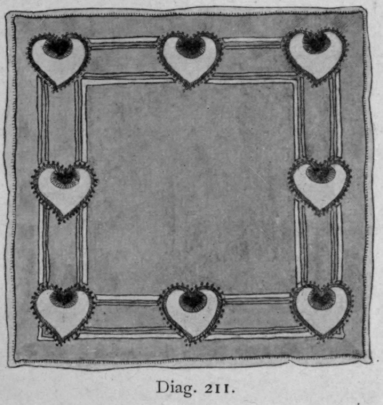
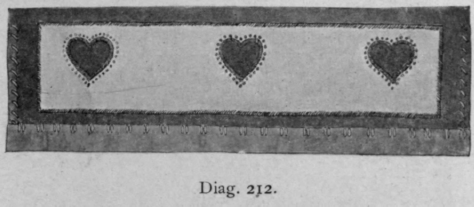
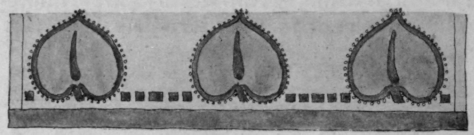
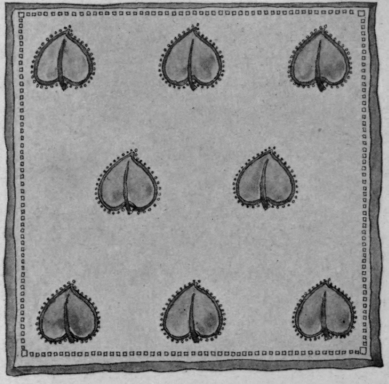
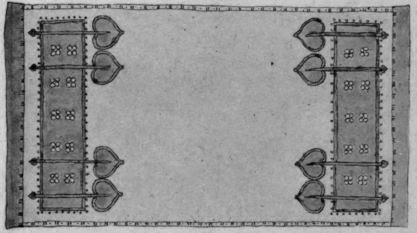
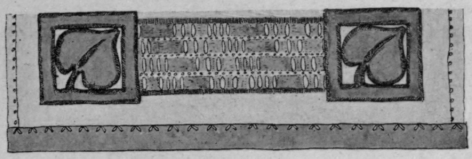
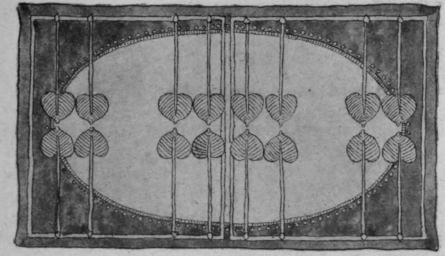
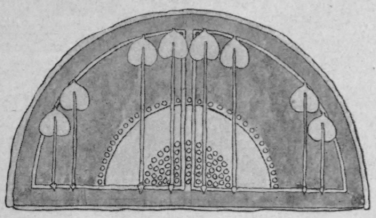
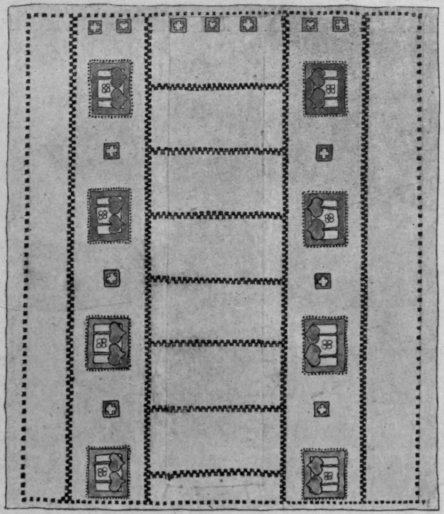
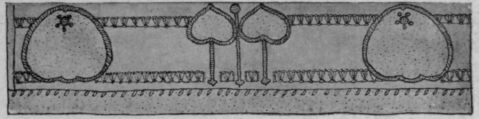
Diags. 210, 211, 212 give various applications of the heart shape; and 213, 214, 215, 216, 217, 218, 219 are all different applications. of the heart-shaped leaf form, combined with borders of spots or open drawn work. Diag. 220 is a suggestion for a coverlet which might be made of three strips of roller towelling, the selvedges joined by means of satin stitch in small chequers. Diag. 221 is another leaf form arranged in a
Diag. 225.
very simple pattern for a border of a curtain.
Diag. 226.
Diag. 222 is a combination of the latter with a four-petalled flower. Diags. 223 and 224 show square flowers of clematis combined with a leaf form ; while 225 shows the circle modified into an apple shape, combined with leaves and hem stitching.
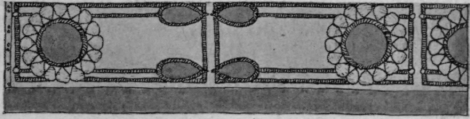
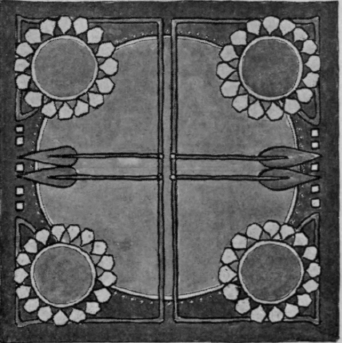
Diags. 226 and 227 are circular and leaf-shaped patches forming daisies, for a border and cushion.
Diag. 227.
Continue to:


My Books

