


![next page: 2. Cassia [Tourn.] L. Sp. Pl 376. 1753](../../../images/nav/page_next.gif)
1. Cercis L. Sp. Pl. 374. 1753
Description
This section is from the book "An Illustrated Flora Of The Northern United States, Canada And The British Possessions Vol2", by Nathaniel Lord Britton, Addison Brown. Also available from Amazon: An Illustrated Flora of the Northern United States, Canada and the British Possessions. 3 Volume Set..
1. Cercis L. Sp. Pl. 374. 1753
Small trees or shrubs, with simple broad leaves, and pink flowers in short lateral fascicles borne on the twigs of preceding seasons. Calyx somewhat oblique, broadly campanulate, 5-toothed. Corolla irregular; petals 5; standard enclosed by the wings in the bud; keel larger than the wings. Stamens 10, distinct, declined; anthers all alike, short, versatile, longitudinally dehiscent. Ovary short-stipitate; ovules ∞. Pod linear-oblong or oblong, flat, margined along the upper suture, 2-valved at maturity, the valves thin, reticulate-veined. [Ancient name of the Old World Judas-tree.]
About 7 species, natives of North America, Europe and temperate Asia. Besides the following, two others occur in the south central and western United States. Type species: Cercis Siliquas-trum L.
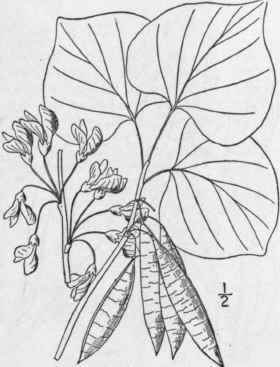
1. Cercis Canadensis L. Red-Bud. American Judas-Tree
Fig. 2436
Cercis canadensis L. Sp. Pl. 374. 1753.
A tree, with greatest height of about 50o and trunk diameter of 1°, or often shrubby. Stipules membranous, small, caducous; leaves simple, petioled, cordate-orbicular, blunt-pointed, rather thick, glabrous, or pubescent along the veins beneath, 2'-6' broad; flowers several together in sessile umbellate clusters, appearing before the leaves; pedicels slender, 4"-12" long; corolla pink-purple, about 4" long; pod short-stalked in the calyx, linear-oblong, acute at each end, glabrous, 2'-3' long, 6" wide, several-seeded.
In rich soil, southern Ontario and New York to Iowa, Nebraska, Arkansas, Florida and Texas. Wood hard, weak, dark reddish-brown; weight per cubic foot 40 lbs. Red Judas-tree. Salad-tree. April.
Continue to:


My Books

