


13. Sisymbrium [Tourn.] L. Sp. Pl. 657. 1753
Description
This section is from the book "An Illustrated Flora Of The Northern United States, Canada And The British Possessions Vol2", by Nathaniel Lord Britton, Addison Brown. Also available from Amazon: An Illustrated Flora of the Northern United States, Canada and the British Possessions. 3 Volume Set..
13. Sisymbrium [Tourn.] L. Sp. Pl. 657. 1753
An aquatic or uliginous herb, with pinnately divided leaves, and small white flowers in terminal racemes. Pods linear to linear-oblong, slender-pedicelled, tipped with the rather stout style, the valves nerveless. Seeds in 2 rows in each cell of the pod. Cotyledons accumbent. [Ancient Greek name.]
A monotypic genus of the Old World.
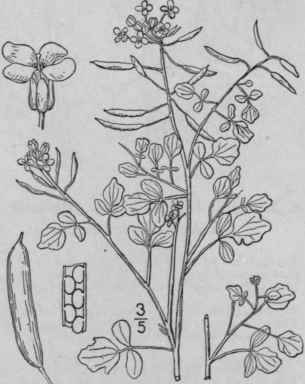
1. Sisymbrium Nastúrtium-Aquaticum L. True Water-Cress
Fig. 2033
Sisymbrium Nasturtium-aquaticum L. Sp. Pl. 657.
1753. Nasturtium officinale R. Br. in Ait. Hort. Kew.
Ed. 2, 4: 110. 1812. Roripa Nasturtium Rusby, Mem. Torr. Club 3:
Part 3, 5. 1893. Radicula Nasturtium-aquaticum Britten & Rendle, Brit. Seed Plants 3. 1907.
Glabrous, branching, floating or creeping, rooting from the nodes. Leaves of 3-9 segments, the terminal one larger than the lateral, all obtuse, ovate or oval, or the terminal one nearly orbicular; racemes elongating in fruit; flowers 2"-2i" broad; petals twice the length of the calyx; pods 6"-16" long, 1" wide, spreading and slightly curved upward, on pedicels of about their length; seeds distinctly in 2 rows.
In brooks and streams, Nova Scotia to Manitoba, Virginia, Missouri, Arizona and California. Common in most districts. Naturalized from Europe. Native also' of northern Asia and introduced into the West Indies and South America. Widely cultivated for salad. Well- or water-grass. Crashes. Brook-lime. Brown-cress. April-Nov.
Continue to:


My Books

