


27. Cercocàrpus H.B.K. Nov. Gen. Et Sp. 6: 232. 1823. Part 5
Description
This section is from the book "An Illustrated Flora Of The Northern United States, Canada And The British Possessions Vol2", by Nathaniel Lord Britton, Addison Brown. Also available from Amazon: An Illustrated Flora of the Northern United States, Canada and the British Possessions. 3 Volume Set..
27. Cercocàrpus H.B.K. Nov. Gen. Et Sp. 6: 232. 1823. Part 5
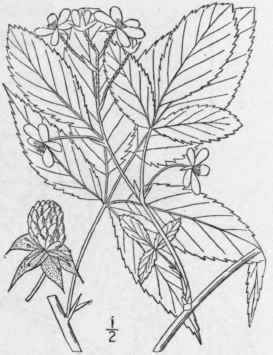
10. Rubus Canadénsis L. Millspaugh's Blackberry
Fig. 2297
Rubus canadensis L. Sp. Pl. 494. 1753. Rubus Millspaughii Britton, Bull. Torr. Club 18: 366. 1891.
Ascending, wand-like, entirely unarmed, or with a few weak prickles, glabrous or the younger shoots scurfy-pubescent, the stems 5°-12° long. Leaves long-petioled, pedately 5-foliolate, or some 3-folio-late; leaflets oval, thin, glabrous on both sides, long-acuminate or acute, rounded or narrowed at the base, often 6' long and 2' wide, sharply but not very deeply dentate; stalk of the terminal leaflet 1 1/2'-4' long; inflorescence loosely racemose; bracts linear-lanceolate; pedicels slender, ascending; sepals lanceolate, acuminate; fruit black, very pulpy, 8"-12" long.
In thickets and woods, Newfoundland to Michigan, and the higher Alleghanies of North Carolina. June-Aug.

11. Rubus Nigricans Rydb. Bristly Blackberry
Fig. 2298
Rubus hispidus var. suberecta Peck, Rep. N. Y. State Mus. 44: 31. 1891. Not R. suberectus Anders. 1815.
Rubus nigricans Rydb. in Britton, Man. 498. 1901.
Stems erect or ascending, 2°-4° high, the older parts densely clothed with slender stiff slightly reflexed bristles. Leaflets generally 5 in leaves of the sterile shoots, 3 in those of the flowering branches, obovate, mostly acute or short-acuminate, sometimes 4' long, short-stalked or sessile, green and glabrous on both sides; flowers 6"-9" broad, racemose; fruit small, sour.
In dry or marshy soil, Quebec and northern New York to Michigan and eastern Pennsylvania. Included in our first edition under Rubus setòsus Bigel., which appears to be a hybrid between this species and R. hispidus L. July-Aug.
12. Rubus Frondòsus Bigel. Leafy-Flowered Blackberry
Fig. 2299
Rubus frondosus Bigel. Fl. Bost. Ed. 2, 199. 1824.
Rubus villosus frondosus Bigel.; Torr. Fl. U. S. I: 487. 1824.
Stems erect or arching, 2 1/2°-4° high, angled, bearing rather stout straight prickles, villous, especially when young. Leaves velvety-pubescent beneath, sparingly pubescent or glabrous above; leaflets elliptic to obovate, sharply serrate, acute or acuminate; racemes more or less elongated, the pedicels subtended by petioled, mostly uni-foliolate leaves (bracts); flowers about 1' broad; petals broadly obovate; fruit subglobose, black, falling away before the subtending leaves.
Mostly in dry soil, Massachusetts to New York, Ohio(?) and Virginia. May-June.


Continue to:


My Books

