
![previous page: 1. Heliotropium [Tourn.] L. Sp. Pl. 130. 1753. Continued](../../../images/nav/page_prev.gif)

![next page: 3. Lappula [Rivin.] Moench, Meth. 416. 1794](../../../images/nav/page_next.gif)
2. Cynoglossum [Tourn.] L. Sp. Pl. 134. 1753
Description
This section is from the book "An Illustrated Flora Of The Northern United States, Canada And The British Possessions Vol3", by Nathaniel Lord Britton, Addison Brown. Also available from Amazon: An Illustrated Flora of the Northern United States, Canada and the British Possessions. 3 Volume Set..
2. Cynoglossum [Tourn.] L. Sp. Pl. 134. 1753
Hirsute or hispid (rarely glabrous) mostly tall herbs, with alternate entire leaves, the basal long-petioled, and purple blue or white flowers in panicled, more or less scorpioid racemes. Calyx 5-cleft or 5-parted, enlarged and spreading or reflexed in fruit. Corolla funnelform or salverform, the tube short, the throat closed by 5 scales opposite the imbricated rounded lobes. Stamens included; filaments short; anthers ovate or oblong. Ovary deeply 4-lobed, separating into 4 diverging nutlets in fruit; style mostly slender. Nutlets oblique, flat or convex above, attached laterally to the convex or conic receptacle, covered with short barbed prickles. [Greek, dog's tongue.]
About 75 species of wide geographic distribution. Besides the following, some 3 others occur in western North America. Type species: Cynoglossum officinale L.
Stem leafy to the top; flowers reddish, purple or white; nutlets flat.
1. C. officinale.
Stem leafless above; flowers blue; nutlets convex. Flowers about 5" broad; nutlets about 4" long.
2. C. virginianum.
Flowers about 3 1/2" broad; nutlets about 2 1/2" long.
3. C. boreale.
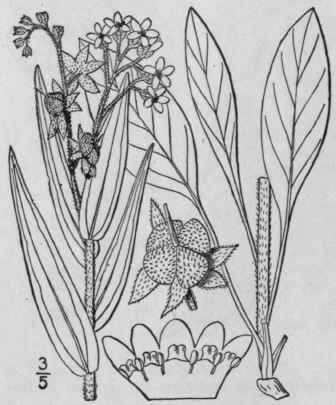
1. Cynoglossum Officinale L. Hound's-Tongue. Gipsy Flower
Fig. 3508
Cynoglossum officinale L. Sp. Pl. 134. 1753.
Biennial, pubescent; stem erect, leafy to the top, stout, usually branched, 1 1/2°-3° high. Basal and lower leaves oblong or oblong-lanceolate, slender-petioled, sometimes obtuse, 6'-12' long, I'-3' wide; upper leaves lanceolate, acute or acuminate, sessile, or the uppermost clasping; racemes several or numerous, bractless or sparingly bracted, simple or branched, much elongated in fruit; pedicels 3"-6" long; calyx-segments ovate-lanceolate, acute; corolla reddish-purple or rarely white, about 4" broad; fruit pyramidal, about 5" broad, each of the 4 nutlets forming a side of the pyramid, flat on their upper faces, margined, splitting away at maturity, but hanging attached to portions of the subulate style.
In fields and waste places, Quebec and Ontario to Manitoba, South Carolina, Alabama, Kansas and Montana. Often a troublesome weed. Naturalized from Europe. Native also of Asia. Called also dog's-tongue, rose noble. Canadian or dog-bur. Sheep-lice. Tory-weed. Wood-mat. May-Sept.
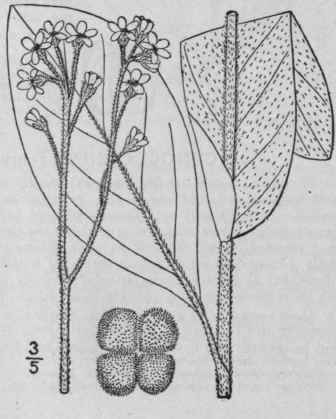
2. Cynoglossum Virginianum L. Wild Comfrey
Fig. 3509
Cynoglossum virginianum L. Sp. Pl. 134-1753- Perennial, hirsute; stem usually simple, leafless above, stout, l 1/2°-2 1/2° high. Basal and lower leaves oval or oblong, 4'-12' long, obtuse at the apex, narrowed into petioles; upper leaves oblong, or ovate-lanceolate, sessile and clasping by a cordate base, acute, nearly as large, or the one or two uppermost quite small; racemes 2-6, corymbose, bractless, long-peduncled; flowers blue, about 5" broad; corolla-lobes obtuse; calyx-segments oblong-lanceolate, obtuse, about 2" long at flowering time; fruit depressed, 4" broad, the nutlets convex on the upper face, not margined, separating and falling away at maturity, about 4" long.
In woods, New Jersey to Kentucky, Missouri, Florida, Louisiana and Kansas. Ascends to 2500 ft. in Virginia. Dog-bur. April-May.
3. Cynoglossum Boreale Fernald. Northern Wild Comfrey
Fig. 3510
Cynoglossum boreale Fernald, Rhodora 7: 250. 1906.
Similar to the preceding species, the stem more slender, villous below, appressed-pubescent above. Upper leaves clasping the stem; lower and basal leaves oblong, acute or acutish, long-peti-oled; racemes few, the flowers distant; calyx-segments only about 1" long at flowering time; corolla 3"-4" broad; nutlets 2"-2 1/2" long.
Woods and banks, Quebec to Ontario, Connecticut, New York and Minnesota. In our first edition included in the preceding species, of which it may be a northern race. May-June.

Continue to:


My Books

