


31. Aster L. Sp. Pl. 872. 1753. Part 20
Description
This section is from the book "An Illustrated Flora Of The Northern United States, Canada And The British Possessions Vol3", by Nathaniel Lord Britton, Addison Brown. Also available from Amazon: An Illustrated Flora of the Northern United States, Canada and the British Possessions. 3 Volume Set..
31. Aster L. Sp. Pl. 872. 1753. Part 20
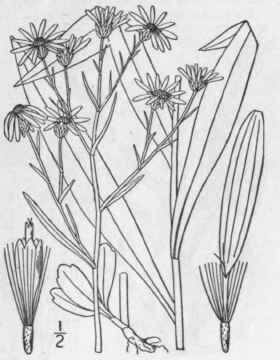
63. Aster Faxoni Porter. Faxon's Aster
Fig. 4344
Aster polyphyllus Willd. Enum. 888. 1809. Not Moench, 1802. Aster Faxoni Porter, Mem. Torr. Club 5: 323. 1894. A. ericoides Randi Britton, in Britt. & Brown, 111. Fl. 3:
379. 1898.
Glabrous throughout; stem paniculately or corym-bosely branched; rather stout, i°-5° high. Stem leaves lanceolate or linear-lanceolate, acute or acuminate, narrowed to a sessile base, or the lower into margined petioles, entire or nearly so, firm, 2'-5' long, 2"-4" wide, those of the branches gradually smaller; basal leaves oblong to spatulate, obtuse, dentate, or entire; heads not very numerous, 6"-9' broad; involucre hemispheric, nearly 4" high, its bracts linear-lanceolate, acute or subulate, green-tipped or green on the back, imbricated in about 3 series, the outer shorter; rays bright white, rarely purplish, 3"-4" long, numerous; pappus white; achenes minutely pubescent.
On moist cliffs, Maine and Vermont to Pennsylvania, Wisconsin and North Carolina. Aug.-Sept.

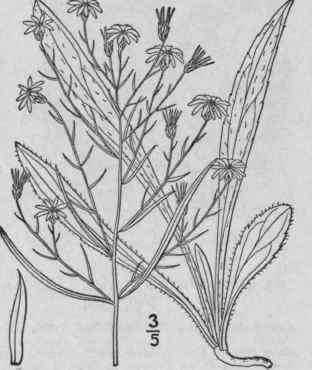
64. Aster Ericoides L. White Heath Aster. Frost-Weed Aster
Fig. 4345
Aster ericoides L. Sp. Pl. 875. 1753.
Aster villosus Michx. Fl. Bor. Am. 2: 113. 1803. Not Thunb. 1800. Aster ericoides var. villosus T. & G. Fl. N. A. 2: 124.
1841. Aster ericoides pilosus Porter, Mem. Torr. Club 5:
323. 1894.
Stem glabrous, villous, or hirsute, paniculately branched, usually bushy, 1°-3° high, the branches racemose, and the branchlets often somewhat secund. Leaves firm or rigid, the basal ones spatulate, obtuse, dentate, narrowed into margined petioles, glabrous or ciliate; stem leaves narrowly linear to linear-lanceolate, acute, entire, 1'-3' long, 1"-3" wide, those of the branches linear-subulate, numerous; heads usually very numerous, 4"-/' broad; involucre campanulate to hemispheric, its bracts coriaceous, lanceolate or linear-lanceolate, abruptly acute or acuminate, green-tipped, imbricated in about 3 series; rays 15-25, white, or tinged with rose; pappus white; achenes finely pubescent. In dry soil, Maine to Ontario, Florida, Minnesota and Missouri. Frost-weed. Michaelmas daisy. Farewell-summer. White rosemary. Dog-fennel.
Mare's-tail. Scrub-bush. Steel-weed. Sept.-Dec.
A densely villous, broad-leaved relative or race of this species, ranging from Ohio to North Carolina and Michigan, is known as Aster ericoides platyphyllus T. & G.
This species apparently hybridizes with A. paniculatus Lam. where the two grow together.
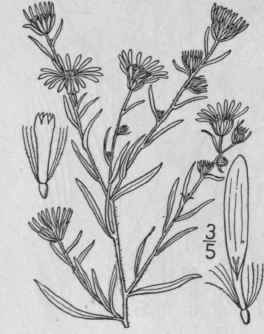
65. Aster Pringlei (A. Gray) Britton. Pringle's Aster
Fig. 4346
Aster ericoides var. Pringlei A. Gray, Syn. Fl. 1:
Part 2, 184. 1884. Aster Pringlei Britton, in Britt. & Brown, 111. Fl. 3:
379. 1898.
Stem very slender, glabrous, simple, or with few or numerous slender ascending branches, not bushy, 6'-2° high. Basal leaves lanceolate, oblong or oblanceolate, 2'-6' long, 2"-6" wide, entire, or slightly toothed, ciliate and sometimes a little pubescent, at least on the slender petioles which are often as long as the blades; stem leaves narrowly linear, those of the branches small and subulate; heads as large as those of A. ericoides, or commonly smaller, usually fewer, solitary at the ends of the branches and branchlets; bracts of the involucre with short green tips; rays white.
On banks, especially in rocky places, Massachusetts and Vermont to Wisconsin. Aug.-Oct
Continue to:


My Books

