
![previous page: 1. Campanula [Tourn.] L. Sp. Pl. 163. 1753. Part 3](../../../images/nav/page_prev.gif)


2. Specularia Heist.; Fabr. Enum. Pl. Hort. Helmst. 225. 1703
Description
This section is from the book "An Illustrated Flora Of The Northern United States, Canada And The British Possessions Vol3", by Nathaniel Lord Britton, Addison Brown. Also available from Amazon: An Illustrated Flora of the Northern United States, Canada and the British Possessions. 3 Volume Set..
2. Specularia Heist.; Fabr. Enum. Pl. Hort. Helmst. 225. 1703
[Legouzia Durand, Fl. Bourg. 2: 26. 1782.]
Annual herbs, with alternate toothed or entire leaves, the stem and branches long, slender. Flowers axillary, sessile or nearly so, 2-bracted, or the upper panicled in some exotic species, the earlier (lower) ones small, cleistogamous, the later with a blue or purple nearly rotate corolla. Calyx-tube narrow, the lobes in the earlier flowers 3 or 4, in the later 4 or 5. Corolla 5-lobed or 5-parted, the lobes imbricated in the bud. Filaments flat; anthers separate, linear. Ovary 3-celled (rarely 2- or 4-celled); ovules numerous; stigma usually 3-lobed. Capsule prismatic, cylindric, or narrowly obconic, opening by lateral valves. Seeds ovoid, oblong, or lenticular. [From Speculum Veneris, the Latin name of the type species.]
About 10 species, natives of the northern hemisphere, one extending into South America. Type species: Campanula Speculum L.; S. Speculum (L.) DC, of Europe, which is adventive in Lancaster County, Pennsylvania.
Capsule narrowly oblong.
Leaves sessile: capsule-valves near the top.
1. S. biflora.
Leaves cordate-clasoinjr: capsule-valves at about the middle.
2. S. perfoliata.
Capsule linear-cylindric; leaves sessile; western.
3. S. leptocarpa.

I. Specularia Biflora (R. & P.) F. & M. Small Venus' Looking-Glass
Fig. 4024
Campanula biflora R. & P. Fl. Per. 2: 55. pl. 200. J. 6. 1799.
S. biflora F. & M. Ind. Sem. Hort. Petrop. 1:17. 1835.
Legouzia biflora Britton, Mem. Torr. Club 5: 309. 1894.
Glabrous, or nearly so; stem simple or branched, very slender, roughish on the angles, 6'-2° high. Leaves ovate, oblong, or the upper lanceolate, sessile, acute or obtuse at the apex, crenate with a few teeth, or entire, 4"-10" long, or the upper smaller; earlier flowers with 3 or 4 ovate to lanceolate calyx-lobes, those of the later flowers 4 or 5, lanceolate-subulate, longer; capsule oblong-cylindric, 3"-5" long, opening by valves close under the calyx-teeth.
In dry soil, Virginia to Kentucky, Missouri, Kansas, Florida and Texas. Also in Oregon, California and South America. April-July.
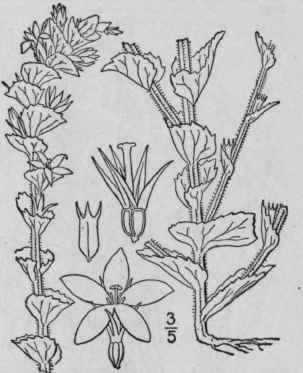
2. Specularia Perfoliata (L.) A. Dc. Venus' Looking-Glass
Fig. 4025
Campanula perfoliata L. Sp. Pl. 169. 1753.
S. perfoliata A. DC. Mon. Campan. 351. 1830.
L. perfoliata Britton, Mem. Torr. Club 5: 309. 1894.
More or less pubescent; stem densely leafy, simple or branched from near the base, slender, rather weak, sometimes prostrate, retrorse-hispid on the angles, or nearly smooth, 6'-24' long. Leaves orbicular or broadly ovate, strongly cordate-clasping or the lower merely sessile, crenate-dentate or sometimes entire, 1/4'-1' wide; flowers solitary or 2-3 together in the axils, sessile, the later (upper) ones with 5 (rarely 4) triangular-lanceolate acuminate rigid calyx-lobes, and a rotate blue or violet corolla 5"-10" broad, the earlier ones with 3-4 shorter calyx-lobes longer than the rudimentary corolla; capsule oblong, or narrowly turbinate, 2"-3" long, finally opening at about the middle; seeds lenticular.
In dry woods, Maine and Ontario to British Columbia, south to Florida, Louisiana, Mexico, Arizona and Oregon. Called also clasping bellflower. May-Sept. Also in the mountains of Jamaica and Santo Domingo.
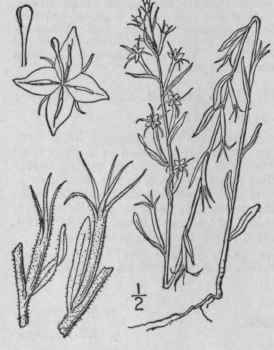
3. Specularia Leptocarpa (Nutt.) A. Gray. Western Venus' Looking-Glass
Fig. 4026
Campylocera leptocarpa Nutt. Trans. Am. Phil. Soc. (II.) 8: 257. 1843.
S. leptocarpa A. Gray, Proc. Am. Acad. 11: 82. 1876. L. leptocarpa Britton, Mem. Torr. Club 5: 309. 1894.
Hirsute, or nearly glabrous; stem slender, simple, or branched from the base, 6'-15' high. Leaves linear-lanceolate to oblong, sessile, not clasping, acute at both ends, or the lowest obtuse at the apex, entire or sparingly denticulate, 1/2'-1' long, 1"-2" wide; flowers sessile and usually solitary in the axils, the later ones with 4-5 subulate calyx-lobes and a rotate corolla 5"-9' broad, the earlier ones with 3 shorter calyx-lobes and rudimentary corolla; capsule linear-cylindric, 4"-8" long, less than 1" thick; the upper at length opening near the summit; seeds oblong.
In dry soil, western Missouri and Kansas to Montana, Colorado and Texas. May-Aug.
Continue to:


My Books

