


Mineral Waters Of Saratoga
Description
This section is from the book "Beverages And Their Adulteration Origin, Composition, Manufacture, Natural, Artificial, Fermented, Distilled, Alkaloidal And Fruit Juices", by Harvey W. Wiley. Also available from Amazon: Beverages And Their Adulteration.
Mineral Waters Of Saratoga
The most famous mineral waters of the United States are those which occur in and near the village of Saratoga. Situated near the foot hills of the Adirondacks, the mineral waters of Saratoga are peculiarly favored as respects immunity from contamination. They flow through a series of soluble rocks, which give to them their saline character. They also evidently are brought into intimate contact with sources of carbon dioxid, as most of them are highly carbonated. Among the more famous springs of Saratoga may be mentioned the Vichy, Hathorn, Arondack, Geyser, Peerless, Magnetic, Star, Seltzer, High Rock, Lincoln, Chief, Victoria and Carlsbad. Inasmuch as these waters are owned by the State a somewhat detailed description without advertising any private interest may be permitted. The waters are quite typical of the principal mineral waters of the World.
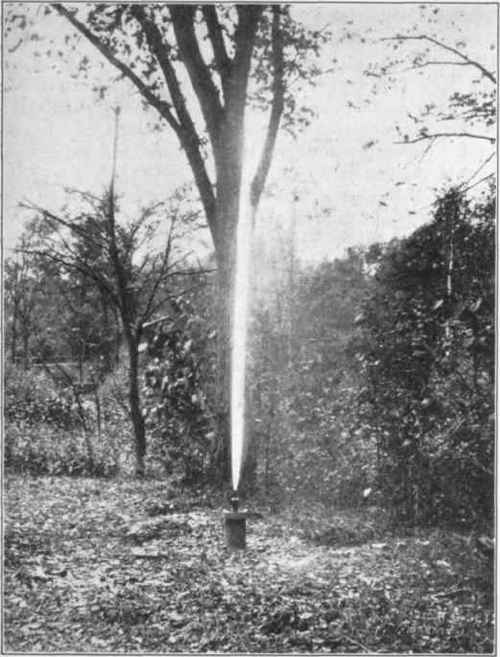
Fig. 5. One of the several spouting springs in Geyser Park, Saratoga. (Courtesy of the Commissioners of the State Reservation at Saratoga Springs.)
Origin of the Name "Saratoga." - In the case of springs as famous as those of Saratoga, and which bid fair in the future to have their fame established on a scientific basis, all data relating to the springs are of interest. In the Report of the Commissioners1 an interesting account is given of the origin of the name:
The aboriginal Saratoga, the Saraghtogha or Saraghtoghie of the red man, and to us - at this distance in time - the romantic Saratoga, dates from a very remote period. Actual history and enticing legend provide a most interesting narrative if one chooses to construct it from available authorities. The appearance of the oldest Saratoga spring is shrouded in the obscurity of geologic ages; but it is fairly certain that a fire was kindled by some aborigines who camped by that spring, during the Second Crusade, if over the charcoal remains disclosed at a depth of 16 feet the deposition of tufa was as rapidly made in those days by High Rock spring as in recent time by Geyser spring. It is indeed fascinating to think that while Conrad III, of Germany, and Louis VII, of France, were engaged in their unsuccessful attack on Damascus, a band of red men were making propitiatory offerings to the Manitou of High Rock spring about the year 1150. Brief mention should be made of the visit of the first white man, as far as we can conjecture, to the healing waters of Saratoga. From the Jesuit Relations we learn that a band of Mohawk Indians in 1643 brought with them to the Saratoga springs Father Isaac Jogues, who had been surprised and taken prisoner by a marauding band. Repairing to the "Medicine Waters of the Great Spirit" with their captive, they rested and secured refreshment and restoration to health and strength at the fountains whither they had been for ages accustomed to repair for relief from exhaustion and disease.
The composition of two typical waters of Saratoga has been determined by the Bureau of Chemistry2 and is given below:
1 State Reservation at Saratoga for 1914, pages 22 and following.
2 Bulletin No. 91, 1905, pages 85 and 86.
Vichy Water, Saratoga, N. Y. (Sodic muriated alkaline-saline, carbon dioxated) Gases (number of cubic centimeters per 1,000 grams at o°C. and 760 mm. pressure).
Carbon dioxid (free), 255; carbon dioxid (set free from bicarbonates on evaporating to dryness), 125.6.
Constituents | Parts per million | Percent of total inorganic material in solution | |
SiO2 (silica)................................. | 14.7 | 0.60 | |
SO4 (sulphuric acid radicle)................................. | 16.7 | 0.68 | |
HCO3 (bicarbonic acid radicle)........................... | 684.3 | 28.04 | |
NO3 (nitric acid radicle)....................................... | Trace | ||
NO2 (nitrous acid radicle).................................... | Trace | ||
PO4 (phosphoric acid radicle).................. | None | ||
BO2 (metaboric acid radicle)............................... | Trace | ||
AsO4 (arsenic acid radicle)................................. | None | ||
Cl (chlorin)................................. | 893.3 | 36.60 | |
Br (bromine) ....................................................... | Trace | ||
I (iodin) ................................................................. | Trace | ||
Fe | (iron and aluminum).................................. | ||
Al | 4.2 | 0.17 | |
Ca (calcium)........................................................ | 41.3 | 1.69 | |
Mg (magnesium)................................................. | 9.1 | 0.37 | |
Ba (barium).......................................................... | 0.06 | ||
Sr (strontium)....................................................... | None | ||
K (potassium)...................................................... | 3.8 | 0.16 | |
Na (sodium)......................................................... | 772.1 | 31.63 | |
Li (lithium).......................................................... | 0.65 | 0.03 | |
NH4 (ammonium).............................................. | 0.714 | 0.03 | |
Total..................................... | 2,440.924 | 100.00 | |
Free ammonia.................................................... | 0.675 | ||
Albuminoid ammonia......................................... | Trace | ||
Nitrogen as nitrates............................................. | Trace | ||
Nitrogen as nitrites.............................................. | Trace | ||
Hypothetical Form of Combination
Formula and name | Parts per million | Percent of total inorganic material in solution |
NH4Cl (ammonium chlorid)................... | 2.11 | 0.09 |
LiCl (lithium chlorid)........................ | 3.94 | 0.16 |
KCl (potassium chlorid)...................... | 7.2 | 0.30 |
NaCl (sodium chlorid)........................ | 1,459.5 | 59.79 |
Na2SO4 (sodium sulphate)..,................. | 24.7 | 1.01 |
NaBO2 (sodium metaborate).................. | Trace | |
NaNO3 (sodium nitrate)...................... | Trace | |
NaNO2 (sodium nitrite)............................................................. | Trace | |
Na(HCO3) (sodium bicarbonate)......................... | 693.1 | 28.40 |
Na(HCO3)2 (barium bicarbonate).............. | 0.11 | |
Mg(HCO3)2 (magnesium bicarbonate).......... | 54.8 | 2.25 |
Ca (HCO3)2 (calcium bicarbonate)...................... | 167.3 | 6.85 |
Fe(HCO3)2 (ferrous bicarbonate)......................... | 13.4 | 0.55 |
SiO2 (silica)................................. | 14.7 | 0.60 |
Total..................................... | 2,440.86 | 100.00 |
Hathorn Water, Saratoga, N. Y. (Sodic muriated alkaline-saline (ferruginous, bromic, and iodic)) Gases (number of cubic centimeters per 1,000 grams at 0oC. and 760 mm. pressure).
Carbon dioxid (free), 75.0; carbon dioxid (set free from bicarbonates on evaporating to dryness), 658.2.
Constituents | Parts per million | Percent of total inorganic material in solution | |
SiO2 (silica).......................................................... | 19.6 | 0.18 | |
SO4 (sulphuric acid radicle)................................. | 5.6 | 0.05 | |
HCO3 (bicarbonic acid radicle)................ | 3,585.6 | 33.02 | |
NO3 (nitric acid radicle)....................................... | None | ||
NO2 (nitrous acid radicle).................................... | None | ||
PO4 (phosphoric acid radicle).............................. | None | ||
BO2 (metaboric acid radicle).................. | (a) | ||
AsO4 (arsenic acid radicle).................... | None | ||
Cl (chlorin)................................. | 3,685.5 | 33.95 | |
Br (bromin)........................................................... | 26.9 | 0.25 | |
I (iodine)............................................................... | 1.5 | 0.01 | |
Fe | (iron and aluminum).................... | 9.8 | 0.00 |
Al | |||
Ca ( calcium)....................................................... | 650.7 | 6.00 | |
Mg (magnesium)................................................. | 228.8 | 2.11 | |
Ba (barium)......................................................... | 5.5 | 0.05 | |
Sr (strontium)............................... | Trace | ||
K (potassium)....................................................... | 197.2 | 1.82 | |
Na (sodium)......................................................... | 2,430.7 | 22.38 | |
Li (lithium)................................. | 0.5 | ||
NH4 (ammonium)................................................. | 10.7 | 0.09 | |
Total..................................... | 10,858.6 | 100.00 | |
Free ammonia........................................................ | 10.1 | ||
Albuminoid ammonia........................................... | Trace | ||
Nitrogen as nitrates............................................... | None | ||
Nitrogen as nitrites................................................ | None | ||
a Small amount.
Hypothetical Form of Combination
Formula and name | Parts per million | Percent of total inorganic material in solution |
NH4Cl (ammonium chlorid)................... | 31.8 | 0.29 |
LiCl (lithium chlorid)........................ | 3.0 | 0.03 |
KC1 (potassium chlorid)...................... | 350.7 | 3.23 |
NaCl (sodium chlorid)........................ | 5,762.4 | 53.06 |
KBr (potassium bromid).......................................................... | 40.0 | 0.37 |
KI (potassium iodid)............................................ | 1.9 | 0.02 |
Na2SO4 (sodium sulphate)................... | 8.2 | 0.08 |
NaBO2 (soidum metaborate) ................. | (a) | |
Na(HCO3) (sodium bicarbonate)............... | 586.4 | 5.40 |
Ba(HCO3)2 (barium bicarbonate)............. | 10.4 | 0.09 |
Sr(HCO3)2 (strontium bicarbonate)............ | Trace | |
Mg(HCO3)2 (magnesium bicarbonate)......... | 1,377.8 | 12.69 |
Ca(HCO3)2 (calcium bicarbonate).............. | 2,635.3 | 24.27 |
Fe(HCO3)2 (ferrous bicarbonate).............. | 31.1 | 0.29 |
SiO2 (silica)................................. | 19.6 | 0.18 |
Total..................................... | 10,858.6 | 100.00 |
a Small amount.
Continue to:


My Books

