


Synthesis Of Alcohol
Description
This section is from the book "Alcohol, Its Production, Properties, Chemistry, And Industrial Applications", by Charles Simmonds. Also available from Amazon: Alcohol: Its Production, Properties, Chemistry, And Industrial Applications.
Synthesis Of Alcohol
The first chemical synthesis of alcohol has generally been attributed to Berthelot, who, in 1854, obtained it from ole-fiant gas by absorbing this gas in sulphuric acid, diluting the product, and distilling it. Meldolahas shown, however, that our own countryman, Henry Hennell, had succeeded in effecting this synthesis some twenty-six years previously. In a paper communicated to the Royal Society in 1827, Hennell indicates that he had identified sulphovinic acid (ethyl sulphuric acid) in a quantity of sulphuric acid given him by Faraday, which had absorbed eighty times its volume of olefiant gas; and in a subsequent paper (1828) he describes how he had distilled sulphovinic acid with water and a little sulphuric acid, and proved that it was decomposed into sulphuric acid and alcohol. Since alcohol is a product of living organisms, Meldola claims for Hennell "a place not inferior to that of Wohler" (who synthesised urea in the same year, 1828), "as being among the first to produce an organic compound independently of the living organism."1 Alcohol was not, however, at that time regarded as a vital product in the same sense as urea was, and hence Hennell's achievement did not attract the same attention as did the synthesis of urea.

Fig. 10. - dr. thomas willis, 1621-1675.
It is, however, on the biological or bio3hemical questions arising out of the study of alcoholic fermentation that the most interesting and important results have accrued. With a brief historical outline and a general indication of these results and their significance we may fitly close this intro-ductory sketch of our subject.
Fermentation
Although the production of spirits from grain was known in Europe as early, perhaps, as the eleventh or twelfth century, and fermented liquors have been used since the dawn of history, only very vague and general ideas were prevalent as to the nature of the fermentation process. To the alchemists, almost any action between two substances, especially when gas was evolved, formed a 'fermentation."
In the seventeenth century, Willis's view of fermentation was current (1659). A ferment is a body in a state of decomposition, with energetic motion of its particles; this motion it can impart to another body which is capable of fermentation. This view was upheld by Stahl (1697), according to whose opinion fermentation was a matter of the decomposition of a fermentable body into its components, which then re-combined in a different manner to form new substances. For example, sugar might thus be disintegrated into its constituent particles, and these then re-united to form alcohol. A body in such a state of internal motion as that supposed by Willis could communicate this motion to another which was itself at rest, provided that the latter body was one fitted for the change. Thus was explained the propagation of fermentation from one liquid to another.
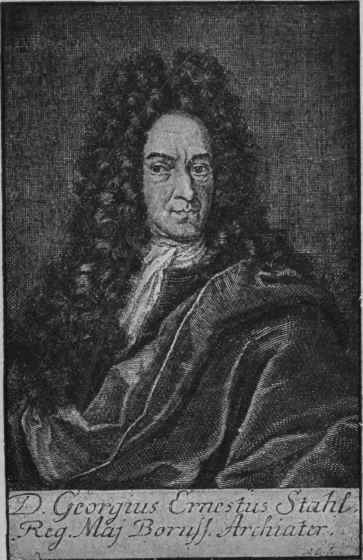
Fig. 11. - g. e. stahl, 1659-1734.
1 "The Chemical Synthesis of Vital Products," p. 1. See also a detailed discussion in J. Soc. Chern. Ind., 1910, 29, 737.
Towards the end of the seventeenth century, Leeuwenhoek, with a home-made microscope of 150 diampters magnifying power, found that yeast was composed of small round or oval particles. He described these in letters to the Royal Society (1680), and may thus be said to have laid the foundation of researches on fermentation by means of the microscope. The further use of this instrument in such researches might have cut short many controversies during the next century and a half, but it appears to have been neglected. Desmazieres in 1826 found that a film taken from beer was composed of elongated cells which he designated Mycoderma cerevisiæ. It is not clear, however, that he looked upon these as fermentative agents.
Van Helmont's discoveries (1648) that in fermentation a gas, as as well as alcohol, was produced, and that a ferment was necessary to start the process, were important steps in the elucidation of fermentation phenomena. So also was the identification by MacBride (1764) of the gas in question as Black's " fixed air" (carbon dioxide). Cavendish (1766) found that the proportion of this "fixed air" yielded by sugar on fermentation was 57 per cent.; and Lavoisier showed by numerous experiments that sugar was decomposed almost quantitatively into alcohol and carbon dioxide.1
The nineteenth century brought forth the famous scientific controversy between Pasteur and Liebig as to the cause of fermentation; and it brought also the definite settlement of the question. Hitherto the phenomenon had been regarded as essentially a chemical one; yeast was a chemical reagent, not a living organism. Even in 1810, Gay-Lussac, discussing the researches of Lavoisier,

Fig. 12. - justus von liebig, 1803-1873.
1 "Traite elementaire de Chimie," 1793.
Fabroni, and Thenard, treats the matter essentially from the chemical point of view. It had been tacitly assumed that fermentation can begin and continue without the aid of oxygen. Gay-Lussac, however, considered that oxygen was certainly necessary, since grape juice preserved by heat in closed bottles began to ferment at once when exposed to the air, but showed no fermentation in absence of air. That the air contained living organisms capable of setting up the fermentation was not, apparently, suspected.
The microscope, however, presently threw further light on the problem. In 1836, Cagniard-Latour1 recognised that yeast was a living organism, reproduced by budding, and probably a plant; alcoholic fermentation was looked upon as due to its vegeta-tive activity. Kutzing, of Nord-hausen, arrived at the same result: yeast is not a chemical compound, but a vegetable organism. Also Schwann.2 about the same time (1837), came to a similar conclusion from experiments on heated air and boiled liquids, confirmed by subsequent micro-scopical examination. Turpin (1838) confirmed the accuracy of Cagniard-Latour's observations and deductions.
Continue to:


My Books

