


Waist-Line Finishes
Description
This section is from the book "A Manual Of Home-Making", by Martha Van Rensselaer. Also available from Amazon: A Manual of Home-Making.
Waist-Line Finishes
The following waist-line finishes may be used for the top of the skirt when it is sewed over the waist on the foundation belt.
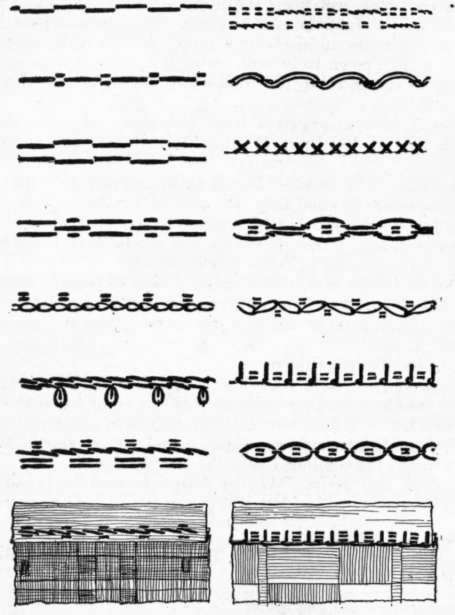
Fig. 82. - Combinations of simple embroidery stitches to be used in decorating collars, cuffs, aprons, and dresses.
1. The skirt may be turned 1/4 inch to the wrong side and basted along the waist-line. It is then stitched 1/8 inch below the edge.
2. If an outside belt is to be used with the dress, the unfinished edge of the skirt may be placed on the waist-line and stitched into place. Taffeta seam-binding is then stitched over the unfinished edges.
3. The skirt may be finished with an inserted cord or piping of the same or a contrasting texture. In using piping or cord finishes, care must be taken not to create an unbecoming line or introduce too many definite lines. Color and texture must be considered.
Finishes for the bottom of the skirt.
The following finishes may be used for the bottom of skirts, overskirts, or flounces:
1. Hem. The skirt may be hemmed by hand or on the machine. In wool or silk it is generally preferable to have the hem slip-stitched into place.
2. Hem with one turning. The raw edge of the material may be catch-stitched into place and covered with Prussian binding. Any surplus fullness may be shrunken out, gathered, or placed in darts which must fall at right angles to the line of stitching. This kind of hem is often used in material which does not fray easily.
3. Fancy hem. The hem may be turned to the right side and finished with a cord or piping; it may be held in place by decorative machine stitching; or it may be scalloped.
4. Facing or false hem.
5. Bindings of various widths.
6. Machine hemstitching.
7. Piping or cording.
Continue to:


My Books

