


Carving. Part 2
Description
This section is from the book "The New Cyclopaedia of Domestic Economy, and Practical Housekeeper", by Elizabeth Fries Ellet. Also available from Amazon: The New Cyclopaedia of Domestic Economy, and Practical Housekeeper.
Carving. Part 2

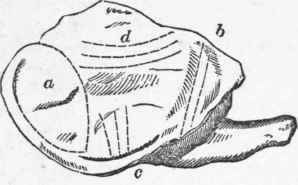
Aitch-bone of Beet.
Bibs Of Beef
Cut along the whole length of the bone, from end to end, a to b, either commencing in the centre or at one side, having the thin end towards you; but if cut from the bone and formed into a round, with the fat end doubled into the centre, it must then be cut in the same manner as the round of beef.

Brisket of Beef must be carved in the direction 1 and 2, quite down to the bone, after cutting off the outside, which should be about three-quarters of an inch thick.
Sirloin Of Beef
Cut in the same manner as the ribs, commencing either at the centre or the side, as from a to b. The under part should be cut across the bone, as at c for the lean, and d for the rich fat; many persons prefer the under to the upper part, the meat being more tender. Fillet of Veal. - Carve it in the same manner as the round of beef; but the upper slice should he cut somewhat thinner, as most persons like a little of the brown, and a portion of it should be served along with each slice, together with a slice of the fat and stuffing, which is skewered within the flap.
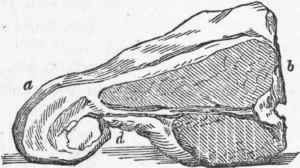
Sirloin of Beef.

Fillet of Veal.
Neck Of Veal
Cut across the ribs, as at a to b: the small bones, as at c to d, being cut off, divided, and served separately, for it is not only a tedious, but a vulgar operation to attempt to disjoint the ribs.

Loin Of Veal
The joint is placed in the dish in the same manner as a sirloin of beef, but should be turned up, and the whole of the kidney and fat cut out; the fat being usually put upon a dry toast and served as marrow. The loin is then returned to its former position, and the meat should be cut across the ribs as in the neck, serving it with a slice of kidney.

Knuckle of Veal.
Knuckle of Veal is to be carved in the direction 1 - 2. The most delicate fat lies about the part 4, and if cut in the line 3 - 4, the two bones, between which the marrowy fat lies, will be divided.
Breast of Veal, being very gristly, is not easily divided into pieces. In order, therefore, to avoid this difficulty, put your knife at a about four inches from the edge of the thickest part (which is called "the brisket"), and cut through it to b, to separate it from the long ribs: cut the short bones across, as at d, d, d, and the long ones as at c, c, c; ask which is chosen, and help accordingly. The remaining scrag part is seldom served at table, but forms an excellent stew when dressed in the French mode.

Breast of Veal.
Shoulder Of Veal
Cut in the same manner as a shoulder of mutton, beginning on the under side.
Calfs Head
Cut slices from a to b in the figure, which describes only half the head, letting the knife go close to the bono. Many like the eye at c, which you roust cut out with the point of your knife, and divide in two, along with some of the glutinous bits which surround it. If the jaw-bone be taken off, there will be found some fine lean, and under the head is the palate, which is reckoned a delicacy.
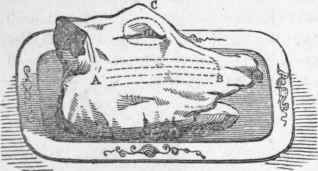
Calf s Head.
The tongue and brains are dished separately, but served in small portions along with the head.
Leg Of Mutton
The best part of a leg of mutton, whether boiled or roasted, is midway between the knuckle and the broad end. Begin to help there from the roundest and thickest part, by cutting slices, not too thin, from b down to c. This part is the most juicy; but many prefer the knuckle, which, in fine mutton, will be very tender, though dry. There are very fine slices in the back of the leg; therefore, if the party be large, turn it up and cut the broad end; not across in the direction you did the other side, but longwise, from the thick end to the knucklebone. To cut out the cramp-bone, which some persons look upon as a delicacy, pass your knife under in the direction of e, and it will be found between that and d.
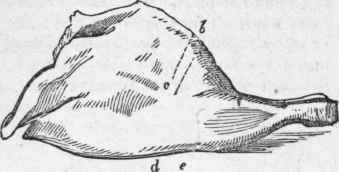
Leg of Mutton.
Shoulder of Mutton, though commonly looked upon as a very homely joint, is by many preferred to the leg, as there is much variety of flavor, as well as texture, in both the upper and under parts.
The figure represents it laid in the dish as always served, with its back uppermost. Cut through it from a down to the blade-bone at b; afterwards slice it along each side of the blade-bone from c c b. The prime part of the fat lies on the outer edge, and is to be cut in thin slices in the direction of d. The under part, as here represented, contains many favorite pieces of different sorts, as, crosswise, in slices, near the shank-bone at b; and, lengthwise, in broad pieces, at the further end a; as well as in the middle and sides in the manner designated at c and d.
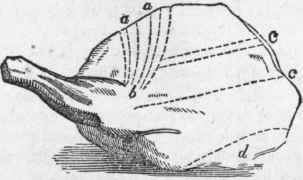
Shoulder of Mutton.
Should it be intended to reserve a portion of the joint to be eaten cold, all this undermost part should be first cut away and served separately, both as it eats better hot than cold, and as the upper remaining part will appear more sightly in the table.
Loin Of Mutton
Continue to:


My Books

