


Carving. Part 3
Description
This section is from the book "The New Cyclopaedia of Domestic Economy, and Practical Housekeeper", by Elizabeth Fries Ellet. Also available from Amazon: The New Cyclopaedia of Domestic Economy, and Practical Housekeeper.
Carving. Part 3
Cut the joints into chops and serve them separately; or cut slices the whole length of the loin; or run the knife along the chine-bone, and then slice it, the fat and lean together, as shown in the cut of the saddle, in the next column.
Neck Of Mutton
It should be prepared for table as follows:- Cut off the scrag; have the chine-bone carefully sawn off, and also the top of the long bones (about an inch and a half,) and the thin part turned under; carve in the direction of the bones.
The scrag of mutton, when roasted, is very frequently separated from the ribs of the neck, and in that case the meat and bones may be helped together.
Saddle Of Mutton
Cut in long and rather thin slices from the tail to the end, beginning at each side close to the back-bone, from a to b, with slices of fat from c to d; or along the bone which divides the two loins, so as to loosen from it the whole of the meat from that side which you then cut crosswise, thus giving with each slice both fat and lean. The tail end is usually divided and partly turned up. Some butchers also skewer the kidneys across the incision, but it is not usual at genteel tables, and the inci sion is better omitted.


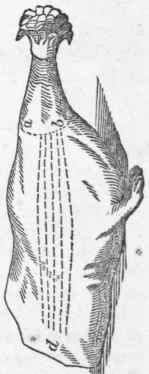
Haunch of Venison.
Hauncli Of Mutton
A haunch is the leg and part of the loin, and is cut in the same manner as a haunch of venison.
Fore-Quarter Of Lamb
Pass the knife under the shoulder in the direction of a, c, b, d, so as to separate it from the ribs without cutting the meat too much off the bones. A Seville orange or lemon should then be divided, the halves sprinkled with salt and pepper, and the juice squeezed over the under part. A little cold or melted butter is then put between both parts, after which the shoulder is placed in a separate dish to be helped by some other person. Divide the ribs from d to e, and then serve the neck f, and breast g, as may be chosen.
Haunch Of Venison
Have the joint lengthwise before you, the knuckle being the farthest point. Cut from a to b, but be careful not to let out the gravy; then cut along the whole length from a down to d. The knife should slope in making the first cut, and then the whole of the gravy will be received in the well. The greater part of the fat, which is the favorite portion, will be found at the left side, and care must be taken to serve some with each slice.
Neck Of Venison
Cut across the ribs diagonally; or it may be cut in slices the whole length of the neck. The first method is equally good, and much more economical.

A leg of Pork, whether boiled or roasted, is carved the same. Commence about midway, between the knuckle and the thick end, and cut thin deep slices from cither side of the line 1 to 2.
Pork
In helping the roast loin and leg, your knife must follow the direction of the scores cut by the cook upon the skin which forms the crackling, as it is too crisp for being conveniently divided, and cannot therefore be cut across the bones of the ribs, as in loin of mutton. The scores upon the roasted leg are, however, always marked too broadly for single cuts; the crackling must therefore be lifted up from the back to allow of thin slices being cut from the meat; the seasoning is under the skin at the larger end.

Ham.
Ham
Serve it with the back upwards, sometimes, ornamented, and generally having, as in France, the shank-bone covered with cut paper. Begin in the middle by cutting long and very thin slices from a to b, continuing down to the thick fat at the broad end. The first slice should be wedge-shaped, that all the others may be cut slanting, which gives a handsome appearance to them. Many persons, however, prefer the hock at d as having more flavor; it is then carved lengthwise from c to d.
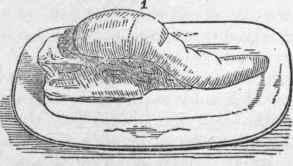
A Tongue.
A Tongue should be cut across, nearly through the middle, at the line 1, and thin slices taken from each side; a portion of the fat, which is situated at the root of the tongue, being helped with each.

Sucking-Pig
The cook usually divides the body before it is sent to table - as thus - and garnishes the dish with the jaws and ears.
Separate a shoulder from one side, and then the leg, according to the direction given by the line along the carcass. The ribs are then to be divided; and an ear or jaw presented with them, and plenty of sauce and stuffing. The joints may either be divided into two each, or pieces may be cut from them. The ribs are reckoned the finest part; but some people prefer the neck end, between the shoulders.

Babbit.
Rabbits
Put the point of the knife under the shoulder at b, and so cut all the way down to the rump, along the sides of the backbone, in the limb b, a, cutting it in moderately thick slices; or, after removing the shoulders and legs, cut the back crosswise in four or five pieces; but this can only be done when the rabbit is very young, or when it is boned. To separate the' legs, and shoulders, put the knife between the leg and back, and give it a little turn inwards at the joint, which you must endeavor to hit, and not to break by force. The shoulders may be removed by a circular cut around them. The back is the most delicate part, and next to that the thighs. A portion of the stuffing should be served with each slice. The brains and ears of sucking-pig and rabbit are also considered epicurean titbits, which must not be neglected; wherefore, when every one is helped, cut off' the head, put your knife between the upper and lower jaw and divide them, which will enable you to lay the upper fiat on your plate; then put the point of the knife into the centre, and cut the head into two.
Continue to:


My Books

