


Housekeeping Accounts. Part 5
Description
This section is from the book "The New Cyclopaedia of Domestic Economy, and Practical Housekeeper", by Elizabeth Fries Ellet. Also available from Amazon: The New Cyclopaedia of Domestic Economy, and Practical Housekeeper.
Housekeeping Accounts. Part 5
Those who would give dinner parties, must, generally speaking, if their menage is small, hire a professed cook. A small, well cooked, well chosen dinner, is far preferable to a table crowded with dishes. Symmetrical arrangement of the dinner table, too, is a powerful adjunct. The silver should be bright, the glass sparkling, the table-linen pure and 6nowy, the room well lighted, of comfortable temperature, and well ventilated. The pleasure of eating a good dinner is greatly enhanced when comfort is studied, and taste gratified.

Vegetable Dish.
The wines, if you give any, should be good; it is better to give only one or two kinds, and let those be good, even though they be only old-fashioned port and sherry, than to aim at greater things, and set before the guest those "cheap and nasty" imitations of other vintages.

Choose the company and arrange them as carefully as the dishes. Ill assorted guests are difficult to please, while persons who assimilate find additional zest in their social enjoyment.
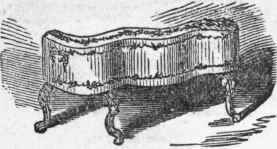
Vegetable Warmer.

Plate Warmer.
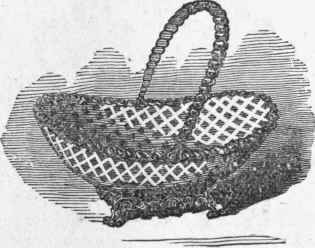
Cake Basket.
The dessert should be well selected, and more choice than plentiful. By choice, do not let us be understood to mean extravagant, consisting of fruits not yet in season nor having their proper flavor, or of preserved fruits, or fancy confectionery. All these are prejudicial to health, and we cannot understand why people who dine out should be tempted to eat indigestible things; why what ought to be a means of social enjoyment, should be made a matter of form, ostentation, and discomfort. Let the dessert consist of fine specimens of the fruits in season, backed in winter by a few dried fruits and biscuits.

Fruit Dish.
Soyer's housewife thus describes her dinner:- The first thing to be looked to is the lights; these ought to be so placed as not to intercept the view of any person at the table, but at the same time they ought to be enough to show everything off to advantage. I prefer removing some of the lights from the table to the side-board when the cloth is removed, as the light after dinner ought to be more subdued. In laying the cloth, we place it over the baize and remove it after dinner, as Mr. B. says he likes to see the mahogany; for when he asks a city friend to come and put his feet under his mahogany, it looks gather foolish if he never sees it. I have, as you know, my table rather wide, that is, six feet, and I generally place a vase of flowers in the centre, as I think their freshness and odor add greatly to the appearance of the table, and admit a flanc on each side. We prefer the old English plan of taking the top and bottom of the table, instead of me and Mr. B. together at the side.

Dish Cover.
"The cloth being laid with its proper side uppermost, I order a napkin, two knives, two prongs, two tablespoons, and two wineglasses to be placed for each person, a saltcellar between every other; that being a condiment which every one uses, though often wrongly; the cruet-frames and other requisites are kept on the sideboards. I then have the fish and soup served together; the potatoes and sauce on the sideboard; I serving the soup, and Mr. B. the fish; and often a little dish of fried fish, such as smelts, etc, to remove the soups. This gives me an opportunity of seeing that my guests are properly attended to, and also leisure to take wine with any gentleman who challenges me. During the time this course has been progressing, the cook has had time to dish up the removes nice and hot, and get all up close to the door, as I like as little time as possible to intervene in changing the dishes; and these consist generally of variously dressed chickens, which I have before me, as this gives an opportunity for the gentleman on my right to display his gallantry; Mr. B., who is a capital carver, either has a saddle or a haunch of mutton, or a quarter of lamb before him the rest of the dishes consisting of a tongue and entrees. I select those most easy to carve, and also easy for the cook to prepare. This is a period of dinner where a great deal depends upon the attendants; they should know almost by the look what this lady or that gentleman requires, and what kind of vegetables to hand them; a first-rate butler should be able to judge by the physiognomy to whom he should offer mint sauce with the lamb, and who prefers cayenne; on their attention and hot plates depends the success of the substantial part of the dinner.
"As soon as I see that all are served, and words are few in consequence of the Organ which utters them being employed in another way, I give a look to the two servants which they understand, and immediately two reports are heard - they are from two bottles of champagne, open-ed at the same time by the attendants, who have each a salver with six glasses on it; this takes but a short time to serve, and prepares the palate for the entrees, which generally get praised; indeed, my cook would think something was wrong if two of the dishes did not go down empty. By having the champagne thus, I find it goes much further than if only one bottle was opened at the time, there being sufficient left in the bottles for a gentleman to challenge a lady to take champagne with him. If I have game I remove the top and bottom dishes with them, and make the sweets a separate course, taking care to have cold plates for the jelly, and having the liquors handed round when the sweets are on the table; one cheese I place opposite Mr. B., and macaroni opposite myself. In the dessert I generally introduce some new importation, such as bananas, sugar-cane, American lady apples, prickly pears, etc.; these also give a subject for the gentlemen to talk about when the ladies have left, as free trade, colonial policy, etc. About half an hour after the dessert is on the table, and when I see that the conversation is becoming less general, I retire to the drawing-room; the servants then remove the used glass and plates, and Mr. B. introduces some of his choice claret or Burgundy in ice coolers."

Silver Skewer.
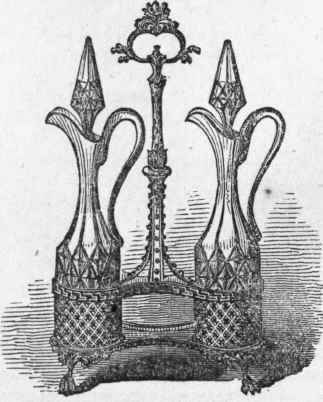

Wine Cooler.
There are so many varieties of evening parties that no directions can be given respecting them. As a general rule, we would advise that they should be as simple, unostentatious, and sociable, as possible. It is the extravagance which has been introduced into these matters, the insane desire of outvying each other felt by individuals, which is the bar to real social enjoyment, and prevents us from being as lively a people as the French. Why cannot we meet to converse, have music, dance, or amuse ourselves in any rational way, and be content with light, simple refreshments, and a sincere welcome? Surely such reunions are more enjoyable than crowds, grand suppers, superb toilettes which are scarcely seen in the crush, and suffocating heat or currents of cold air. Such assemblies upset the house of the party-giver for a week at least, weary and worry her. and are criticised most severely by all her "dear friends " who did not enjoy themselves nor receive the attention they expected. In them all is most certainly " vanity and vexation of spirit;" there is no pleasant converse, no comfort, no intellectual enjoyment; weariness, lassitude, headache, and expense, are the only concomitants of such parties. May our "model housewife " have courage to reject them altogether.

Continue to:


My Books

