


Furnishing. No. 1. On the Colour-Sense in Furnishing. Continued
Description
This section is from "Every Woman's Encyclopaedia". Also available from Amazon: Every Woman's Encyclopaedia.
Furnishing. No. 1. On the Colour-Sense in Furnishing. Continued
For beauty is godliness, beauty is worship of God, and the man who thinks that, by eating an ill-cooked meal and surrounding himself by things that offend the eye, he is getting nearer to heaven, makes a terrible mistake. The more we satisfy that beauty-sense in our daily life, the more we are getting into touch with another world that is even more wonderful than this, and the less we shall have to learn when we get there. To vibrate to colour to loveliness, in any form, is the same as to vibrate to a noble deed, a thrilling thought, an entrancing melody, for they are all in harmony with Nature.
But we can discount even Nature, and one great danger to guard against - it is one incurred daily by those who pride themselves justly on their taste - may be termed, grotesquely enough, the vulgarity of flowers.
All flowers are beautiful - in due relation to other colours; but to put red in a blue room, and blue in a red, is to commit a crime, and a crime which the poor flowers must feel acutely, for they understand the laws of harmony better, far better, than do we. For a white-walled room with chintzes in which a note of rose predominates, you may use any note of rose or red, but no pink; for a red room, any shade of pink, but no red; for a blue room, blue flowers, if obtainable (they are all too rare), but, failing them, all shades of mauve and purple; for a pink room, very pale yellow and pink; while for a brown-walled room, all shades of orange alone are effectual.
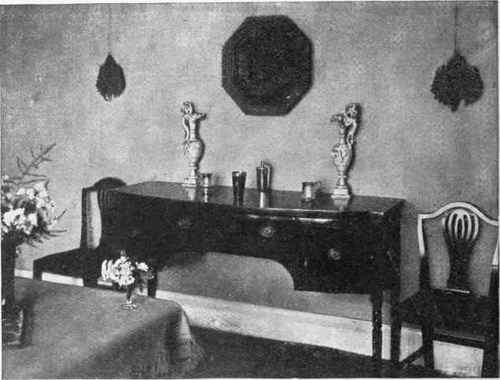
Furniture should never be crowded together. This Sheraton sideboard looks well because it is almost isolated
It is not a question of money, this taste. You may find it in the cottager's home when its inmates are simple, kind, and of pure life; and this sense of harmony (or comfort) and colour can be so cultivated that by degrees it comes under the head of moral order, and everything falls naturally into place. Without arguing about it, instinctively whatever you buy, whatever you touch, blends into the right colour-scheme, and at last it becomes as natural to a woman to sort out the contents of a tray of flowers into their proper sequence of colour, as it is to another to cram red, white, blue, and orange into one vase, and stand it on a cabinet or table that does not want it, being complete already by what is upon it. For it is not the colour only that matters, but where you place the flowers. You may be just as vulgar in your distribution of them as if you crowded too much furniture on your floors, or had all the dinner dishes put at once upon your table. Flowers require isolation to show off their beauty as much as do objets d'urt, and because your garden is lull there is no reason why the house should suffer from a plethora of unsuitable ones. I have seen an exquisite interior ruined by hard, staring-eyed Marguerite daisies, a flower that should never be used save when sparingly mixed with poppies, and then only in a particular place.
I would rather sit down in a white-washed room, with a chair and a table that holds a bunch of flowers that delight me with their mauves shading into purples, or their pinks into scarlets, than in one where the balconies riot in colour, every jar, pot, and pipkin holds a flowering plant, or cut nosegay, till, in the confusion of scents, not one is able to emerge clearly out of the prevailing sickly sweetness. There should be growing plants in every room, but merely as a background, like the carpet or the walls. In the most exquisite room that I think I have ever entered, the final touch of distinction, of perfection, was given by one vase of blue sweet-peas. In thinking of it afterwards, it seemed to me that all the harmony, the loveliness of the details of that room, was summed up in the one note of colour struck by those tall, blue sweet-peas.
The sun plays an important part in all colour schemes, and I am a sworn foe to lace curtains, shutting out light and air that by day should be free to enter. At night, the chintz or satin curtains should be wide enough to draw completely across the windows, and beautiful enough to make it a pleasure to see their pattern and their colour against the walls, which, for preference, should be white. White shows up good furniture (which is almost uniformly dark) as does no other background - it is cheery, healthful, attracts sunlight, and gives one a free hand in the dominating note of colour - blue, rose, or what not - that you may have decided on.
Of course, a blue paper is necessary for that thing of beauty, a blue room; but for houses and flats of moderate dimensions, a white-striped paper for dining and drawing rooms, white Lincrusta Walton (varnished) for the hall make the best background, especially where engravings are used. White gets dirty, you say; on the contrary, it lasts much longer, shows marks far less than the dark papers, that have a knack of wearing white in places. I confess I always long to see Piccadilly take itself in hand, and from Stratton Street to Hyde Park Corner literally whitewash itself. Venice itself would not be able to show a fairer, more picturesque sight. I would plead for more and more whitewash in our sunless country; to surround ourselves with white would be to supplement as far as possible the source of all light, heat, and happiness.
A room that is all golds and shades of orange appeals strongly to me. An old-fashioned gold-leather paper, all burnished gold, deep yellow or orange satin hangings, a very dark carpet, and quiet easy-chairs, an old Dutch marqueterie cabinet or so, and a sparing use of yellow and orange flowers - with these you get the effect of sunlight, even on a day of fog. Melancholy is banished from such a room, and that, I take it, should be the object of all intelligent furnishing, which aims at comfort before everything else.

This delightful blue room is regarded by Miss Helen Mathers as a perfect example of good taste in furnishing
Yes; to make a house in the homelier sense home, I would make comfort, simplicity, and elegance the watchwords - the comfort that comes of restful, harmonious colouring, of deep easy-chairs and couches; the simplicity that does away with everything not making directly for bodily comfort, or mind refreshment; the elegance that corrects the redundant, creates the right atmosphere, gives the individual touch to a room that is equivalent to the inspired detail that makes the " chou " of a woman's successful toilette.
Then the lighting of the room forms an important part of the colour scheme. Many a quite harmonious room is ruined, either from the point of comfort or effect, by lights placed too high and shades of the wrong colour. To seat people in frocks (presumably of different shades) round a table dressed with a particular colour, and then suspend over them a lamp that not only flashes the electric lights full into their unhappy eyes, but whose inadequate petticoat is of an unbecoming tint, is to neglect the very first duty of a hostess, and to ensure her complete failure as a dinner-giver. It is impossible to have too diffused a light to feed by, just as for reading, writing, and working, it cannot be too concentrated. The wise woman does not stop at making her dwelling-rooms beautiful, and lighting them properly; she furnishes every bedroom as a sulking retreat, with an easy-chair, a sofa, a bookshelf, and a writing-table, and I think every boy and girl should be encouraged to save up and buy one good bit of furniture for his or her sanctum.
I never see such a piece without being thankful that its owner has something to show for his money, instead of its being frittered away in useless things that at the end of the year appear in " current expenses," usually doubling the legitimate outlay he had planned for himself.
And so I say, cut your taxis, save when you can, say "No "to a new frock or suit of clothes, and buy something really good, but don't buy anything because it is very old; I have my own opinion as to the ill-luck pursuing persons who annex curios, say a couple of thousand years old. They have a history, and usually a grim one, to have been so carefully preserved. Chippendale is far enough back for me, and, notwithstanding the enormously mounting prices, there are still some wonderful bits to be found after diligent search here and there.
To me rather a bare room, like a tree in winter, appeals very strongly; but it must be beautifully bare. In one I have seen there was literally nothing but a few exquisitely carved chairs, an equally beautiful quaintly shaped buffet, and a table of the same golden-brown wood as the chairs. The walls were of some pale, cool colour, with sconces, and flat pink shades against the electric lights, and the curtains were of ivory silk.
But if I love beautiful bareness I detest those naked, "unco' clean" houses, whose cleanliness is beyond godliness, beyond taste, and far, far beyond the comfort that poor humans love. Do we not' all know homes where the " house-proud " mistress resents a speck of dust on her furniture, where fires end early, and begin late, where a scrap of paper thrown into the grate is pounced upon and reproachfully conveyed to the paper-basket ? Do we not balance in our minds this house against the easy-going one where comfort comes miles before cleanliness, and half-sneakingly (for we love to be clean) give the latter our preference ? The more especially as often in the untidy one we get the kindly atmosphere that, after all, counts for more than anything else, and that somehow is seldom, or never, found with the ingrained, vulgar, colour-blind people, who would perish in any but their own vulgar surroundings.
You go to a house; your bedroom is airy, clean, chilly even, though it has flowers in it, and you shiver. Why ? Because the atmosphere of a kind hostess is missing, which is the heart of hospitality. You feel her influence in every chair and table, or you do not - some of herself has been withheld or given into everything there; you sleep badly or the reverse, unconsciously repelled or refreshed by the pervading influence about you. And I must confess that, in my own experience, heart mostly spells intelligence, and intelligence, taste.
Continue to:


My Books

