


The Romance of Old China
Description
This section is from "Every Woman's Encyclopaedia". Also available from Amazon: Every Woman's Encyclopaedia.
The Romance of Old China
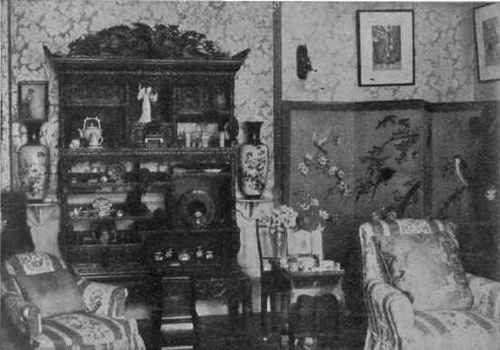
The comfort that comes of restful, harmonious colouring and of deep. easy chairs "
Covers of the antique are apt to use the expression, " old china " as a too comprehensive term, meaning, as it does with them, both pottery and porcelain. I have frequently-been invited to " come and see some old china," and have found the collection to consist of Staffordshire figures, jugs, and mugs, pieces of Wedgwood, and other pottery; but the old Worcester, Chelsea, or Derby china which I had expected to see has been conspicuous by its absence.
Let me, therefore, advise women readers to begin by learning to distinguish between the two. This, like everything else, is quite easy when the way has been pointed out. Pottery is opaque, porcelain translucent.
If a piece of porcelain is held before a strong light and the hand passed between it and the light, a shadow will be seen more or less distinct, according to the porcelain, some makes being less transparent than others. The same test applied to a piece of pottery will demonstrate the fact that no ray of light, however strong, can be seen through it. Then, porcelain, being a better conductor of heat, is colder to the touch than pottery, and it has a more metallic ring when tapped with the finger-nails.
The potter, the potter's wheel, and the potter's thumb are as old as the hills - it would seem that they have always been.
Can we say the same of porcelain ? Not in our own country, or. in Europe for the matter of that; but if we turn to the East, to that wonderful land of the inscrutable Chinese, we might almost say porcelain has always been. It is wonderful in these days, when china is in common use even in the homes of the very poor, to reflect that had it not been for the Chinese the world would probably never have known porcelain at all. Of marvellous inventions and industries all the world over none has such an interesting, tragic, and romantic history as that of the beginnings of porcelain in our own country and in other parts of Europe. Pieces made by the Chinese had been brought from the East by travellers, by Crusaders, and by merchants trading in the Persian Gulf. These fired the ambition of the potter. Then began those attempts to copy the wonderful porcelain of the Indies," as it was called, attempts which brought disappointment, persecution, and ruin upon the potter, who cheerfully sacrificed youth, health, fortune, and even life itself, in vain attempts to discover the secret of its ingredients.
The Western world was still wrapped in barbaric gloom when porcelain was invented in China. The discovery is attributed to the prehistoric Emperor Yu-ti-shun, 2255 B.c., who reigned it is said, for a hundred years. Of course, we must look upon such statements as legendary, but there is better evidence that during the Han Dynasty, 206 B.c. to a.d. 220, porcelain was really being made.
Mr. Stanislas Julian, the translator of old Chinese documents, believed that it was invented during that dynasty, between the years 185 B.c. and a.d. 87. More modern authorities, however, without giving any precise date, say that the industry came into existence during the T'ang Dynasty, a.d. 618 to 906.
Certain it is that seven manufactories were working at this time, each making a different ware, though whether of pottery or porcelain it is impossible to say. In the ninth century we have the evidence of an Arab traveller (translated by M. Reinand), who said:
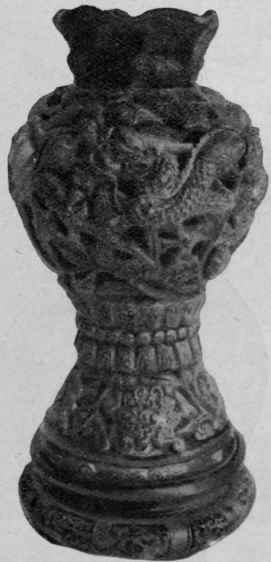
An example of Chinese porcelain of the Ming Dynasty
" There is in China a very fine clay, with which they make vases which are as transparent as bottles, water is seen through them. These vases are made of clay."
From its earliest days the history of Chinese porcelain tends to show an almost reverent devotion in the attitude of the potter towards his art. This was only equalled by the interest of the reigning sovereign - one of whom, the Emperor Chin-tung, issued in 954 an edict that all porcelain made for the Imperial household should be "as the colour of the blue of heaven seen between the clouds after rain." A description of this wonderful porcelain has been handed down to us. It was " blue as the sky, thin as paper, shining as a looking-glass, and giving out a sound like a musical instrument when struck." It is quite possible that fragments of this beautiful ware may still exist. The Chinese have always been •ardent collectors of their own antiques, and it is said that small pieces of this were so highly prized that in after years ■ they were used as ornaments on caps set in gold, or as jewels strung upon silk.
The work of the old Chinese potter is remarkable for its poetic individuality, no two pieces are exactly alike. The workman had an absolute love for his art, and the great mandarins and others who managed the factories fostered this spirit, and laid down rules for his guidance, which are most interesting reading. Some of these rules have been translated by the late Dr. Stephen Bushell. What could be more elevating to the worker than to be taught that, " for painting of flowers and of birds, fishes, and water plants, and living objects generally, the study of nature is the first requisite " ? Or, again, that " colour should be taken from a garden as seen in spring time from a pavilion " ? Then, too, the Chinese signed and dedicated their porcelain with inscriptions both poetic and beautiful, all of which tend to show veneration and love for their art. It is strange when, after many years of fruitless struggle and research, the English potter did discover the ingredients of porcelain, that he almost at once degraded it by applying decoration which was mechanical and inartistic. It would seem that having attained his desire to discover the secret, his ambition carried him no further, for within a few years of their establishment we find the owners of manufactories in this country decorating their wares with transfer printing and other crude designs. Of the romantic finding of china clay in England I hope to write another time; needless to say, the hint which eventually led to the elucidation of the mystery came from China.
We cannot fail to marvel in these days that an art which had flourished in the East for many centuries should have been a sealed book in England till almost the middle of the eighteenth century. This leads me to say a few words on the subject of the age of old English china, and I commend them to all women lovers of china, be they collectors or not.
Owners are apt to state that their Worcester or other English porcelain has " been in our family over 200 years." Indeed, I was on one occasion asked to identify a piece which was " known " to have been in its owner's family 150 years, and which bore the mark of a Staffordshire manufactory established in 1850. Many people own china which is 200 years old, but it is of Chinese origin, the earliest known date on English porcelain being 1745.
The Dresden factory dates back to 1712, the secret having been discovered by Johann Friedrich Bottger, a chemist, who, in consequence of his experiments in Berlin, fled from that city, being persecuted as a votary of the black art.
This exhaustive series will be continued in Every Woman's Encyclopaedia

Chinese porcelain bowl, Wan-li period, 1573-1619.
Mounted in fine silver gilt From the Pierpont Morgan collection on loan at the Victoria and Albert Museum. London
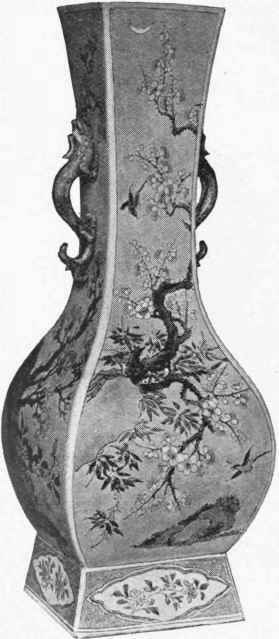
A magnificent example of Chinese porcelain valued at £5.000
Continue to:


My Books

