


Practical Millinery. The Art of Choosing Fabrics
Description
This section is from "Every Woman's Encyclopaedia". Also available from Amazon: Every Woman's Encyclopaedia.
Practical Millinery. The Art of Choosing Fabrics
The Art of Choosing Fabrics - How to Make Bows - The Charms of Colour Schemes Individuality of Taste
In my last article I left the "shape" completed in cloth, satin, or velvet ready for whatever trimming might be selected. Trimmings, of course, alter with different seasons of the year, and follow wild flights of fashion. We must remember that we Englishwomen have a somewhat deserved reputation for using decoration on hats with a distinctly heavy and all too lavish hand. I will commence by describing one of the most popular forms of trimming - namely, the bow. There are, at the moment of writing, many pretty and large hats trimmed with wide bows of velvet or satin, and lined with a contrasting colour, just as there are small toques adorned with "choux," and wonderfully constructed rosettes. But bows and bow-making are quite an independent part of millinery. We must first of all choose our fabrics with care both in respect to quantity as well as to quality.
One of the newest ideas is to line the loops of our bows with a material known as tapestry galon - a lovely model seen in Paris had a bow made of a piece of velvet edged with a piping cord and partly lined or edged with a narrow galon of tapestry. Since this idea is fairly simple of construction and most effective. I am adopting the idea for our bow.
Purchase 5/8 yard black velvet, about 21 inches wide, the usual price at West End drapers' for a good millinery velvet being 4s. 11 1/2. per yard. (Be careful not to get too blue a black; the cheaper velvets err in this direction.) Buy a skein of narrow black piping cord, at 1 1/2d. The tapestry galon should be 2 inches wide, and is obtainable at is. 0 3/4d. per yard - 3 3/4 yards will be required.
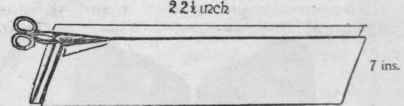
Fig. 1
Fold the velvet into three longitudinal layers, cut, and leave three lengths measuring 5/8 yard by 7 inches wide, as illustrated.
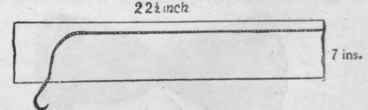
Fig. 2
Take one length, and place the piping cord on the wrong side, 1/2 inch from the edge. See Fig. 2.
Dress
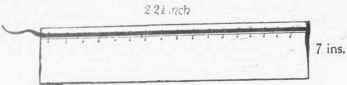
Fig. 3
Turn material or velvet over, pin cord in.
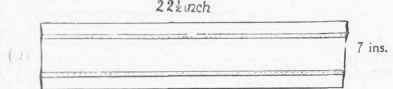

Fig. 4
Sew cord neatly in, as illustrated, and repeat the same process on the other edge of fabric, and also on all other lengths, the 22 1/2 inch by - inch pieces being destined for loops of bow.
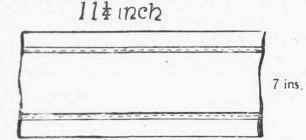
Fig. 5
Cut your third length into two equal halves, thus making two lengths measuring 11 1/4 inches by 7 inches, the one piece being for the extra short loop, the other for the tie-over one; repeat directions for Figs. 2, 3, 4.
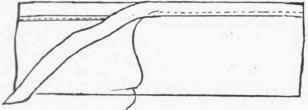
Fig. 6
Take one length of the velvet, place galon inch from edge on wrong side, and sew on 10 the piping cord (being careful not to take stitches through), repeat the same on the other side, and on'remaining four lengths.
The separate pieces (Figs. 4 and 5) being now completed, we proceed to shape our bow.
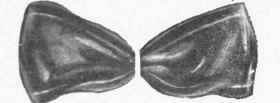
Fig. 7
Double over the two longest lengths (right sade being outside), and sew as illustrated.
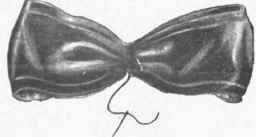
Fig. 8
Join the two longest loops together.
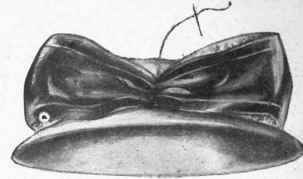
Fig. 9
Sew the bow (the two long loops that have been thus joined) to the centre front of the crown of the hat, taking stitches through crown to ensure firmness.

Fig. 10
Make one of the remaining small pieces of velvet into a loop, and sew on to right side of crown.
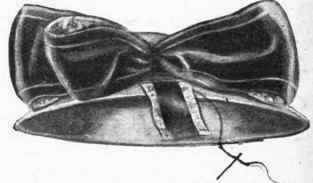
Fig. 11
The tie-over plays an important part in the success of the bow. To attain this tie-over, take the last short length and sew on to brim of hat about 1 1/2 inches from the crown (not allowing stitches to show through the brim).
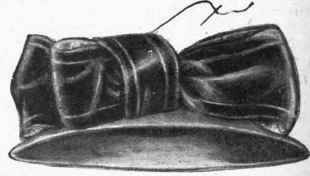
Fig. 12
Throw the tie-over in an artistic manner to meet the loop on the right side.

Fig. 13
Catch end of this tie-over very neatly at the back of the loop and sew firmly.
I must impress on my readers that although great neatness and exactitude must be observed in the measurements and finishing off of all trimmings, they must not be too much sewn on to the hat itself.
How often we hear the remark: "You can tell that is a French hat by the lightness of the bow," and it is an undeniable fact that it is very difficult to acquire this light touch. Great care should be taken in handling such fabrics as velvet and silk, as if the bloom gets rubbed off, the trimming looks "messy " and unsmart. Some people are born with the artistic tendency, but an artistic training is also essential in all matters relating to millinery; and the well-known successful millinery houses of Paris and London always possess some man or woman designer, who has what can only be described as individuality of taste. It is this individuality that produces those wonderful specimens of headgear that, used as models, procure for their firm such startling prices - £ 10 to 20 for a Paris model is by no means an uncommon sum to be given by English and American buyers in well-known Parisian houses.
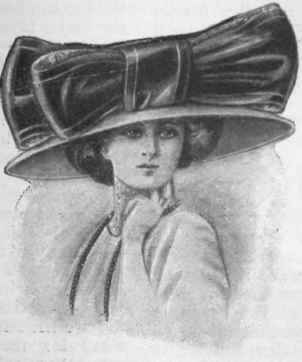
Shows the model completely finished, the loops of the bow being lined with delightful contrasts in colour
It is, therefore, an error to suppose that any amount of feathers or beautiful materials can make a smart and marketable hat - the essence of success lies in the magic word "style," still better expressed by the French as "chic," and this is only attained by hard study and much practice.
Continue to:


My Books

