


The Flower World in Spring
Description
This section is from "Every Woman's Encyclopaedia". Also available from Amazon: Every Woman's Encyclopaedia.
The Flower World in Spring
How by Artificial Methods to Accelerate the Changes which Take Place in the Flower World in Spring - Shrubs and Plants Suitable for the Treatment - The Process and How to Preserve the Blooms
In the best-managed garden there is always a time when the borders may be searched in vain for blossoms. The sleep of Nature is so deep during the month of January that, unless one can resort to the arts of the skilled florist, it is difficult to secure anything in the way of flowers for house decoration.
All the more welcome, then, will be the knowledge of an entirely new system whereby, with the greatest ease, anyone can obtain a wealth of floral loveliness during the early months of the year. The method is so simple that it cannot fail to appeal strongly to the busy housewife in search of fresh means whereby the home may be beautified.
Autumn Growth
To understand the new system of flower production it is as well to take a small peep into the great book of Nature. Those who study the matter tell us that it is quite a mistake to suppose that the autumn is a time of death and decay. True, on all sides the leaves are falling to the ground, but beneath this apparent flagging of life there is going forward a tremendous amount of activity. If we examine the contents of the buds which are left behind when the foliage has gone from tree and shrub, we shall find that they present tiny leaves and shoots, all ready for next spring.

Wild plum, which may be secured in any hedgerow, expands perfectly in a warm room any time after Christmas
Hastening Spring
When the first season of the year comes round, it will simply be that this growth is expanded by the force of the uprising sap. Further, the sap as it travels up the stem of the tree, and through all the branches, is really little more than plain water drawn from the soil.
Now, it is possible in an artificial way to bring about the changes which take place in the plant world during the spring. After a good deal of experimenting, it was found that branches of trees and shrubs could be induced to expand their leaves and flowers quite two months before their normal time. In this way we may produce spring flowers in mid-winter without a hot-house, or even any knowledge of ordinary gardening. Almost any kinds of deciduous trees and shrubs are suitable for the treatment, though those which are naturally early flowering seem to give the best results. Thus, the almond, the cherry, the blackthorn of the hedgerows, and nearly all the well-known fruit-trees, provide excellent subjects.

Shave off the lower part of the twigs so that a considerable surface is exposed
The best time to get the material is from about the middle of January onwards, and if there has been a spell of frost the results will be all the better. In some way, the intense cold seems to cause a deeper sleep on the part of vegetation, and on this account the shoots are all the more eager to start when the treatment begins.
In dealing with flowering trees, such as almond or wild plum, it is important to be able to distinguish between the buds which will produce blossom and those which will only throw foliage. There is really no difficulty in this. In all cases the flower-buds are stouter, generally with rather blunt points, and are produced on a somewhat short, twiggy growth.
When a suitable number of branches have been secured, trim the cut end of the branch with a sharp knife, taking care to ensure that the shoot will readily draw up the water into which it will be presently placed. Several methods of bringing this about have been tried, but quite the best consists in cutting away the bark in thin strips for about three inches up the stem If one does not care to go to this amount of trouble, a similar result may be secured by splitting the twig upwards for several inches.
To prevent the natural sealing-up process, it is important, as each branch is prepared. to place the end at once in water. When all are finished, jars or bowls may be secured to accommodate the branches, and the water in these should be kept quite fresh, by constant changing.
It is advisable to place a small lump of charcoal in each receptacle. This will prevent a loss of sweetness.
For the first few days place the jars containing the twigs in a dark cupboard. On the fourth day the branches may be brought out into the full light. For their subsequent development it is not possible to have too sunny a position, and best of all is a place in front of a south window. Of course, the branches may be grown on in any room, but for their speedy growth a warm atmosphere is essential.
If the illumination comes from one side, as will be the case if the branch is in front of a window, the jar should be turned round daily so that all parts get an equal amount of light. Dust will be found to be a great enemy to all plant growth in any room where there is an open fireplace. To remove any settlement of dirt which may arise, sprinkle the buds with water, through the rose of a water-can, every day.
As the flowers unfold and the leaf-buds expand, the sprays will become increasingly beautiful, until one morning the whole branch will be decked with the fresh loveliness of spring. It will be a surprise to most people to find how long these flowering branches will remain in good condition.
It may be of interest in this connection to mention that when the blossoms are once fully out they will last longer if they are not exposed to the full sunshine and the apartment in which they are kept is not too warm. Of course, the effect of the flowering sprays is very much enhanced if they are placed in artistic vases.
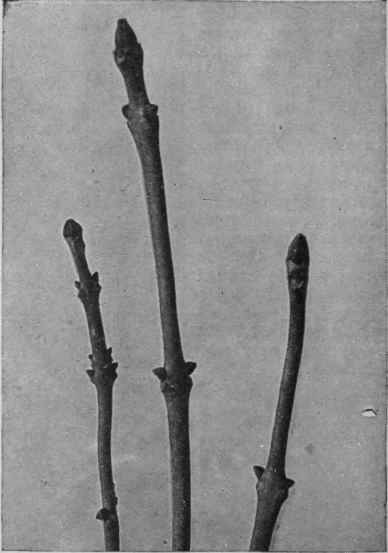
Select shoots with large buds, preferably during the month of
January
Continue to:


My Books

