


Wedding Dresses
Description
This section is from "Every Woman's Encyclopaedia". Also available from Amazon: Every Woman's Encyclopaedia.
Wedding Dresses
Coloured Wedding Dresses - Bridal Crowns - A Golden Girdle - The Chinese Bride - Breton
Brides - Why Blue is the Bridal Colour in Russia
What is she going to wear? That is the question that leaps naturally to the lips when one hears that a girl is going to be married. I can imagine it asked throughout all the centuries of the past, and through all those that are to come, in every language of the world. For surely there never has been, and never will be, a toilet of greater interest to the world of women than the wedding one.
We are apt to connect white, and white only, with the attire of a bride, unless she be a widow who is marrying again. But, as a matter of fact, white, the symbol of inno-cence, has not always been the choice of English brides, and is not to this day of the brides of other nationalties. Hence, no great surprise need be signified at the custom that is growing up among fashionable brides of introducing a tint of colour into their wedding dresses - here a train of cloth of silver, there a foundation of palest rose, and in another instance a tracery of green embroidery to enhance the naturalism of a floral spray. .

Queen Alexandra in her wedding dress and veil. Royal brides never wear the veil over the face
History tells us that on the day of her marriage to Francis II. of France, Mary Stuart, whom we know as Mary-queen of Scots, wore a gown of dark blue velvet "covered with jewels, and white embroidery of beautiful workmanship, so that it was admirable to see. On her head she wore a coronet of jewels so magnificent that it was worth the large sum of over 60,000 in English sovereigns of the present day. She had two ladies in waiting attending upon her, who bore her long train.
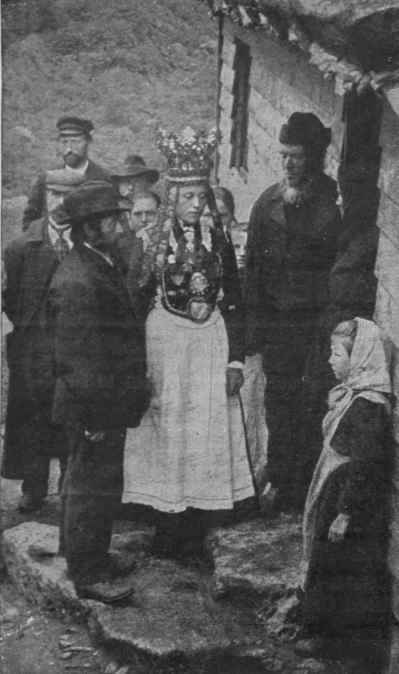
Norwegian bride and groom of Brigsdal, Norway. The crown of jewels and metal worn by the bride is the most important feature of her nuptial array Copyright, Underwood
Mary Stuart was devoted to her jewels, and when her first husband, Francis II., died, and she was setting out for Scotland, her uncle, the Cardinal de Guise, suggested that she should leave her jewels behind her, until he could send them to her by some safe hand, to which the Queen replied, "If I am not afraid for myself, why should I fear for my jewels?"
Concerning the wearing of a white bridal garment, however, past usage has not laid down a cut and dried law.
The Chinese Bride
The Chinese bride wears red and is veiled with red, and in every detail the same colour predominates - in the ties that bind the nuptial wine-cups together, in the cords that fasten the respective ankles and waists of the wedded pair, the chair in which the principal wife goes to her husband, and in the clothes of the men who carry it, as well as the musicians, even in the tray on which is borne the orange tree, heavily laden with coins and fruit, which are the symbols of wealth.
The peasants of many countries put on dark frocks - for economy's sake, in some instances, and in accordance with traditional custom in others. Their coloured raiment is made bridal by the special crowns and jewels they wear, which have been handed down from generation to generation, and are held in the sincerest reverence, despite the ruthless hand of civilisation which sweeps away many old customs.
Nuptial Crowns
The Norwegian crown that, is worn by the virgin bride - all metal or tinsel, inset with jewels or crystals - and the German "Madchen's" nuptial crown, partly velvet and partly tinsel, with a plethora of coins and buttons upon it, and chains dangling from it, to say nothing of her virginal chaplet of myrtle, rosemary, and white rose twigs, scrambled for by her girl friends for luck after the last and "wreath" dance of the wedding festivities, are typical of the ornaments worn by the brides of many other countries.
Italian peasants wear jewels that are added to from generation to generation by means of an extra chain or another gem, and so precious and so sacred are these wedding ornaments that only the most terrible poverty induces their owners to sell them.
There is a family likeness all the world over in many of the wedding-dress adjuncts of the bride, as also in their symbols and the weddingrday customs connected with them.
The Japanese bride wears white silk, sent to her by her bridegroom-elect for the purpose of making the wedding-dress, and a marriage girdle of gold embroidery, also the gift of the bridegroom, an item of raiment deemed in Japan of importance as great as that which the wedding-ring possesses in our country.
Breton Sentimental Traditions
But, then, the girdle in days of yore was a very necessary part of the wedding garment. The bride of ancient Rome was attired on her mariiage day in a long white tunica, or robe, fastened by a woollen girdle with a peculiar knot. Her hair was arranged in six locks, and in it she wore a garland of flowers of her own gathering. Her head was covered with a red veil. As she went in the festal procession, the bride threw walnuts to the boys in the street, to signify her good-bye to childish amusements.
Concerning the girdle, or sash, it is interesting to note that the Breton bride wears one so tied that it falls not in single ends, but in long double loops. The typical peasants of Brittany, who adhere to old customs most tenaciously, are a people linked closely together by ties of sentiment and a love of traditional observances.
When the wedding party at a Breton marriage has been formed into a procession, and is about to walk to church, it is stopped by the mother of the bride, who, cutting the loops of her daughter's sash, embraces her, blesses her, and says the following words:
Continue to:


My Books

