


How To Make Ducklings Pay
Description
This section is from "Every Woman's Encyclopaedia". Also available from Amazon: Every Woman's Encyclopaedia.
How To Make Ducklings Pay
Editor of " The Encyclopaedia of Poultry," etc.
The Choice of a Breed - Housing and Feeding the Breeding Stock - Incubation and Rearing of
Ducklings - Feeding and Fattening
The hatching and marketing of ducklings forms one of the most profitable branches of the poultry industry.
Like the day-old chicken trade, the newly-hatched duckling business has made enormous strides during recent years. Not many years ago, ducks were kept either with a view to egg-production or to supply savoury dishes for the table; but to-day they are put to wider uses. Some are kept for exhibition purposes, others for breeding ducklings for fattening, and others for the production of eggs, to be sold as "sittings," or turned into ducklings to be sold as "day-olds," or placed on the egg market for edible use.
Like other classes of poultry, ducks may be said to consist of two strains - namely, egg-producing and flesh-producing - and it is important that one should have a definite object in view before choosing a breed. If the ducklings are to be sold as day-olds, the two breeds most likely to meet with a ready sale are the Aylesbury and the Indian runner. In scanning the advertisement columns of the poultry press, one will generally see more of these two breeds offered than any other kinds, which proves their popularity. The Aylesbury is the best duck for the table, while the Indian runner excels in the way of egg-production.
Importance of Healthy Stock
When taking up the keeping of ducks with a view to the production of ducklings for the market, it is highly important that the breeding stock should be sound in constitution, or the birds will fail to produce the maximum number of eggs, or eggs calculated to produce a high percentage of ducklings at hatching time. The breeders intended for the production of eggs early in the year must be in the healthiest possible condition, and in procuring such birds the stock of a duck breeder of good repute should be chosen.
With healthy, well-matured breeding stock, one is enabled, with the assistance of good feeding, to get eggs and produce ducklings in the earlier months of the year, when the highest prices are obtainable. Before securing the breeding stock, shelters for their reception should be erected, and adequate runs and ponds provided.
The house for ducks need not be elaborate in structure. A building six feet square and four feet high will afford ample accommodation for ten of the larger, or twelve of the smaller kind of ducks. The front of the house should be boarded half-way up from the ground, whilst the upper half should be wire-netted, and fitted with a hinged, canvas-covered frame, so as to admit of an abundance of ventilation in good weather, and to keep out wind and wet when the weather is inclement.
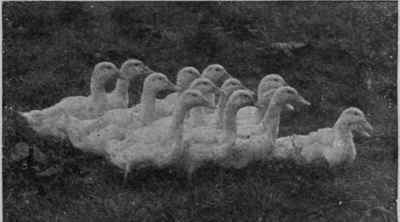
A fine flock of Aylesbury ducklings. The Aylesbury is the best breed to choose if table birds are to be produced
The floor of the house may be of the earth itself; but a gutter should be cut round the outside and a little distance from the walls of the structure to keep heavy rains from finding their way to the interior. If the floor is kept clean and well bedded with litter, the ducks will steer clear of cramp.
Attached to the house should be a good-sized enclosure, in which the birds can be fed at breakfast-time; otherwise they must be kept in the sleeping-house until 9 a.m. each morning, or they will be liable to stray away and lay in the pond or about the run.
The number of ducks that may be mated to a drake will depend upon the breed chosen. Of the heavy table breeds, three or four females to a male will be ample, whilst of the lighter breeds five or six will suffice. To economise space, double breeding pens may be mated up - that is to say, eight or ten ducks may be run with two drakes.
How to Feed Ducks
In the warmer season ducks will find most of their food, and lay and breed well, but they must be well sheltered and nourished if they are to reproduce their kind during the winter and early springtime. Soft food should be fed in the morning, and hard grain in the evening. The former may be prepared by boiling roots or green vegetables, and mixing with them equal parts of barley meal, bran, and ground oats or biscuit meal. This mash should be like stiff pudding when mixed, and should be rendered crumbly by the addition of sharps. Oats and wheat may be fed alternately at supper-time. In an enclosed run, attached to the house, should be kept troughs, one of grit, and another of water; and when the birds are cut off from the grass run by heavy snows, chopped vegetables should be given them at midday.
To hatch out ducks' eggs in any quantity
Woman's Work early in the year, the services of an incubator must be requisitioned, as broody hens are so scarce. Excepting that the egg chamber should be kept as near as possible to 1020, the general management of the machine should be the same as when used for hens' eggs.
When it is intended that the ducklings shall be reared and fattened for the table, the little ones, when hatched out, should be placed in a roomy foster-mother, the heated chamber of which should be kept for the first week somewhere between 700 and 8o°. Too much heat is injurious to ducklings, all they require being sufficient to prevent them from becoming chilled. During the second week no artificial heat will be necessary in the brooding-chamber, unless the weather is excessively cold, when just sufficient should be allowed to ensure comfort to the inmates. After the second week the ducklings should be placed in roomy, damp-proof coops, to which are attached wire runs. Should broody hens be used, both hens and broods may be cooped together for a fortnight, when they should be separated.
Rearing Ducklings
The first food given to the little ones should be composed of eggs boiled hard, chopped up finely, shells included, and mixed with stale bread, moistened with milk. This food may be used two or three days, when mashes made up of boiled vegetables, ground oats, fine biscuit meal, barley meal, and sharps may be given. The dietary should be varied as much as possible, and the birds should be fed six times per diem during the first fortnight. After they are a fortnight old, their food should be served up four times a day, and should be of a coarser nature, such as mashes made up of biscuit meal dried off with sharps, boiled rice mixed with ground oats or oatmeal, barley meal and bran scalded and mixed with sharps, and groats boiled and mixed with sharps. These mashes should be changed about, and a little chopped meat should be added to them. Too much water for the youngsters to dabble in is not advisable when they are intended for fattening purposes; clean water should, however,' be placed before them after they have finished each meal, and at the bottom of the drinking vessel some fine grit should be kept, which will be taken by the birds, and assist digestion. The importance of fresh vegetables in a chopped form must not be overlooked, as these act beneficially upon the digestive organs and keep the blood in order. The Fattening Process
The fattening process, which takes about three weeks, should begin when the birds are six or seven weeks old. The ducklings should be given a house with an enclosure, the latter being used to feed them in. Ayles-burys arc, if previously well looked after, generally ready for the fattening process at the age of six weeks. There is nothing better for fattening than cooked rice. This food is cheap, but it produces a good quantity of flesh of first-class quality.
Other food suitable for fattening, but which does not yield such good results, is barley meal and greaves. Failing the greaves, rough fat from the butcher's must be used, that of mutton being the best kind. The birds should be fed three times a day, suitable hours being 7 a.m., midday, and 5.30 p.m. At these times they should be allowed to eat as much as they will, but the moment they seem satisfied any food left should be removed, and no more should be allowed till the next feeding time. A little drinking water should be allowed at the end of each meal, and not whilst the birds are eating, the object being to get as much solid food into them as possible. After feeding, the birds should be gently driven into their house, and allowed to remain there till next fed. While under the fattening process, grit and chopped vegetables should be supplied to the birds. Humane Killing
Food should be withheld from the birds for a day previous to killing them, so that the bowels may become empty, otherwise the quality and flavour of the flesh will depreciate. Dislocation of the neck is the most humane way of killing ducks, and this method, besides being clean, allows of the birds being plucked right away. When plucked, the birds should be placed on a table on their backs, and left till quite cold.
No branch of poultry-keeping offers better inducements than the hatching and marketing of ducklings. When sold as day-olds, the birds show a splendid profit on their cost of production, and if kept, fattened, and sold, either locally to private customers, or drafted off to dealers, they leave a good margin of profit after cost of food and working expenses are deducted. Where the duckling scores over the chicken as a marketable product is in its rapidity of growth. At nine or ten weeks it is ready for the market, and if marketed in the earlier months of the year, the price realised for it will be anything from three-and-six to seven shillings, according to its quality and the quality of the market, whilst its cost of production should not be more than eighteenpence.

Twin ducklings. There is always a good market for young ducklings, especially as " day-olds." They can travel well at that age without food
The Star Life Assurance Society, Ltd., make a feature of a Policy which secures an annuity for Women Workers.
Continue to:


My Books

