


Medical - The Poison Bottle
Description
This section is from "Every Woman's Encyclopaedia". Also available from Amazon: Every Woman's Encyclopaedia.
Medical - The Poison Bottle
A Word of Warning in the Use of Poisons - Special Bottles in Which to Keep Them - Distinctive
Labels - Symptoms and Antidotes of Certain Poisons
As various poisons have been mentioned in other articles, it is only right that some emphasis should be laid on the dangers attending the home poison bottle. Hundreds of accidents occur every year through carelessness in handling poisonous medicines.
Strong acids often are applied to the eyes in mistake for a harmless eye lotion. Children are given poisonous drugs instead of simple aperients. More than one tragedy has occurred through poisons having been put temporarily into ordinary medicine bottles.
The mistress of a household cannot be too careful or too strict- in her rules regarding poisons in the home.
All poisons should invariably be placed in special bottles. In America, triangular bottles of blue glass are now coming into use. These have a white label with the name of the poison and the antidote for it on red labelling. Of course, no chemist in this country is allowed to sell poisons without placing them in special ribbed, dark-coloured bottles.
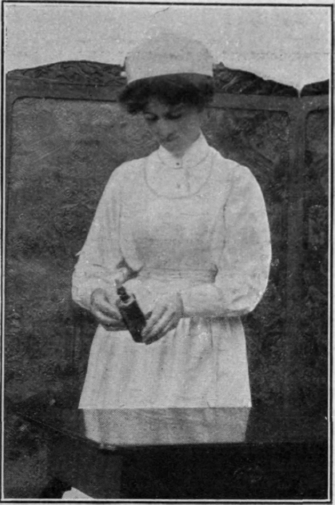
The poison bottle should be dark in colour and ribbed so that it can be recognised even in a dim light
Now it should be made an unbreakable rule in every household that poisons are never to be put into any other kind of bottle.
The second rule is that all poison bottles should be kept under lock and key out of reach of children, and if every person would read the label twice before giving any medicine whatever many accidents would be prevented in the home.
Unlabelled bottles should not be permitted under any circumstances whatever. To write a label really gives very little trouble. Whilst neglecting to do so is the cause of many mishaps.
The following poisons, with their antidotes, should be carefully studied by the amateur nurse:
Poison | Symptoms | Antidote |
Ammonia or other alkali, such as caustic potash or caustic soda. | Pain in the throat and stomach, thirst, and collapse, staining or charring of the lips and mouth, odour in the breath. | A wineglassful of vinegar in an equal quantity of water; then milk and eggs and olive oil. |
Acids (nitric, sulphuric, carbolic). | Same symptoms as alkalis, but constipation present instead of diarrhoea. | Two tablespoonfuls of chalk, magnesia, washing soda or plaster off the wall in plenty of water; then milk, eggs, and olive oil. |
Prussic acid. | Giddiness, convulsions, and collapse, breath smells of bitter almonds. | An emetic (mustard-and-water), artificial respiration, brandy, fifteen drops of tincture of belladonna. |
Phosphorus (rat poisoning). | Pain, thirst, dark vomit, which may be phosphorescent in the dark. | Stomach should be washed out with a stomach pump, and then copious drinks of Condy's Fluid and water may be taken. |
Copper (verdigris). | Griping pain, and greenish vomit and diarrhoea. | Give whites of egg and milk in large quantities, then an emetic of mustard-and-water. |
Tartar emetic poisoning. | Pain and vomiting. | Same as for copper. |
Akonite (in mistake for horseradish). | Pain and vomiting, breathless-ness and collapse. | Emetic, warmth, brandy, artificial respiration. |
Belladonna. | Dryness of the mouth and throat, dilated pupils, diarrhoea, and delirium. | Emetic, brandy, coffee, warmth, artificial respiration. |
Food poisoning. | Colic, vomiting, diarrhoea, pallor, coldness of extremities. | Emetic, or one ounce of castor oil, heat, and stimulants. |
Opium. | Sleep and coma, contracted i pupils, breathing slow and quiet. | An emetic, wash out the stomach with Condy's Fluid and water, strong coffee, and brandy. Prevent sleep. |
Continue to:


My Books

