


The Well-Shod Woman
Description
This section is from "Every Woman's Encyclopaedia". Also available from Amazon: Every Woman's Encyclopaedia.
The Well-Shod Woman
The High Heels of the Past - Tight Shoes are Foes to Beauty - The Shoe of the Pompadour - What the Hobble Skirt is Responsible For - Why Velvet Shoes are liked for the Motor-car - The Shoe with a Heart in the Sole - Wedding Favours and Wedding Shoes - The Baby Who Goes Barefoot - A
Shoe Made Of Feathers
Down the centuries come tripping and tramping the boots and shoes of all times and all nations, a motley crew, each pair with its special interest, historical and temperamental, for it is very true that the footgear of humanity not only discloses the manners and modes of life of its wearers, but is governed by the state of affairs in which the community finds itself
The Monstrous Chopine
There never was a period of more foolish vanity, for example, than the one which introduced the chopine, or tall clog, the heels of which were 5 1/2 inches high - in some cases much more - constructed of layers of small blocks of cork, with a hollow centre. Such a pair of monstrosities is to be seen in the Ashmolean Museum, Oxford, and in the British Museum there is a very elegant edition of this curious vogue, made of wood covered with white leather.
Those who wore chopines, which were really a kind of stilt or false heel, imported in the seventeenth century from Turkey into Italy, and from Venice into England, had to be supported when they walked abroad, as otherwise they would have fallen. Thus the purse-proud proved their wealth, for the poor would not have been able to hire servants to uphold them ; nor would they have been so foolish, surely, if they had been sufficiently well dowered with this world's goods, as to cripple themselves in order to demonstrate their opulence.

Modern footgear gives ample scope for individual tastes. Evening shoes, exquisitely embroidered or decorated with simple straps or buckles, are made in endless variety, while the requirements of the woman who is devoted to outdoor sports are not overlooked
Students of Shakespeare will remember the lines in " Hamlet," which refer to this kind of boot : " By 'r lady, your ladyship is nearer heaven than when I saw you last by the altitude of a chopine."
It is recorded that when Charles I. met his future Queen, Henrietta Maria, at Dover, she seemed taller than he had expected ; and realising his surprise, she showed him her shoes, saying to this effect :
" Sir, I stand upon my own feet, I have no help of art; thus high I am, and am neither higher nor lower." By which she denied the implication that she was a patroness of the altitude-giving chopines.
Not even the Chinese method of cramping the feet, and so keeping them small as those of a baby to adult age, is more foolish than was the wearing of chopines, unless it was that of wearing boots with toes so long that they had to be chained upwards. But in England these silly freaks were soon abandoned ; whereas in conservative China the parallel foolishness still lingers an evidence of barbarism.
It is to the influence of the motor-car and of the hobble skirt that we owe the mar-vellous array of delightfully pretty boots and shoes that now form an essential part of the well-dressed woman's toilette.
The Parisienne, who has always made a particular point of clothing her feet daintily, favours boots as a rule, because of their neatness ; while the Englishwoman is more prone to the wearing of shoes. When the hobble skirt, cut extraordinarily short, made its appearance it was realised that more particular attention than ever would be focussed upon the feet, and then it was that the boot and shoe makers put forth their best endeavours, and brought to light the beautiful specimens of footgear that are to be seen now.
Into the limbo of forgotten things has gone the vogue for humdrum black leather boots and shoes, and in every wardrobe are to be found coloured footgear, as well as daintily soft suede specimens of shoes and boots, in some instances allied to patent leather, and in others to calf.
Since the motor-car became perfected and reliable it has been the pleasure of luxury-loving women to wear black velvet shoes whilst driving, and even whilst walking a short distance upon clean pavements and in the park parterre. Following that vogue, has come one for brocaded satin and cashmere shoes which are to be fashionable for winter wear, though for wet walks and country mire they are changed for boots with leather vamps and suede or cloth uppers, and a heavier sole.
The salutary lesson has been well learned in modern times that it is not only right but possible to find comfortable foot leather. It was a startling revelation to the woman who pinched her feet to learn, as she did within recent years from the beauty specialists, that tight boots meant wrinkled faces, haggard eyes, and a miserable frame of mind. That this is so everyone realises, and the boot and shoe makers having been aroused to a sense of their duties, now produce their wares not only in a few sizes but in many and in every kind of shape, so that the foot in all its varieties of form can be fitted perfectly.
Still, it is customary in many families to have specially made footgear, and lasts are kept and bows and buckles form a finish. Heelless dancing sandals are much in favour, while suede, calf, kid, and patent leather are all utilised in modern footgear.
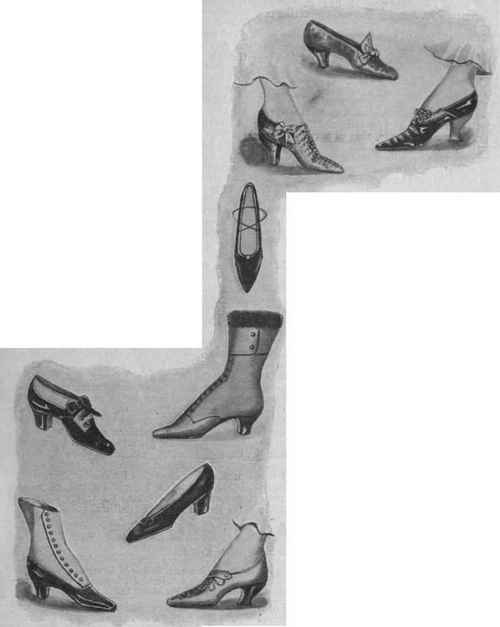
Evening shoes in satin to match the gown are richly embroidered in beads; dainty
Continue to:


My Books

