


Recipe For Making Relishes And Hors D'Oeuvres
Description
This section is from the book "Practical Cooking And Serving", by Janet McKenzie Hill. Also available from Amazon: Practical Cooking and Serving: A Complete Manual of How to Select, Prepare, and Serve Food [1919].
Recipe For Making Relishes And Hors D'Oeuvres
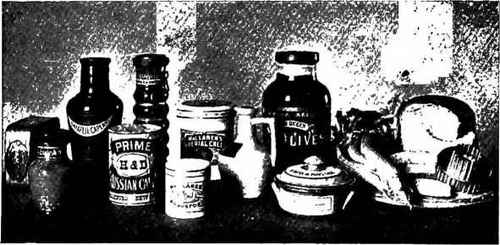
Materials For Hors D'Oeuvres
Sardines, olives, anchovies, cheese, pate de foie gras, caviare, mustard, celery, etc.
From time out of mind, as the prelude to an elaborate English or American dinner, raw oysters with brown bread and butter have been served, though conservatively inclined entertainers are agreed that, at the best appointed tables, the perfect dinner begins with soup.
Raw oysters on the half shell were the opening wedge to innovation; and now, even on very formal occasions, the standard Italian custom - once considered so very Bohemian - of prefacing the meal with little "kickshaws," carefully prepared and served, has obtained. In Russia these relishes, or hors d'oeuvres, that serve to whet the appetite for the more substantial dishes that are to follow, form quite a meal in themselves. Also, the Italian service is quite elaborate; dishes, divided into compartments, are provided; and in the several compartments are tastefully arranged thin slices of tongue, sausage, or ham, potted or devilled meats, caviare, turned from its receptacle and garnished with slices of lemon, fillets of sardine or anchovies, lobster, oysters, chickens' livers, pickles, cucumbers, olives, radishes, bread and butter sandwiches, oat biscuit, etc. The respective compartments of the dish are appropriately garnished with celery plumes, parsley, cress, pepper grass, aspic jelly, etc.
On formal occasions, perhaps the most satisfactory way of dealing with this feature of the meal is to place upon the plate of each guest just before the dinner is announced a single cold canapé. For the foundation of these, thin slices of stale brown or white bread, prepared as for sandwiches, are needed. The pieces of bread should not be more than two inches long and an inch and a half wide. First spread them with butter. Then press upon the butter, using either plain or fancy butter, such bits of material as it is desired to use, taking care to secure proper combinations in flavor and color. Similar canapés may be served at the close of the dinner, with the cheese, though at this stage of the meal pulled bread, devilled biscuit, etc., with a bit of celery, an olive, and a tiny cube of choice cheese, are in place.
The fancy butters are easily made, and a new kind may be presented on each occasion. The best of butter is, of course, a first requisite. This is creamed a little; then sifted material is added to secure such tint and flavor as is desired, cress, olives, capers, cooked spinach, chopped, pounded, and sifted, give a green tinge to butter. Either fish or flesh may be used as the canopy or covering. Anchovies may be added to green butter to produce anchovy butter, while lobster coral alone gives a reddish color to butter. Cooked yolks of eggs, sharpened with capers, are added with advantage to almost any fancy butter. When pastes, as of ham, sardine, etc., are used, a forcing bag and tube is called into requisition to place them neatly upon the bread. Hot savories or hors d'oeuvres may be substituted for the cold, either at the beginning or at the end of the meal. These include savory soufflés of fish or cheese, or of highly seasoned ragout mixtures, also various kinds of cheese mixtures, Gnocchi, rarebits, etc. All are served in tiny paper or pastry cases, or in very small individual portions. In all savories, whether hot or cold, three things are essential: smallness in size, neatness and daintiness in appearance, and piquancy in flavor.
Continue to:


My Books

