


Ice-House
Description
This section is from the book "A Dictionary Of Modern Gardening", by George William Johnson, David Landreth. Also available from Amazon: The Winter Harvest Handbook: Year Round Vegetable Production Using Deep Organic Techniques and Unheated Greenhouses.
Ice-House
Any vacant out-house which can be thoroughly drained will be an efficient ice-house. Moisture is a much more rapid solvent of ice than mere heat. If in an out-house, with drains leading from its floor, a layer of faggots three feet deep be placed, and round the sides of the house a lining of stubble or straw nearly as thick, and then the ice be rammed in hard, and covered over with a similar coat of stubble, the ice may be preserved there for twelve months.
"The accompanying drawing and description of an approved ice-house and dairy united, has been contributed by John C. Boyd, Esq., of Danville, Pa. Mr. B. says, "For various purposes it is far superior to the best constructed spring-house; permitting to the largest extent all the luxuries of sweet cream and milk, the preservation of fresh meat, pies, fruit, etc, for a length of time. Mine has been in use two years, and during that period, we have not had any milk to sour, which cannot be said by those dependent on spring-houses".
Fig. 94.
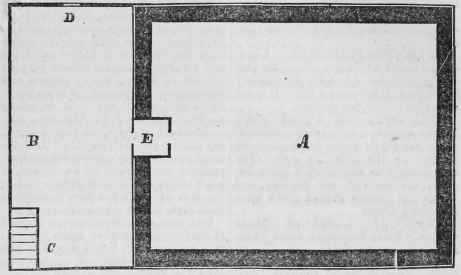
"A represents the ice-house, proper. B dairy-room. C the steps thereto. D window in dairy-room. E entrance into the ice-house.
"The whole length, 24 feet: width 15 feet; pit sunk, 5 feet in ground; stone wall carried 21/2 feet above ground; making depth of stone work 71/2 feet. On stone work, a frame of 8 feet to the square is placed. Weather-boarded on the outside in usual manner. Over milk house, on top of wall is placed, joist 18 inches from centre to centre, on which a tight floor is laid, which forms a convenient room for keeping various things connected with the dairy.
"The partition between the icehouse and milk-house is formed by setting up studding from the sill in the bottom of the ice-house to the square under the roof, and weather-boarded with inch boards halved together, well nailed, so as to prevent any charcoal dust, or dust of the bark from dropping down into the milk trough.
"The inside frame is made 12 inches less all round than the inside of main building. That is to say, a space of 12 inches, (and it would be better if it were 15,) must be left between the two frames - to be filled in with charcoal or tanner's bark, well dried, and well rammed when filled.
The inside frame may be very simply and cheaply made, by taking four pieces of scantling, say 4 by 6, and halving them together - and planking, or double boarding up or down on the inside - three of those frames - one oh the floor - one midway, and the other at top, are sufficient.
"The floor, which is the most particular part, should be made by placing in the bottom good oak sills, with a descent from the back part of an apartment to milk-house of 15 inches. The sills well bedded in clay, tan bark or charcoal. Mine is bedded in common yellow clay, well pounded in.
"The floor should be well laid, either of plank, jointed, or boards double, and small grooves run along to carry ice water down to the milk trough. This floor should be the size of the ice room before inside frame is erected. On that part of the floor which passes under the partition between the ice and milk-houses, small strips of a quarter of an inch thick should be laid, and a board fitted down tight to keep the filling-in from stopping up the water as it leaves the ice. On top of square, joists with floor on, is laid and covered about 2 feet thick with tan-bark. A ventilator should be made through the upper floor and roof about 2 feet square.
"The closet or recess formed on each side of the small doors, leading into the ice, may have hooks to hang meats, or shelves, on which anything may be set. This closet, or cold room, is 3 feet 3 inches, by 3 feet 6 inches - 5 feet high, two doors in centre, each 18 inches wide, made of a single board, and made to fit closely.
The ice may be put in on either side just under the upper joists; an opening 18 inches by 2 feet is sufficiently large, with two doors or shutters - and the space between, when the ice is in, should be well stuffed with straw. No straw to be used in filling ice-house - except on top, when a good supply will be of service.
"The milk-house should be well white-washed. The room above milk-house should be lined on inside of shedding, and the space between filled with tan-bark or charcoal. The covering may be a shed-roof, or any other form best suited to the convenience of the location. The door of my ice-house is within a few steps of my back kitchen door. An arbour of grape vines adds much to the comfort and coolness of the establishment.
"In filling the ice-house, much pains should be taken to pack the ice closely. The ice is taken out by entering from the milk-house through the small doors, and any child who can use a hatchet can procure ice for the use of the house.
"The ice-water, if the troughs are made tight, (and they ought to be perfectly so.) will keep them full, or nearly so, and during south winds may overflow a little. The milk-room is too cold to do the work in, therefore there is no water but the ice water to get clear of, which will disappear without giving any trouble." - Rural Register.
For an interesting article on this subject, See Downing's "Horticulturist".
Continue to:


My Books

