


83. Leading Rules For Laying Out And Planting Flower-Beds In The Gardens Of Suburban Residences
Description
This section is from the book "The Villa Gardener", by J. C. Loudon. Also available from Amazon: The Villa Gardener.
83. Leading Rules For Laying Out And Planting Flower-Beds In The Gardens Of Suburban Residences
The following rules will be found useful in laying out and planting all flower-gardens, but more especially those of suburban residences, where a regular gardener is not kept.
1. Where the space is small, and surrounded by trees and high walls, so as not to be open and airy, it is not desirable to form beds or borders round the margin of the plot, but rather to have only one bed in the centre, and the rest in grass.
2. Where the space is open and airy, either large or small beds may be formed; and it will generally be desirable to surround the whole plot with a narrow border. If the ground-floor of the house is 2 ft or 3ft. above the level of the plot, then a figure, or collection of beds, may be laid out, which shall be looked down upon from the window as a whole; and, consequently, to aid this purpose, the beds ought to be planted with low-growing plants, and, in general, to have the surface covered by them; each bed, in this case, being of only one kind of plant.
3. Where the rooms on the ground-floor are on a level with the surface of the front garden, or nearly so, large plants may be employed in the beds, provided the beds also are large; because, as in this case the beds cannot be looked down upon, and, consequently, their plan can never be taken in at one glance, they never can be seen as a whole from above. It is better, therefore, to use large plants, which, by growing of such a height as to form a whole, or group, when looked at laterally, will prevent the idea of a whole formed by the shapes and lines of the beds, when seen from above, having been intended by the planter.
4. In general, no figure or assemblage of beds of any degree of intricacy, and where the beauty is dependent on the 'shapes of the beds and their connection together, should be formed where it cannot be looked down on so as to be seen all at once. In general, also, parterres, or assemblages of figures of this kind, should only be planted with very low plants, which will not obstruct any part of the outline of the figures; with the exception, however, of an occasional tall plant, such as a standard rose, to produce effect by contrast It may be further observed, that, when plants are to remain permanently, such should be chosen as continue in flower for a long period (say two or three months), in preference to such as complete their time of flowering in a short period, say two or three weeks. On the other hand, when flower-beds are furnished with plants in pots plunged in the soil, with a view to changing them, and replacing them by others as soon as they have done flowering, plants which remain a short time in flower should be chosen; because these have, in general, a greater number of blooms expanded at the same time, and, consequently, while they last, they have a more brilliant effect.
This is particularly exemplified in the ease of bulbous flowers, and in certain annuals, such as candytuft, ten-week stock, etc.
5. Where a symmetrical figure is employed, beds which answer to each other in form and position ought to be filled with plants, either of the same kind, or of the same general appearance, and which flower at the same time: for example, a bed of mixed hyacinths can only be properly opposed to another bed of mixed hyacinths; but the mixtures need not be the same in both beds. A bed of the small dwarf blue lobelia, may be opposed to a bed of the blue anagallis, and so on.
6. Where it is desirable not to have more than one plant of a species, in a symmetrical figure consisting of various beds, the principle of symmetry may be preserved in planting by placing each colour by itself. Thus, a bed of white flowers, consisting of ten plants of as many different species, may be opposed to another bed of ten other different species, also with white flowers.
7. The dug surface of beds formed on a grass plot ought either to be decidedly under the surface of the grass, or decidedly above its level, in order to increase the expression of art and; to take away from the common-place idea of merely digging down a portion of the turf of a particular shape, and planting it with flowers.
8. In the case of flower-beds on turf or lawn, where a regular gardener is not kept, the outlines of the beds ought to be formed by concealed brickwork, masonry, tiles, or slates, otherwise, every time the grass is mown, and the edges of the bed trimmed with the spade; and, especially, every time the beds are dug, their outlines will be liable to be pat cut of shape. Where common bricks and plain tiles can be procured, the simplest mode of faxing the outlines of the beds or borders is by forming an underground outline, if the expression may be used, by tiles or bricks laid on their broad sides, at an angle of 45° as shown in the section, fig, 24.; in which a is the brick, b the surface of the grass, and e the surface of the dug bed, decidedly under the level of the grass plot, agreeably to Rule 7. On the other hand, when the surface of the dug bed is to be above the level of the turf, agreeably to the same rule, the brick should be placed as at d in fig. 25.; the turf kept to the level shown at e, and the surface of the bed to the level shown at f. when plain tiles are to be used instead of bricks, they may either be let into the ground perpendicularly, and their upper edge kept to the level of whichever surface is to be the highest (viz. that of the grass plot, or the bed); or they may be laid sloping in the same manner as the bricks, which will form a very delicate outline, well adapted for beds in small front gardens, By using semicircular tiles, and inserting them perpendicularly, in the soil, very neat curvilinear outlines may be formed; but such tiles cannot be used in a sloping direction, like bricks or plain tiles.
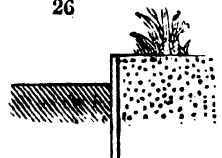
Fig. 26. shows the tiles let in perpendicularly, forming a bed 2 in. higher than the surrounding turf. Fig. 27. shows the tiles let in in the same manner, and the bed made 2 in. lower than the surrounding turf. Fig. 28. shows the tiles laid in, in a sloping manner, so as to form a, bed the thicknenss of the tile only under the level of the turf; and fig. 29. shows the tiles so arranged as to form. a. bed only the thickness Of the tile higher than the surrounding turf. Fig. 30. is a surface plan, showing; the manner of forming the outlines of beds with, semicircular tiles.
9,. Where it is desired to express high art, every bed or border ought to be surrounded, or, if the border be against a wall, bordered on one side, with either a raised or a depressed framework of turf, or of stone, or bricks, or pebbles, flints, etc. where the beds are raised, the plants grown in them should be such as do not require excess of moisture, and which thrive best in a free air; such, for example, as pinks. Where the beds are lowered, an, excellent opportunity is afforded of growing plants which require more than ordinary moisture, especially when they are in flower such as ranunculuses, polyanthuses, heart's eases, etc. 10. Borders of brick or stone, or other architectural materials, ought, in general, to be narrower than borders of turf, lest the force of contrast should be too great for the general effect.




11. When borders of box or other plants are employed to form margins to flower-beds on turf, they ought to be of several times the breadth which they are when employed to separate walks from gravel, in order to give them a distinctive character, and to produce sufficient force of effect to Justify their use. Nothing looks worse than a narrow edging of box, surrounding a bed on turf; the narrow edge of box, appearing, in that situation, to be quite superfluous; and, its colour not contrasting with that of the grass, it has a dead dull appearance.
13. Where beds are surrounded by gravel walks, and edged with box, the latter ought always to be of such a breadth as to form a strongly marked line; and, though the sides of the edging may be clipped so as to give them a slope, and prevent their getting naked close to the surface of the ground, yet the top should always he cut quite flat and level.
13. Nothing looks worse in a flower-garden than to have the box edgings narrow and high; except having the edges of turf margins so pared by. the spade as to show the raw naked earth.
Continue to:


My Books

