


Regularity And Symmetry. Part 3
Description
This section is from the book "The Villa Gardener", by J. C. Loudon. Also available from Amazon: The Villa Gardener.
Regularity And Symmetry. Part 3
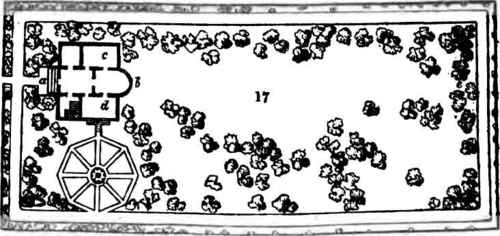
A deep view includes a greater number of objects, and, consequently, admits of a greater variety of effect of light and shade; it increases our ideas of extent, and, by concealing more from the eye than can be done in a confined view, it gives a greater exercise to the imagination. Add to this, that, in a small place, depth of view is not expected; and, consequently, when it does occur, its effect is the more striking by the surprise it occasions, as well as by its contrast with the other views, which must necessarily be very limited. In fig. 17., a is the house, placed at one side of a plot; 6, the drawing-room, having a view the whole length of the garden: c is the dining-room, having a very confined view, and, in short, looking across some bushes, to a screen of evergreens (say hollies or evergreen oaks); d is the breakfastroom, or common sitting-room of the family, looking on a flower-garden, to which there it a descent from a balcony by three steps. The other small room may be used as a business, waiting, or gentleman's room; and the situation of the staircase is indicated. The central hall is large for the size of the house, and may, in summer, be used occasionally as a music-room, or as a play-place, or dancing-room, for children.
All the offices are on the basement story, and the first and second floors are bed-rooms. If the garden were larger, or even of its present size, if circumstances were favourable, a small piece of water, supplied from a dripping rock, at e, would have a good effect; and there might be a statue on a pedestal, surrounded with tazza vases of flowers, in the centre of the flower-garden; or, if water were abundant, a fountain might be substituted for the statue. The rest of the garden, with the exception of the surrounding border between the walk and the boundary wall, is entirely of turf, varied by choice ornamental trees and shrubs, including some fruit-trees and fruit shrubs. The standard roses, and the fruit shrubs, such as gooseberries, currants, raspberries, etc, of which there cannot be more than two or three plants of each kind, stand in small circles, kept dug and manured, in order that they may produce their flowers and fruit of good size; but the mulberry, the quince, the medlar, and the few apples, pears, plums, etc, for which space can be afforded, may stand on the grass. Against the walls are planted one or two peaches, nectarines, and apricots; and against the house, a fig-tree and a vine.
The remainder of the walls, and of the house, may be varied by roses and flowering creepers; except the more shady parts of the surrounding wall, which may be covered with the common, the giant, and the variegated ivy. The surrounding border, between the walk and the boundary-wall, is wholly devoted to bulbs in spring and the beginning of summer; with a row of Russian violets inside the box, for producing fragrance in winter; and patches of mignonette at regular distances, to scent the air during summer. Among the groups of trees, and close by their roots, common cowslips, snowdrops, wild violets, and wood anemones may be planted to come up among the grass; and, being only planted in a few places, and these near the roots of the trees, they may be easily avoided by the mower. In such a garden as this, small though it be, a very great variety of trees and shrubs might be grown; and the flower-garden is sufficiently large to produce a very good display of the finer kinds of hardy flowers.
46. Where walks have been judiciously laid out, and the grounds on each side of them planted with the proper degree of skill, (he views from them will continually vary, even in grounds of limited extent, and without any distant prospect. This result, however, is not to be obtained otherwise than by a very carefully-studied plan for disposing of the walks and the trees. It can neither be attained, even in a tolerable degree, by a gardener who knows nothing of the principles of composition, nor by an architect or landscape-gardener who is not well acquainted with the forms, sizes, modes of growth, times of flowering, etc, of trees and shrubs. In proceeding to lay out a small place, with the view of making the most of it in this manner, the first thing is to ascertain what extent of walk may be produced without ever showing any portion of the walk to the pedestrian, except that which is immediately before him. This is evidently more difficult to accomplish in a small place, with a level surface, than in one where it is sloping or undulating; but, by creating artificial undulations, even on a very small scale, much may be accomplished in a very little space; and the effect of such undulations can always be determined beforehand.
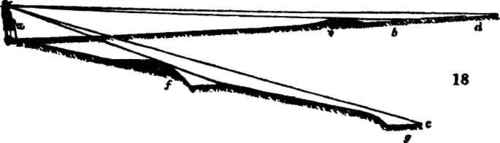
Thus in fig. 18., a spectator at a, 63 ft. from a walk at b, would see the gravel of that walk, unless the view of it were intercepted by a small flower-bed, or gentle rise in the turf, 18 in. high, such as c; whereas, by removing the walk to d, the mere distance would conceal it. This is supposing the general surface of the ground to be a perfect level; but if it were to slope from the house in the degree indicated by the line a e, then the walk would be concealed by a raised bed at f, at little more than half the distance from the eye; and by extreme distance at g.
47. Another means of concealing walks is by chains or continuous groups of low shrubs; but these, when not carefully introduced, are, in very small places, apt to injure the view, by interrupting the continuity of the surface of lawn, and by producing too many parts for so small a picture. These groups of shrubs may, however, be resorted to for purposes of concealment, at a great distance from the eye at the sides of a view, or at its farther extremity. In some cases walks may be concealed, or prevented from obtruding them-selves on the eye, by forming the more conspicuous parts of them of blocks of earth-coloured stone, which will not have so glaring an effect as bright-coloured gravel Walks laid with blocks of wood, or with grey bricks, have also a subdued tone of colour, and are not offensive to the eye; but of course they can only he adopted on a small scale, or in particular parts of a design, on account of the expense.
48. The walks about a place mag be increased and varied by occasionally crossing each other, either in grotto-like tunnels under ground, or by disguised bridges above the surface. This is a source not only of great variety in the character of the views, but a means of procuring views of a very striking description. In forming short tunnels in pleasure-grounds, the greatest care must be taken to hare them straight in direction, so that, on entering at one end, the light may he seen at that opposite; and never to construct them in a circuitous direction, because, in that case, they are necessarily dark, in consequence of the light not entering the tunnel directly. This kind of circuitous tunnel is also objectionable, because it might raise in some minds an idea of the tricks of grotto-work, which were thought so much of in the ornamental gardening of the seventeenth century, but which are now justly considered as puerile conceits. The kind of tunnel that we allude to as desirable in small gardens is, in point of use, nothing more than a bridge carried over a walk instead of over water; and with the architecture so disguised by vegetation as not to be obtrusive, or to interrupt the idea of the continuation of the walk.
It is almost needless to observe that perfect dryness, both in the walk and in the masonry, is essential to bridges or tunnels of this kind; and this can readily be obtained by covering the arch, after it is built, with a layer of clay. The effect of even one tunnel of this kind in a limited space, in adding to the length of walk, and in giving variety to the scenery, may be seen in the public terrace-garden at Gravesend. Open and covered seats are also sources of variety in the views of artificial scenery, both as foregrounds to look from, and as objects to look at In small places, however, they require to be introduced with the greatest caution, and never as conspicuous feature!; because more than one, for the sake of being able to read or work in the open air in fine weather, can seldom be requisite. In large places, on the other hand, seats in different situations are not only useful as affording resting-places, but as indicating particular points of view, which might otherwise pass unnoticed by a stranger.
49. Architectural ornaments, such at vases, statues, etc., water in different forms, pieces of rockwork, and other objects of the like kind, independently altogether of trees, shrubs, and plants, and of the view of objects beyond the boundary fence, form sources for varying the views from the walks of a small place. Statues, vases, and other architectural ornaments, ought to be very sparingly introduced at a distance from the house, in gardens in any style; but more especially in such as are laid out in the irregular or modern manner. Mixed up with groups of flowers and shrubs, they divide the attention between the beauties of art and the beauties of nature; and, as the mind can only attend to one sensation, and experience one emotion of pleasure, at a time, it becomes distracted among so many. The true situation for statues is on an architectural terrace, or in an architectural flower-garden adjoining the house, the conservatory, or some other architectural structure, where architecture and sculpture are the main features, and flowers and vegetation are altogether subordinate.
Continue to:


My Books

