


Moisture And Temperature In Plant Culture
Description
This section is from "The Horticulturist, And Journal Of Rural Art And Rural Taste", by P. Barry, A. J. Downing, J. Jay Smith, Peter B. Mead, F. W. Woodward, Henry T. Williams. Also available from Amazon: Horticulturist and Journal of Rural Art and Rural Taste.
Moisture And Temperature In Plant Culture
A healthy and vigorous growth of plants in green-houses is dependent so much upon a proper degree of temperature and atmospheric humidity, that he who would be a successful cultivator must be a close observer, and devote much time and attention to the subject to secure the proper conditions for success.
Plants may have a congenial soil, a proper amount of root moisture, and yet suffer from aridity, humidity, or a lack of proper temperature of the atmosphere in which they grow. The thermometer gives the actual temperature of the air; but all observing persons will acknowledge that we require some means of ascertaining the amount of. moisture or the sensible temperature due to evaporation. We enter a proper regulated green-house, with a temperature of 65°, and feel a greater degree of warmth than in our furnace-heated dwelling at 70°, for the reason that in the latter we have abundant moisture, while in the former not enough for comfort or health.
Scientific men have made hygrometry a careful study, and it is due to their efforts that we have the hygrometer. This instrument, as ordinarily constructed, requires a somewhat intricate calculation to arrive at the amount of moisture contained in the air at different temperatures; and elaborate tables were constructed, which obviated the difficulty to some extent.
A Mr. Edson has lately invented an instrument which he calls a hydrodeik, which is manufactured by N. M. Lowe, of 103 Court Street, Boston, which is so simple in its operation and indications as to be within the comprehension of almost every person.
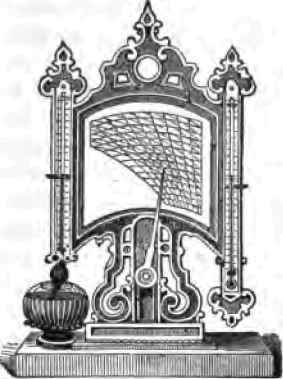
Fig. 97.
Our figure shows the general form of the instrument, which is not self-acting.
The pointers may be moved by means of the knob in front, as per following directions :
To find the actual temperature, read the right-hand or dry bulb thermometer.
To find the sensible temperature, or temperature due to evaporation, read the left-hand or wet bulb thermometer.
To find the relative humidity, take hold of the small knob in front of the instrument, and raise or lower it as the case may be until the upper edge of the right-hand adjusting pointer coincides with the surface of the mercury in the right-hand thermometer; then, by turning the knob to the right or left, bring the upper.edge of the left-hand adjusting pointer to the surface of the mercury in the left-hand thermometer. The instrument is now adjusted; and the relative humidity, dew-point, and absolute amount will be indicated by the dial and index hand. Thus observing upon which of the nearly vertical lines the end of the index hand rests, let the eyes follow this line to the top of the dial, and there will be found numbers which give the per cent, of humidity sought.
Observe upon the dial the diagonal line upon which the end of the index hand rests. Let the eye follow it down to the right of the dial, and there numbers indicate the dew-point sought.
Upon this line also are two sets of numbers, one of which gives, in grains and tenths, the weight of water (in form of vapor) in each cubic foot of air. The others give in inches of water the force of vapor.
The use of the hygrometer will show why stoves, now so generally in use, are injurious to health from the excessive dryness of the air which they produce in a room, causing moisture to evaporate too freely from the skin, with all the painful consequences to the general health of those who come under their influence. The use of stoves for heating green-houses has been long discarded, from the aridity of the atmosphere produced, as well as from the escape of noxious gases, the product of combustion of the fuel used. A difference of from six to eight degrees between the reading of the two thermometers, or about 60° of humidity, according to Ed-son's instrument, will be found to produce or to accompany a pleasant degree of moisture in a room. In the culture of plants in glass houses, some species will require more humidity than this.
We presume that most superior gardeners are well acquainted with the nature of the proper climates of their plants. At any rate such knowledge is necessary for their proper treatment, not only as to temperature, but also as to moisture. If this knowledge is not possessed by the gardener, his employer should be familiar with it; and then, provided with such instruments as the hydrodeik and a self-registering thermometer, he will be enabled to ascertain if the plants have been properly cared for in his absence. How often do our green-house plants become shriveled or weak before we have the least suspicion that there is any alteration in the moisture of the air ! Then, as soon as we become aware of the fact, we drench them with water without taking their actual requirements into consideration. On the other hand, if we fancy from our own sensations that the air of our green-house is dry, we, sprinkle water about without measure. Mr. Glashier, an English author on meteorology, observes, "that our sensations with regard to heat and humidity are very fallacious guides. Every one must have felt in summer the heat to be at times almost unsupportable, without any apparent reason, as shown by the reading of the thermometer.
This happens when the air is nearly calm and moist; the air is already so moist that it can not take off our own moisture as we give it off in perspiration, and so we say it is sultry; but only let the air get in motion, if only by means of the Indian punkah or huge fan swinging about, and then we feel cool and experience relief. Yet the same hygromet-ric condition exists. It is only a very small amount of vapor and heat that we force the air to take from us by the process. But should the air get. drier with the same temperature, then evaporation from the skin takes place with great activ-itv, and we feel a marked sensation of cold, and this result is as great a fallacy as the former. The fact is, that with the same temperature, and enjoying an equal state of health, we experience, according to our mere sensations, various changes of temperature, and so our senses can not guide us with regard to heat and humidity as far as our own health is concerned, and much less with respect to that of our plants. Therefore the hygrometer, properly used, and its indications attended to, may be made the means of preserving many valuable plants which might otherwise perish in an ill-regulated atmosphere.
In our gardens our tender plants are sometimes endangered by changes in the hy-grometric condition of the air. Abundant dews at this season are often connected with white-frost, which may prove disastrous to the plants. Now, if we consult the hygrometer in the evening, and find the two bulbs pretty much alike in their reading, while the sky is clear, even should there be no rain, there will certainly be a copious deposit of dew. After sunset, all bodies on the surface of the earth, after having been heated by the sun during the day, radiate or give off their heat into space, get cold, and soon reach the dew-point, when they become covered with moisture, provided there are no clouds or other objects to check the dispersion of heat or reflect it back to the earth. If the temperature be low, the dew becomes hoar-frost. All gardeners know that it may be produced without the thermometer falling to the freezing-point. The reason is, that dew evaporates so rapidly that it deprives itself of a considerable amount of heat, so as to congeal into minute needles the water remaining on the plant or other bodies.
"But the frosts of spring and autumn, which are so injurious, proceed generally, not from the congelation of moisture deposited from the atmosphere, but from the congelation of their own proper moisture, which forms part of their composition by the radiation of their temperature, caused by the nocturnal radiation which, in other cases, produces dew or hoar-frost. Now all this may be known beforehand by carefully noting the hygrometer, and then we can prevent or diminish the deposit of dew by covering our plants with a screen of some kind".
The Best Manure to mingle with the clay loam and sand in preparing soil for potting of roses, fuchsias, geraniums, etc., is clear, well-rotted cow dung If well and thoroughly decayed, one part to every three may be safely used.
Continue to:


My Books

