


The Peach In The North - How To Train It. Part 3
Description
This section is from "The Horticulturist, And Journal Of Rural Art And Rural Taste", by P. Barry, A. J. Downing, J. Jay Smith, Peter B. Mead, F. W. Woodward, Henry T. Williams. Also available from Amazon: Horticulturist and Journal of Rural Art and Rural Taste.
The Peach In The North - How To Train It. Part 3
Formerly a stock was in cultivation called the Brompton Plum, a variety of very thrifty growth, but on Which the peach was pre-disposed to disease, and on which it did not live long; this variety is now little used, and no English gardener that knows anything about peaches, would think of planting a tree if it were on this stock.
Let us now see in what way they are prepared for working. Small stocks are bedded out in good ground; here they stand two years; at the expiration of the second year, they are cut down to the ground level; the following, season they throw up fine clean shoots, three to four feet in hight, and by the end of this yearf they are taken up and planted out in the nursery lines for budding; every workman can perceive how much easier and better such young stuff" can be budded, than stocks that may have taken the same. or even a less amount of time, to grow, but had not been headed down. Standard peaches and nectarines are generally budded at a height of from five to six feet, on the stock* the latter is grown for the purpose in this way: strong stocks are lined out in the nursery, in the same way as when they are Intended for working dwarfs upon; here they are allowed to stand and grow two years; when they are cut even with the surface of the ground, they wilt throw up shoots from five to seven feet that summer; many will be fit to bud the same season, at a height of five or six feet, and the remainder the following summer, t have been thus particular in describing how this tree is raised in England, contrasted with the ease with which it may be cultivated here, I say ease, for the best culture which we can give it here, wilt be easy in comparison with its cultivation there.
See what care is there required in selecting stocks suited to the varieties; next, the preparation which these stocks undergo to have them healthy and thrifty to receive the buds; and as we proceed we shall find the alter treatment is equally assiduous; care, attention, and labor being as little spared. Here is the proper place to notice stocks, for this climate, and where this tree succeeds on its own roots there unquestionably is nothing better,if there is any thing as good; but in some of the northern states the plum stock may be useful; here, however, the stock must be of such a nature. that the peach will take and grow freely upon, and be likely to last; for the more delicate varieties of peaches, a stock of moderate growth should be used; time and experience alone can however determine which varieties will answer this purpose best, and which the varieties of peaches will grow upon.
I have extended these introductory remarks longer than I intended when I commenced, but I hope if I have made a digression it may be useful in its way. We shall now turn to the other part, and that which more immediately concerns us at present - the proper training of the tree. When the latter are purchased in the nursery, they should be young, clean and thrifty; one year old from the bud is best; if older, when beaded back they do not break free; they will have the appearance of No. 1. In the present day I should hope no person would think of planting these or any other valuable trees with out trenching, draining, and otherwise preparing the ground for their reception. Were I to enter into a description of the manner in which ground is made and prepared for the reception of these trees. in England, it would surprise many. However, I take for granted our ground is properly prepared, and our trees planted; the latter operation I think is best performed in autumn; except for a very cold northern latitude-, when perhaps early in spring is preferable; after planting, the heads may be lightened, but not cut fully back until spring; early in the latter season, say when the sap is about to move, let the plants be headed back to within three eyes of the place where it had been budded as shown in No. 2. As-soon as these three eyes break, and the shoots are of sufficient length, they must be secured carefully to the trellis- to which they are to be trained ; they should be constanly watched when growing, that the shoots may not be injured by insects- or other causes, as the loss of a branch would now be of vital importance to the future symmetry of the tree; all the lateral or summer shoots which these produce should be allowed to grow, and secured in the same way as the principal branches.
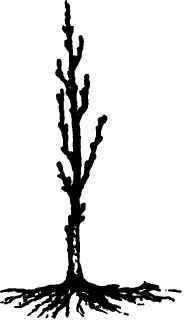
No. l - the tree as received from the nursery.
As during the season of growth there is a reciprocal action carried on between the roots and branches, the numbers of the former will be regulated by the proportions of the-fatter. The amount of healthy foliage which a tree possesses, is also of paramount importance, leaves being the functions of respiration and digestion; the numerous fibres of a free growing peach tree collect an immense quantity of crude matter, which is propelled into-the leaves; here it is digested and assimilated, and is prepared to become the wood of the tree Now, if we had not an amount of foliage equivalent to the amount of roots, how would matters stand? Something m this- way; the roots, as in the other case, would collect food, force it into the stem and branches, but not having a sufficiency of leaves to elaborate the sap, it remains in the pores of the tree, in a crude, indigested state; the following autumn arrives, and what shall we find ? A tree with, it may be, strong wood, but that so sappy and unripened, that ere spring arrives it will be a mass of gum and canker. Let us now see what appearance our trees will present that had an abundance of healthy foliage, and which well performed their altotted offices under the bright light and intense heat of our fine summers.
In the autumn we find the branches well ripened, ruddy in color, and as firm as a piece of oak; our young trees will bow have concentrated within them, health and strength, and will have the appearance of No. 3. Perhaps I should have remarked when the trees had been planted, they should be well mulched with long stable litter, which should be left oar through the summer, as it is of great benefit inkeeping the roots moist; should the weather prove dry in early spring, a few good soakings of liquid manure will benefit them. Early in the spring of the second year, our trees must again be headed down, as shown in No 4, to two eyes, and as our tree is-by this time pretty well established, it will break with considerable vigor -The previous year I called attention to the great necessity of vigilance and care being given to the tree at the time of the shoots breaking, and if anything, it will require more vigilance now; allow these soft young shoots to be now injured, and the symmetry of the tree is irretrievably lost; en the other hand, lay in and tie these shoots with care and in good time, and we shall accomplish mack towards the perfect shape of our future tree.
Continue to:


My Books

