


Pruning Roses
Description
This section is from "The Horticulturist, And Journal Of Rural Art And Rural Taste", by P. Barry, A. J. Downing, J. Jay Smith, Peter B. Mead, F. W. Woodward, Henry T. Williams. Also available from Amazon: Horticulturist and Journal of Rural Art and Rural Taste.
Pruning Roses
The introduction of a wood-cut of a closely-pruned Rose in last year's Almanac, induced some subscribers to ask for more information which it seemed to foreshadow; we therefore present the following general instructions. It is, however, hoped that the practical ideas will be of such assistance to the amateur, as to prevent the ail-but fatal operations generally performed under the above title; neither can an attempt be made to particularize the treatment necessary for the several families; their growth, to which our subject alone refers, will be readily comprehended by the terms luxuriant or short growing, and tender. Budded Roses when received from the Nursery are generally one year old, and during the first season the knife must be sparingly used; but after all chance of severe frost has disappeared (earlyin April,) the branches should be cut back to four or five eyes, having previously cut out all growth that interferes with the shape the sketches illustrate, being especially careful in performing the former operation, to cut to an outer bud.
The following illustration (fig. 1,) of a budded Hybrid Perpetual, when received from the Nursery, shows, by the marks, where the knife is to be used; and further to exemplify the great advantage of adhering to this principle, the next sketch (fig. 2,) shows the results, after the first pruning, where it has been attended to and where neglected; the single lines showing the former, and the dotted the latter.
During the following October, any shoots which started in the center of the head, or any cross branches, may be entirely removed; but the shortening the branches leave till April, as the bud to which the branch is cut may be destroyed by frost, Ac.; this would necessarily produce the very growth these directions, when attended to, will prevent.
With erect-growing varieties, as Mrs. Elliott (H. P.,) Madle. Armé, etc, the shape of the plants, when young, may be often much improved by ligatures, training the branches into a more outward direction.
In shortening the shoots of the majority of Hybrid Perpetuals, four or five eyes should be left; but when of luxuriant growth, as Louis Bonaparte, Ac, shorten the branches to about half their length, and with the more robust summer-blooming varieties, take off about one-third only, keeping the center of the head well-thinned; any thing like short pruning, with such subjects, being productive of abundant wood and scanty blossoms.
In the short-growing Hybrid Perpetuals and Bourbons two or three eyes are sufficient to be left; in the tender Tea-scented and Chinas, all weakly growth should be removed, and the shortening the branches must be performed with care; and, as in several varieties the eyes are recollecting the previous directions,) the amateur must use his own discretion and the other Austrian Briers too slightly, as not more than about an inch of the point of the shoots must be removed, as these varieties bloom only on wood of one year old.
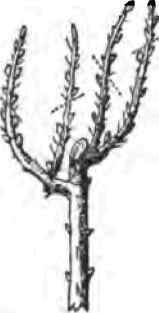
Fig. 1.
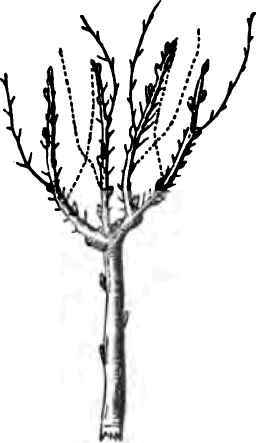
Fig. 2.
Before concluding, it may be remarked that summer-pruning is often desirable, and frequently saves much trouble, This may be effected to a great extent by cutting the blossoms for ornament, or when decaying; and several varieties, such as Hybrid Perpetuals William Jesse, Duchess of Sutherland, etc., will, by reducing a moiety of their branches to one half their length in July, be much more certain to give autumnal blossoms; besides which, much unseemly growth may be easily checked when in a young state; and it may be, in conclusion, remarked, that the form it is most essential budded Roses should assume is that of an expanded inverted umbrella, which insures the perfect ripening of the wood, and consequent certainty of bloom. Supposing these operations are to be performed on wood one year old, the pruning scissors and a knife are all the tools required; where older wood is to be removed, a double-toothed key-hole saw will be requisite, not neglecting to make clean cuts with the knife after wounds made by either of the other instruments. - Edward's National Almanac, England.
Pruning Roses #1
This operation will require to be performed during March, April, and the first two weeks of May, (but not later.) Commence with the more hardy varieties, such as the French, Moss, Provence, etc.; these, for the most part, have dormant-looking buds, and being less active than others, take a longer time for their development. Next begin with the hybrids, hybrid perpetual, hybrid Bourbon, and hybrid China; but as these are more excitable than the above, they should be pruned the latter end of March and beginning of April. The tender Noisettes, China, and tea-scented kinds should not be pruned till the latter end of April and beginning of May.
Before commencing to prune, it is necessary to observe the habit of the plant, whether it be a vigorous, or a moderate, or a dwarf variety; also, to determine, with those kinds suitable for exhibiting, whether they are required for that purpose, or merely for effect; if for the former, large blooms will be required, and less of them, and these can be obtained by close pruning; in the latter instance, longer pruning must be adopted, when a greater quantity of blooms will be obtained, but they will be inferior in quality, and less in size. Carefully thin out the heads of the plants, and take away the small crowded branches, and all gross, unripe shoots, leaving such only as are composed of firm and well-ripened wood, and leave these at regular and equal distances. Prune down according to the strength of the shoot and habit of the variety; in some cases, to two or three inches; in others, where the habit is vigorous, one foot, or even eighteen inches, will not be too long for a shoot to be left; but as this depends upon the habit of the variety and shoot to be pruned, no absolute general rule can be given in shortening the shoots.
Cut close to an eye, observing, when practicable, to leave well-swollen, plump buds, which will always produce the finest blooms; likewise secure those having an outward tendency, and pointing in a direction proper for the handsome formation of the plant. The French, Alba, and nearly all the Moss Roses, require rather close pruning; and if large blooms are required for exhibition, this particular must be strictly attended to. The hybrid Chinas and hybrid Bourbons are, with very few exceptions, very vigorous growers, and require more care in pruning than most other sorts. An acquaintance with the varieties is necessary to' enable the operator to prune successfully; for instance, we have Fulgens and Brennus, two vigorous growing varieties, which frequently product shoots five or six feet long in a season, either of which, if pruned as recommended for the French, or some other of like habits, would not produce a flower; whereas, with judicious pruning, every shoot would bo made to give large trusses of blooms. The varieties in these two classes must therefore be carefully studied, as there are some among them which require close pruning, and these may be known by their moderate style of growth, when compared with the ma- jority of the same classes.
Young plants, just received from the nursery, will require to be pruned down to two or three eyes, a little more or less, according to the habit of the variety. Unless this is attended to, large and handsome heads are rarely obtained.
[A thoroughly practical article, which will be acceptable to many of our readers. We suggest that you continue the subject, classify the Roses, and give a select list of kinds. It is very important to understand the habits of some kinds, otherwise the wood that produces the flowers is cut away: this we have often seen done. But we leave the subject in your hands, with the hope that you will follow it up. - Ed].
Continue to:


My Books

