


Mathews' Curculio Remedy - May Beetles And Rose Chafer - How To Get Mid Of Them
Description
This section is from "The Horticulturist, And Journal Of Rural Art And Rural Taste", by P. Barry, A. J. Downing, J. Jay Smith, Peter B. Mead, F. W. Woodward, Henry T. Williams. Also available from Amazon: Horticulturist and Journal of Rural Art and Rural Taste.
Mathews' Curculio Remedy - May Beetles And Rose Chafer - How To Get Mid Of Them
Mathews' Curculio Remedy
(P. B. W., Picton, C. W.) "What has become of Mathews' curculio remedy? Why don't the committee report?" Can't guess - probably because it is a secret remedy.
(Hyacinth Bulbs.) "Will Hyacinth and other Dutch bulbs run out in this country?" Not if they are treated to the same care the Dutch florists bestow on them. To prevent their deterioration - indeed, to see them at all in perfection, they require to be grown in the open air, in sandy alluvial soil, well enriched with well decayed manure - cow-dung being found most advantageous. Forcing, or growing them in rooms or windows, weakens them to such a degree as to render them almost worthless for a second season.
Mathilde De Dandevomn
A fine variety, producing large strong racemes of white flowers striped with deep violet purple.
Matthiolas, Stock Gilliflowers
Matthiolas, Stock Gilliflowers, or the old-fashioned wall-flowers, are fine winter-flowering plants for the parlor windows. Their heavily-clustered spikes of purest white, yellow, crimson, purple, or rose-colored double blossoms, make a grand display. Sow the seed in a sunny garden-bed in May, and in August pot the plants in good soil and keep in the shade a fortnight. At the end of that time give more sun, water freely, and allow liquid manure twice a week for two months, then once a week through the winter. Cut old stocks to the roots in May - sometimes good plants may be obtained of those cuttings rooted in moist sand, but it is surer to depend entirely on seed for new plants.
Maturity
Citron melon seeds were planted on the 3d of May; those of the Borneo, the 9th. They germinated within twelve hours of each other. The citron melons commenced to ripen freely about the 20th of August - 104 days from planting. Mr. Surra states, that his melons ripened in 112 days from planting, with his appliances of glass, brick squares, and milnet boxes. This allows an advantage to the open culture of six days.
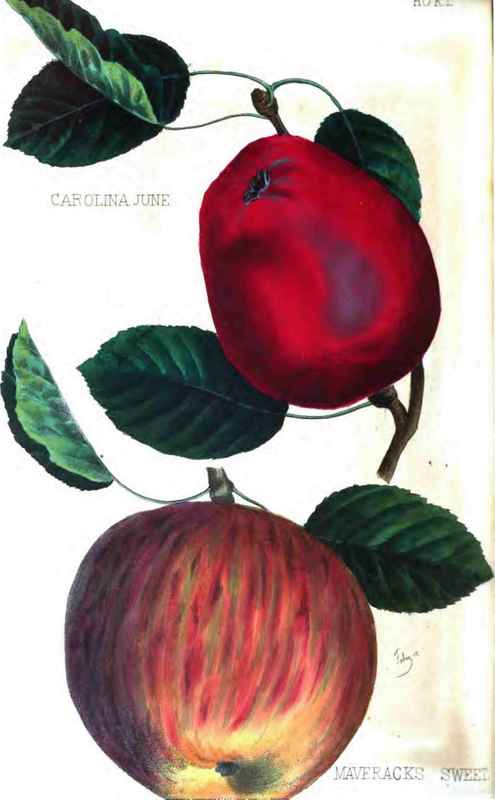
Maverack's Sweet, Or Maverick Sweet
This description we take from White's Gardening for the South: " Very large, roundish, irregular, sometimes slightly conical, striped with bright red. sprinkled with greenish flecks. Stem, short, in a rather large, regular cavity. Calyx, open. Basin, medium. Skin, rather thick. Flesh, fine grained, tender, of sweet, excellent flavor. Ripens, November and December." Mr. White is a pomologist to be depended on; he furnishes us, this month, with the ad interim Report of the Committee of the Pomological Society Of Georgia, to which we refer with great satisfaction.
The Maxatony Grape
We have heard this grape spoken very highly of, but have never seen it. Can any of our readers give us any reliable information in regard to it?
May Beetles And Rose Chafer - How To Get Mid Of Them
Prof. Cook, of the Michigan Agricultural College, says they can be shaken from the vines quite readily; and if no better way is discovered, collect them in sheets and scald them.
Dr. Le Baron, entomologist, recommends tobacco water and whale oil soap solution.
Continue to:


My Books

