


Strawberry Notes From Kentucky - Stuartia Pentagynia
Description
This section is from "The Horticulturist, And Journal Of Rural Art And Rural Taste", by P. Barry, A. J. Downing, J. Jay Smith, Peter B. Mead, F. W. Woodward, Henry T. Williams. Also available from Amazon: Horticulturist and Journal of Rural Art and Rural Taste.
Strawberry Notes From Kentucky - Stuartia Pentagynia
Strawberry Notes From Kentucky
Two years ago I ordered from B. K. Bliss & Sons, a few plants each of the following varieties of strawberries, for the purpose of testing in my soil and climate, and now give the result: Varieties, Black Defiance, Late Prolific, Champion and Kissena. These varieties have all fruited this season, though under very unfavorable circumstances, a drouth through the whole fruiting season.
Strawberry Plants
We are indebted to several valued correspondents lor new strawberry plants for experimental culture, of which reports will be made in due time. Mr. Saul, of Washington, Mr. Thorburn, of Newark, Mr. Mish, of Harrisburg, Mr. Hooker, of Roches-tor, will accept our thanks. The Hooker's Seedling notice, in small type, in our last number, should be referred to by those planting strawberries.
Strawberry Sir Harry
The French catalogue of plants and seeds of Bossin, of Paris, just received, says of the new strawberry Sir Marry: "This variety, which we place in our list for the first time, is, without doubt, the most beautiful and the best of all the known strawberries." It has not yet reached America that we are aware of, but doubtless will be here for the fall planting. Bossin's price is three francs each plant.
Street Shades
The recommendation of the English elm is good. The writer might have added that it is a very free grower; and any person who chooses to visit the grounds of Charles Downing will see trees of it, now only about twenty-five years old, that many have estimated at from sixty to one hundred years. As I notice you are to give us descriptions of other trees, I will not forestall you; but, nevertheless, I will mention the Linden as one that has clean broad foliage, is of rapid growth, and valuable as a country street shade. Some years since it was badly affected with worms, and its foliage denuded early in the season, so that its use was abandoned; but for many years past I have seen no indication of the pest, and again hope to see it planted freely.
Striking Ross Cuttings
I have succeeded well in striking cuttings of the rose this season by disobeying the usual routine, thus: The cuttings were placed in pots -as usually practiced, put out into the full blaze of a summer sun and watered six times every day. Cuttings similarly planted and placed in the shade failed almost entirely.
: Here is a fact for others to try. 0. J. W.
Strong Climbers For A Greenhouse
Habrothamnus elegans, Mandevilla suaveolens, Passiflora coerula, P. alata-coerulea, P. Colvillii, P. edulis, Tasconia pinnatistipula, T. mollissima, Lapageria rosea, Plumbago Capensis, Kennedya nigricans, K. Marryattse.
Stuartia Pentagynia
We saw a fine specimen of this beautiful shrub at the Messrs. Parsons', of Flushing, L. L, last season. It ought to be much more commonly grown than it is, blooming, as it does, at a season of the year when our shrubbery is quite destitute of flowers. The specimen at the Messrs. Parsons' is about ten feet high, and as many in diameter, forming a beautiful, compact, round-headed tree, or shrub. It is a native, is perfectly hardy, and will grow well in any ordinary good soil. It blooms in August; the flowers (of which our drawing, reduced in size, gives a good idea) are about two inches and a half in diameter, with a purple centre and crimped petals. We shall hope to see this fine shrub more common.
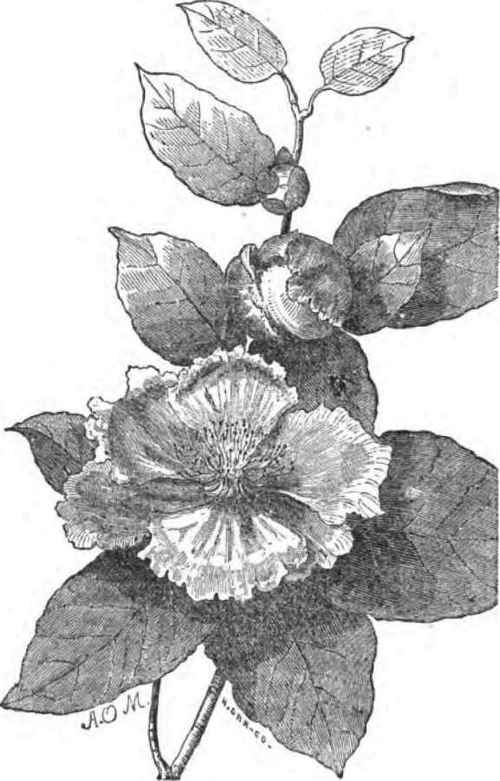
Stuartia Pentagynia.
Continue to:


My Books

