


Grafting The Cactus Tribe
Description
This section is from "The Horticulturist, And Journal Of Rural Art And Rural Taste", by P. Barry, A. J. Downing, J. Jay Smith, Peter B. Mead, F. W. Woodward, Henry T. Williams. Also available from Amazon: Horticulturist and Journal of Rural Art and Rural Taste.
Grafting The Cactus Tribe
The method employed in grafting Cacti is thus described, in the Gardeners' Chronicle, by Mr. John Green, one of the most skilful growers of ornamental plants: "I grow four stocks, Pereskia acule-ata, Cerens hexagonus, and Cerens speciosissi-mns; I prefer the latter, on account of its hardy, lasting, and robust habit. I grow the stocks freely till they attain the height that I want them. Some I grow with five or six stems, from one to five feet high; others I grow with one stem, from one to four feet; the short stems I ingraft at the top with the Epiphyllum speciosum and Ackermanni, the tall single stems with E. truncatum, and some from the surface of the pot to the top, all of which is of course according to individual fancy; E. trnncatum should always be engrafted high, without which, from its drooping habit, the greater part of the beauty of the bloom is last. The grafts that I find to succeed the best, are young growing shoots, about one and a half or two inches long. I pare off the outer skin or bark for about half an inch at the base of the graft, and cut what is intended to be inserted into the stock in the shape of a wedge; I then make an incision in the angles or top of the stock, with a pointed stick made the same shape as the scion.
When the grafts are first pot in, to pre-Tent their slipping out, I pass through each a small wooden peg or the spine of a thorn; I then cover each with a small piece of moss, and place them in a shady damp house, and syringe them over the tops occasionally in the evening; they will all adhere to the stocks in ten days or a fortnight, and make good plants by winter. By ingrafting the finest kinds of Cacti on the stocks that I recommend above, noble specimens can be grown in a few years from one to ten feet high if required; and the size and color of the blooms are much superior to what they ever produce when grown on their own roots. E. truncatum, by the above treatment, becomes quite a hardy greenhouse plant, and will bloom three months later than it does when grown in the stove on its own roots in the usual way".
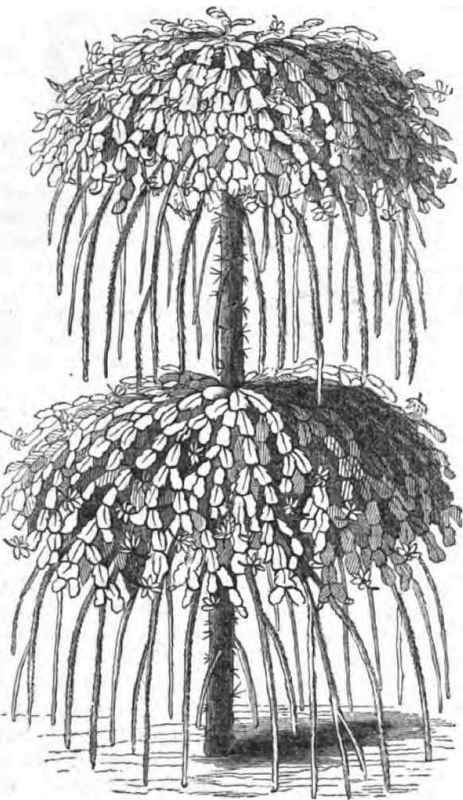
Mr. Henry Ford, another successful grower, gives the following detailed account of his practice: "Last year, having several plants of Pereskia aculeata, from eight to ten feet high, which had previously been grafted at the top with Cereus flagelliformis, I inserted at various heights upon the latter grafts of different kinds of Epiphyllum, such as Ackermanni and truncatum, with Cereus speciosus and C. triumphans. The beauty, in June last, of a plant of this kind, which had been grafted in the previous autumn, I cannot describe. In grafting them, I make, with the point of the knife, an incision upwards, into which I insert small grafts, pared a little on both sides, of the kinds required. A small piece of matting is bound round the wounded stem, to keep the grafts tight until they have taken hold, which generally is the case in three weeks' time; the bast is then untied. Where room is no object, I think it preferable to graft E. truncatum upon specimens by itself, as it flowers in the autumn, whereas the other kinds bloom in the spring and summer. The pendulous habit of Cereus flagelliformis allows of its being trained in any form, according to the fancy of the owner.
I have grafted Cacti at all seasons of the year, but I find that the best time is from the end of September until November; probably owing to the plants being in a more dormant state. I apply no fire to the house during this period, unless to dry up damp or exclude frost. One specimen of Pereskia aculeata, nine feet high, which was grafted two years ago with E. truncatum, the grafts being inserted three inches apart, along the whole height of the stem, and alternately on each side, has now the appearance of a pillar, and in about six weeks' time will be covered with many hundred flowers. It is advisable, in grafting these plants, to insert the scion upside down, especially if worked upon the main stem; in which case I remove a small piece of the bark from the stock, and fit a thin piece of the desired kind upon it. If this is bound up so as to prevent air from entering between the parts, it will take quite as well as if grafted in the usual way. Where this operation is performed upon spurs, the latter should be trained downwards previously to being grafted, otherwise the grafts, especially those with fleshy leaves, are apt to break off when they attain to any size.
I have also grafted E. truncatum upon a stock of Cactus Braziliensis, which makes an excellent standard, as from its robust habit it does not require any support. E. truncatum succeeds better if suspended, with a ball of earth about its roots, in a wire basket filled with moss, than when grown in a pot".
The brilliant effect produced by plants treated in this manner may be judged of from the accompanying sketch of a specimen growing in the garden of Mrs. Hus-kisson, of Eartham, where it had been made by Mr. Webster, her gardener.
Continue to:


My Books

