


The Probable Evolution of the Eucalypts. Part 3
Description
This section is from the book "A Research On The Eucalypts Especially In Regard To Their Essential Oils", by Richard T. Baker, Henry G. Smith. Also available from Amazon: A Research On The Eucalypts And Their Essential Oils.
The Probable Evolution of the Eucalypts. Part 3
In other parts of this work we show that this alteration in leaf venation and chemical constituents is not local in its incidence, and that the specific characters of each species are practically constant over the whole range of its distribution, and numerous instances are given of this constancy. It can thus be supposed that the formation of the several species of Eucalyptus has been one of evolution, and that the alteration in the chemical constituents of the oil has been contemporaneous with the changing of the leaf venation. It is thus assumed that the several species, as we know them to-day, have gradually deviated from a progenitor, and we have attempted to show through which channels this deviation has taken place. That the constituents of the oil have been fixed and constant for a long period of time must be evident by the fact that, to whatever extent or range any particular species has reached, it contains the same characteristic constituents, and has its botanical characters in agreement. This evidence is of the greatest importance when the length of time is considered which must necessarily have elapsed, before any one species could have established itself over such an extensive area as found to exist to-day. Some Eucalypts, however, appear to possess botanical and chemical characters which give them an affinity with one or two particular species only, whilst a few seem to have no pronounced connecting features, and, therefore, appear to stand quite alone; such species are thus not easy to place in a regular line of sequence, as though there were a complete gradation passing from one species to another. The intermediate forms, therefore, seem to be wanting in several instances, which may, perhaps, be largely accounted for by their extinction, or due to mutation.
The long period of quietude or comparative stability of terrestrial conditions in Australia probably accounts for the few indefinite varieties of Eucalypts that we have met with, and the environment also, having undergone little change, has produced a definiteness of species previously unsuspected in this Genus. This stability is illustrated in a most striking manner by the associations between the Tasmanian species and those of the mainland.
Such, then, are our views of the probable evolution of the Eucalypts, founded, as they are, on the broad basis of the natural classification previously enunciated.
Necessarily, our conclusions cannot always be expected to coincide with those who have classified on morphological grounds alone so wonderful a, Genus as the Eucalypts-trees that will in the future be more fully appreciated, and more highly prized in Australia than they are at the present day.
This Diagram Is The Result Of This Research, And Is An Attempt To Show The Probable Evolution Of The Eucalypts "As Evidenced By Their Botanical And Chemical Characters
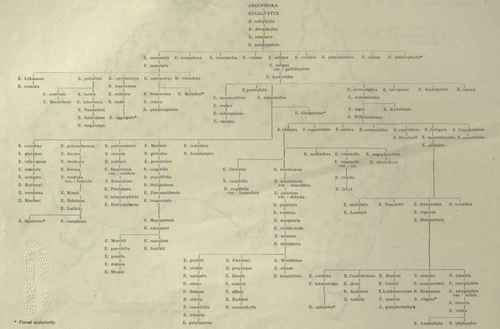
Plate I.
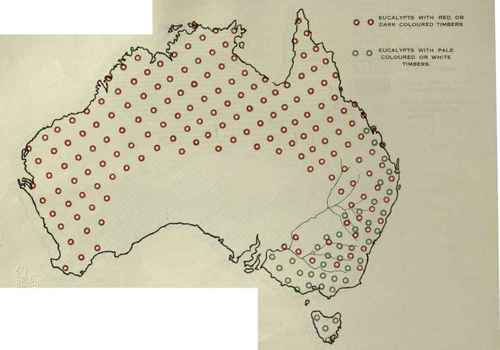
Map Showing The Distribution Of Red And Pale Coloured Eucalyptus Timbers
Plate II.
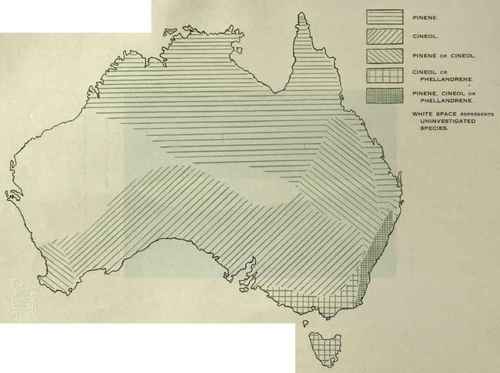
Map Showing Approximately The Geographical Limitation Of Eucalyptus Specles According To The Main Chemical Constituents In Their Oils
Plate III.
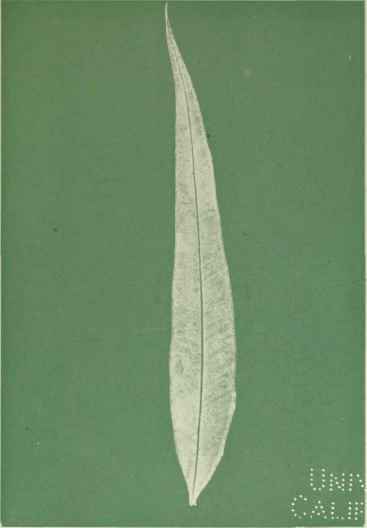
[M. F. Connelly, Photo.] [Natural Size].
Leaf Of Angophora Lanceolata. Cav
The venation indicates close affinity with those Eucalypts belonging to that end of the genus the leaves of which have a similar venation.
Plate IV.
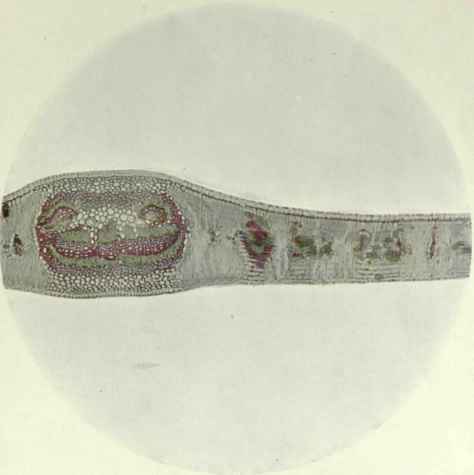
Transverse section through a leaf showing mid-rib (on the left) and portions of the leaf in proximity to it. Angophoras are comparatively free of oil glands and none was seen in the original section. The supporting tissue of the mid-rib is a conspicuous feature. The xvlem of the midrib or vascular bundle is surrounded by phloem, so that it is bicollateral in this case. Palisade tissue is developed towards the upper side only, thus showing a great resemblance in this respect to E. corymbosa, and adding more weight to the evolutionary hypothesis advanced in this work.
Angophora Lanceolata, Cav
Plate V.
Connelly, Photo
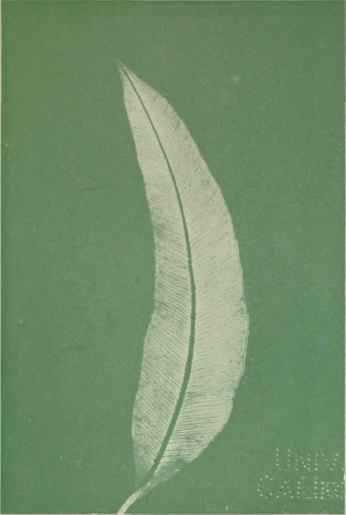
Leaf Of Eucalyptus Corymbosa. Sm
The arrangement of the lateral veins indicates the presence of pinene as a principal constituent in the oil, and the absence of phellandrene.
Plate VI.
M. F. Connelly, Photo [Natural Site].
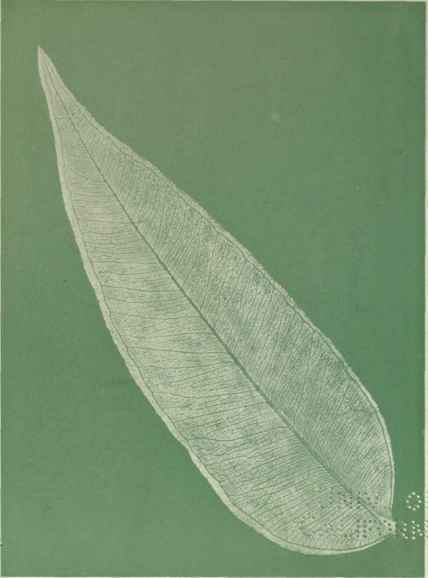
Leaf Of Eucalyptus Botryoides. Sm
The venation indicates the presence of pinene in the oil, and shows the commencement of the definition of certain lateral veins which feature becomes more characteristic in the venation of those leaves belonging to the cineol-pinene group, as E. globulus, etc.
Plate VII.
[M. F. Connelly, Photo.]
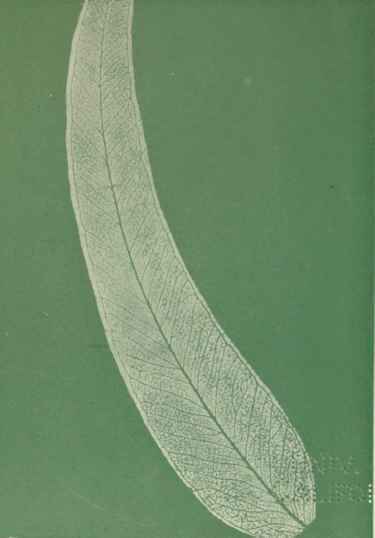
Natural Size.
Leaf Of Eucalyptus Globulus. Labill
The venation indicates that the oil contains cineol together with pinene, and that phellandrene is absent.
Plate VIII.

[M. F. Connelly, Photo.]
[Natural Size].
Leaf Of Eucalyptus Smithii. R.T.B
The venation indicates that the oil contains cineol together with pinene, and that phellandrene is absent.
Oils from Eucalyptus species having this leaf venation are extensively used for pharmaceutical purposes.
Plate IX.
[M. F. Connelly, Photo.]
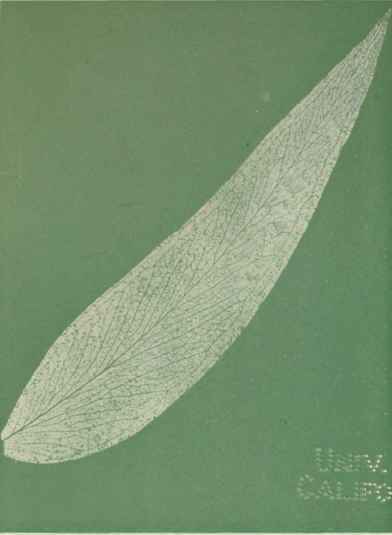
Leaf Of Eucalyptus Sieberiana. F.V.M
The venation indicates a predominance of phellandrene in the oil, together with the peppermint ketone.
Plate X.
[M. F. Connelly, Photo.]
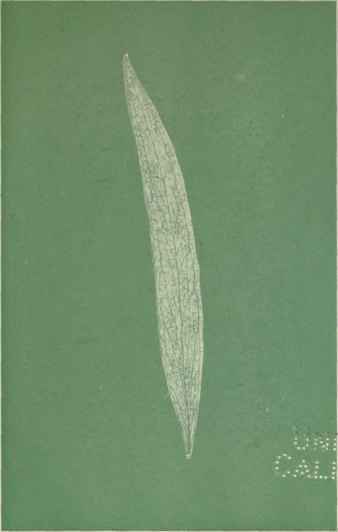
Leaf Of Eucalyptus Australiana. R.T B. A H G.S
The innumerable oil glands shown in this leaf account for the abundance of oil obtained from this species.
Plate XI
[M. F. Connelly, Photo.]
[Natural size]
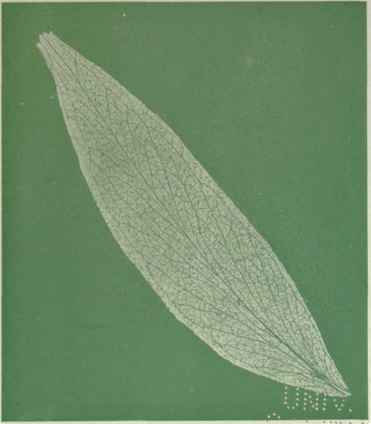
Leaf Of Eucalyptus Dives. Schau
The venation indicates the presence of phellandrene in the oil together with the peppermint ketone. Note the characteristic looping arrangement of the principal veins, the commencement of which feature is first seen in the bending of the marginal vein in the venation of the leaves belonging to the cineol-pinene group. Oils obtained from Eucalyptus species having this leaf venation are now extensively used for the separation of metallic sulpirides by a flotation process.
Continue to:


My Books

