


III. Treatment Of Scoliosis. Part 4
Description
This section is from the book "Massage And Medical Gymnastics", by Emil A. G. Kleen. Also available from Amazon: Massage and medical gymnastics.
III. Treatment Of Scoliosis. Part 4
Fig. 163 is an example of the use of the measurement diagram in connection with K2. The patient with a left lumbar curvature deeply inclined towards the pelvis rests on his left side with the curve against the cushion, c; the legs from the iliac crest rest on the reclining board, a. The patient is first placed with the iliac crest exactly over the edge of the board. This can be done with fair accuracy by palpation of the crest. It is, however, safer to estimate from the diagram the height of the crest above the footboard - in this case 101 cm. As the scale of the board begins from the edge, the patient is so placed that the soles of his feet when' his knees are stretched reach the number 101 on the scale, and this number is marked on the prescription. After that the position of the trunk-cushion is decided, and especially its distance from the iliac crest. In this case it is 10 cm. above the crest. When one refers to the scale of the apparatus for the height of the middle of the cushion one finds it must be placed on number 10 on the horizontal scale. The height by which the pressure is determined is empirical, and is tested when the patient is lying in position. The head-cushion is placed in a comfortable position for the patient, and its position need not be noted on the prescription. To influence the lowest part of the curve, denoted by i, the board is raised in the direction of the arrow. The prescription will read thus : -

Fig. 163.
K2. Left, 101; | Dist. 10 | ; Angle of inclination, 20°. |
Height, 8 (?) |
K3. Lying Rotatory Pressure (Fig. 164). - This apparatus aims at directly correcting the rotation of the thorax which often accompanies lateral curvature. The patient rests on a slanting board, suspended by the head and arm-pits, so that the spine is stretched. Two cushions (one behind, the other in front) are pressed against the prominence of the ribs. Lying at the two ends of the lengthened diagonal of the chest, they aim at compressing this diagonal, at the same time expanding the chest in the direction of the opposite shortened diagonal. The cushions are pressed against the patient's body by a lever, on which an easily modified pressure can be put by means of a weight at varying points. The cushions can of course be placed in either diagonal (the right behind and the left in front, or vice versa). They can moreover be placed at different distances from each other to fit various sizes of chest. The patient is placed in the apparatus so that the middle of the backward prominence of the ribs comes just over the back cushion. To make the patient rest comfortably there is a foot-board at the lower end of the reclining board, placed at a height according to scale, on which the patient's feet are supported; the higher the foot-board is placed the higher the patient lies and the lower is the pressure of the cushion on his back. The arm supports are pushed right up to the arm-pits, the head is fixed in Glisson's apparatus, and the pelvis fixed with a strap. The foot-board is then removed, and the patient hangs in the required position from his head and arms (see Fig. 164). The foot support scale has its zero point at the lowest edge of the board, where the distance upward to the middle of the back cushion is 135 cm. If the foot-board be moved higher, for example to No. 10, the above distance becomes diminished to 125 cm., etc.

Fig. 164.
The patient lies from five to ten or fifteen minutes in the apparatus, and should often take deep breaths so that the diameter of the chest on which there is no pressure may be duly expanded. Fig. 165 shows how the measurement diagram is used in prescribing the apparatus. The patient, as is shown by the two waved lines, has an upper prominence of the ribs corresponding to the right dorsal and a lower prominence corresponding to the left lumbar curve. If the apparatus is used for the dorsal curve, we must ascertain the height of the maximum deviation - in this case 114 cm. above the foot-board, corresponding to 116 cm. when the patient has his shoes on. The distance between the back cushion and the foot-board is therefore 116 cm., which is the case when the foot-board is placed at No. 19 of the scale (135 - 116 = 15)). The prescription will read thus: Back cushion right, foot-board 19. If the apparatus is used for the lumbar curve it is obvious that the corresponding prescription will read Back cushion left, foot-board 29.
K4. Chair with inclined Seat. - The patient sits on a board which can be inclined at different angles and supports the side of his trunk against an adjustable side support. The apparatus is used for lumbar curves. One hip rests higher than the other, and the lumbar curve is thus pressed over to the opposite side. The patient must sit with the hip on the convex side higher than the other. The patient may maintain this corrected position for half to one hour, and even more, with advantage. This apparatus is most suitable for the patient to use at home; more powerful methods are used in treatment by gymnastics.
K5. Sitting Side Pressure (Fig. 166). - This apparatus resembles two hands which grasp the trunk from behind, one on each side at different heights, and try, by pressure, to correct the curvatures of the spine. It is never used alone, but always in combination with an active arm movement (A2), the object of which is partly to prevent a too great downward pressure on the spine by the weight of the arms, and partly to aid the correction which arm movements actively try to produce.
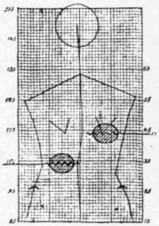
Fig. 165.
The two pressure pads can be placed at different heights over the patient's sitting plane, and are placed so that they rest at the height of the maximum convexities. By pressing down the handle of the angular levers the pressure pads are pressed against the patient's sides, and the handle is fixed at a sufficient pressure. The patient then performs the prescribed active arm movements.

Fig. 166.
Continue to:


My Books

