


Massage Techniques. Part 3
Description
This section is from the book "Massage And Medical Gymnastics", by Emil A. G. Kleen. Also available from Amazon: Massage and medical gymnastics.
Massage Techniques. Part 3
There are many different forms of massage according to the anatomical conditions. Generally massage is local and is applied only to a small part of the surface of the body, but it may also be applied to the greater part of the body, and is then called general.
The different forms of local massage are described later in their proper places; for practical reasons, and to make the study of the physiological and general therapeutic effects mentioned in the next chapter easier for the reader, we give here a short description of the technique of massage of the front of neck and of the abdomen as well as of general massage.
Massage, or rather effleurage, of front of neck* aims at hastening the circulation in the area of the blood vessels concerned, which are for this purpose favourably situated anatomically. With the palmar surface of each hand pressed against the corresponding side of the patient's neck, and with both hands together, the masseur passes his hands several times from above down with rather firm pressure over the jugular veins in as much of their course as possible, at the same time avoiding pressure on the hyoid bone or larynx (see Fig. 23).
* Massage of front of neck has been used in Sweden at least since the time of Ling, who mentioned it and understood its chief effects. In our days Gerst, Weiss, and others have laid stress on its therapeutic value in various inflammatory processes and hyperaemic conditions of the head (see later).
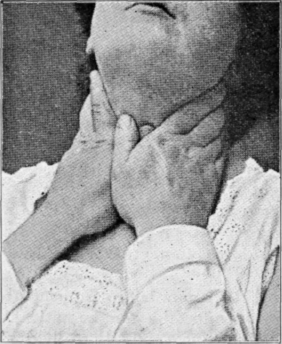
Fig. 23.
Fig. 24 shows the method of giving effleurage of front of neck used by Hoffinger and others, standing behind the patient, which seems to me more comfortable and better than standing in front. The illustration is not quite satisfactory, as it gives the impression that the strongest pressure is given near the mid-line.
In case of necessity Gerst allows the patient himself to massage the front of the neck, using first one hand and then the other, with the thumb on the corresponding side of the neck passing down over the common jugular vein; the other fingers work over the veins of the other side of the neck.
Weiss employs the following method chiefly for children : in the recumbent position the child's head is fixed by the nurse; the stroking is performed solely with the thumbs while the other fingers encircle the neck.
Effleurage of front of neck is performed with constantly repeated strokings for about ten minutes at a sitting; the number of sittings advisable in acute cases may be as many as five to six a day.
In such cases a lubricant is useful. Massage of front of neck is preferably given by a doctor, but may be entrusted to others, as Gerst has shown.
Abdominal massage or "abdominal kneading" aims at manipulating the alimentary canal through the abdominal walls, and is generally given (see later) for chronic constipation. The masseur, holding his fingers hyperextended, places the palmar surface of the three apposed middle fingers over the part which is for the moment to be massaged, with moderate force presses in the abdominal wall, and, by means of small circular manipulations with steady pressure, kneads or rubs the corresponding part of the alimentary canal, between the anterior and posterior abdominal walls (see Figs. 25, 26). The patient's skin moves with the masseur's fingers and a lubricant is unnecessary. During this manipulation the masseur keeps] his hand fixed in slight dorsal flexion at the (upper and lower) wrist joint, and in the sitting position the movement is divided between the elbow, shoulder, and hip joints. One hand is used at a time, the right and left moving alternately.

Fig. 24.

Fig. 25.
In massage of the stomach this manipulation is applied over the gastric and left hypochondriac regions, but reaches only a small part of the organ if it is approximately normal in size. If the stomach is dilated it is to that extent more within reach of massage. By performing the above manipulation more staccato (more after the manner of tapotement, although the fingers do not leave the abdominal wall), for example, over an atonic or dilated stomach, one can give a stronger mechanical stimulus than by means of the smoother pressure to the non-striated muscle and so produce contraction. Among Zander's apparatus there is a vibrating pellet which vibrates from side to side; by leaning against this with the part of the abdomen required the patient receives a forcible shaking over the stomach and bowels.
In manipulating the large intestine one begins over the caecum, then going over the ascending, transverse, and descending colon and sigmoid flexure down to the symphysis pubis, paying careful attention to every 1/4 cm. of bowel, except those parts (the hepatic and splenic flexures) which for anatomical reasons cannot be reached. The small intestine is got at by similar manipulations over the umbilical and lumbar regions. In very severe cases of chronic constipation one should insist on treatment twice a day. The effect of the treatment depends essentially on the manipulation being performed long enough on each part of the bowel before the fingers are moved on to the next; the whole seance should occupy at least fifteen minutes.

Fig. 26.
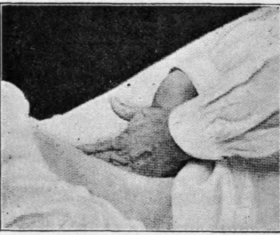
Fig. 27.
To empty the contents of the large intestine into the rectum one can afterwards with one hand - or better and more strongly with one hand applied over the other to strengthen it, only one hand coming in contact with the patient's skin - perform stroking over the large bowel, especially over the transverse and descending colon and sigmoid flexure. One can also attain this object by placing the hands one over the other (see Figs. 27 and 28), and constantly moving first the under, then the upper hand a little at a time and without for a moment relaxing the pressure on the bowel. In this one does not press directly downwards all the time, rather upwards, but the whole procedure, which ends over the symphysis pubis, is extremely effective in emptying the contents of the large intestine into the rectum.
In ordinary cases there is no great necessity for the doctor to perform the abdominal kneading, and no danger in leaving it after some instruction to non-medical workers, although it then seldom gives such good or rapid results even when performed in the simple and effective manner above described. It is noteworthy and interesting that, in spite of the extreme simplicity of abdominal kneading and the eagerness of my pupils to learn it, I have great difficulty in getting them to do it properly; and I understand more readily since I have begun to teach these subjects how it happens that so few masseurs can perform the "miracles" so easily obtained in severe cases of chronic constipation. I will refer again to this subject at the end of the next chapter and in the chapter on Diseases of the Alimentary Canal and Abdomen.
The above-described simple technique is that which for nearly a quarter of a century I have found most effective while experimenting with different manipulations on a large number of patients with chronic constipation, and I think from my experience I am giving the reader good advice when I beg him not to waste time on other less effective or quite ineffective manipulations by whatever masseur they are recommended. Many classes of manipulations, so warmly recommended in some quarters, with circular strokings round the umbilicus, with pressures over the coeliac plexus (half-way between the ensiform process and the umbilicus), and over the splanchnic plexus (half-way between the umbilicus and the symphysis pubis), with sacral beating, etc., are empty "ornaments," or at least of very doubtful and certainly subordinate value, and one only wastes time over them. Strokings over the colon, strongly performed with one hand, or with one hand over the other, are certainly capable for the moment of sending the contents of the bowel into the rectum, and thus promote, also for the moment, a more immediate action. But this is not the chief aim of the treatment (see next chapter), and the same result is obtained by the manipulations already recommended, which in all their simplicity, when conscientiously performed, gain their end with certainty, although, in severe cases of chronic constipation, often not till after several months' treatment.
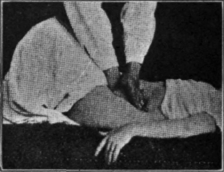
Fig. 28.
Continue to:


My Books

