


Physiological And Therapeutic Effects Of Gymnastics. Part 5
Description
This section is from the book "Massage And Medical Gymnastics", by Emil A. G. Kleen. Also available from Amazon: Massage and medical gymnastics.
Physiological And Therapeutic Effects Of Gymnastics. Part 5
The strength of the muscular contraction diminishes markedly to the extent the muscle tires. Muscular fatigue is recognised by weaker contractions, and at the maximum degree of fatigue voluntary impulses cease to be able to produce any contraction whatever (see pp. 45 and 85, and further on re Strain).
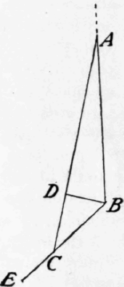
Fig. 29.
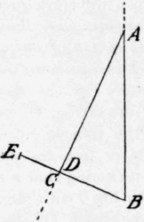
Fig. 30.
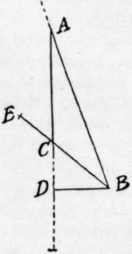
Fig. 31.
The actual length of the lever arm is of great importance in turning the strength of our movements fully to account. This length is represented by the line drawn from the fulcrum of the joint (round which the movement takes place) perpendicular to the axis of the muscle, i.e., to the line representing its direction.
We must clearly distinguish between the true or actual physiological lever, which changes its length during the different stages of the movement, and the constant anatomical lever which is made up of that portion of the bone in question between the fulcrum or axis of rotation within the joint and the insertion of the muscle on the same bone.
The true lever varies in length during the different stages of the same movement, and changes in different ways in different joints. In "neck-raising" or bending of the neck backwards, for example, the true lever is least at the beginning of the movement and greatest at its close. In flexion of the elbow joint (from full extension) the true lever is least at the beginning of the movement, reaches its maximum when the movement has gone almost to a right angle and thence to a rather wide acute angle, in which the flexors meet the bones of the forearm perpendicularly, and it diminishes again afterwards.
Figs. 29, 30, and 31 show changes in the length of the physiological lever BD, while the anatomical lever BC of the bone BE is bent by the muscle AC towards the fixed bone AB. BD is greatest in Fig. 30 where it is equal to and coincides with BC, but smaller than BC in both Fig. 29 and Fig. 31.
The movement of a force about a point is measured by the product of the force and the length of the true lever; it constitutes an important point in deciding the strength of the movement.
In order to examine critically the moment of a rotary force (Ma) I make use of Fig. 32. AB is the fixed bone and BX the bone moving round its axis in the joint B, part of which, BC, is the anatomical lever for the muscle AC, whose physiological or true lever is represented by the straight line BD drawn from the fulcrum in joint B perpendicular to the line of action of the muscle AC. The force acting at C in the direction CA is represented by the portion CL of the line CA. The parallelogram, which in this case is rectangular, is drawn upon CL. The two components are CJ and CH. One of these, CJ, presses upon the joint B, but does not produce any movement; the other, CH, works with all its force upon the anatomical lever BC, causing rotation in B (in the direction of the tangent, with B as centre and BC as radius).
1 may now either give the moment of the rotatory force (Ma) as the product of the anatomical lever BC and the force CH working perpendicularly to it, which force I may call K'.
Ma = BC . K'; or I may give Ma as the product of the whole muscle force CL, which I call K and the true lever BD :
M = BD . K.
That both products are the same is obvious : for K' = JL. The triangles Bcd and Lcj are similar, because the angle Dcb (a) is common to both and the angles Bdc and Ljc are right angles, and the other angles Clj and Dbc are therefore equal. We may therefore make up the equations BC : BD = LC : L.7 = K : K', and therefore BC . K' = BD . K.
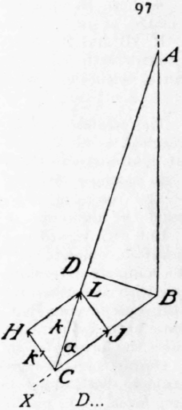
Fig. 32.
For our examination the following equation is most suitable :
Mα = BC . K'.
Into this we may introduce K' = K . sin α, and we get Mα = BC . K sin α.
As both BC and K are constant, the changes of Mα depend upon changes of sin α.
If AB and BC were in a straight line with one another, AC would coincide with this line, sin α would = 0, and therefore also Mα = 0. Sin α reaches its highest value, which is 1, when α = 90°.
M90 = BC . K
The greatest moment of rotation, e.g., in flexion of the forearm, is reached, as we see from the above, when the bones of the forearm stand at right angles to the flexors.
In stronger flexion a increases and Mα diminishes. If a became = 180°, or in other words if AC coincided with AB, we should again reach the minimum, and the moment of rotation would become = 0.
But with regard to movements in joints, flexion, as we all know, is never so complete but that the muscle retains a considerable leverage. In complete extension, when the upper and forearm are in a straight line with each other, the muscles (the axis of which we here call AC) have still some leverage left, because they change their direction as they lie close to the cylindrical joint surface of the humerus, and in full extension meet the forearm at an angle, although a very acute angle.
During the last degree of flexion the power of the muscles diminishes strongly, both on account of Schwann's law and of the shortening of the true lever.
It is obvious that many pathological changes in both the osseous and soft parts of the joints influence the strength of our movements to a considerable extent (see Diseases of Joints).
The momenta referred to above cannot by themselves give us an adequate understanding of the force with which movements in the different joints take place. Even normally the differently constructed joint surfaces, the different canals for the tendons, and the different amount of resistance to the movements offered by the joint capsules in different positions play some part (A. Kick). Herz has made diagrams for each separate joint showing how the force changes in different positions. By diagrams one can estimate the strength of each muscle group and, by taking the powerful quadriceps femoris as 100, obtain the relative value of the specific energy of every group. These diagrams, which are of value chiefly for constructors of gymnastic machines, show that if certain movements have their greatest strength during their first part, there are others which are weakest at the beginning, and that the force may either first increase and then diminish, or it may do the opposite. »
Continue to:


My Books

