


Artificial feeding. Part 10
Description
This section is from the book "Hygiene Of The Nursery", by Louis Starr. Also available from Amazon: Hygiene of the nursery.
Artificial feeding. Part 10
The tips or nipples, of which there should also be several, must be composed of soft, flexible India-rubber, and a conical shape is to be preferred, as being more readily everted and cleaned; the opening at the point must be free, but not large enough to permit the milk to flow in a stream without suction. At the end of each feeding the nipple must be removed at once from the bottle, cleansed externally by rubbing with a stiff brush wet with warm water and borax, everted and treated in the same way, and then placed in a covered jar containing boric acid solution, freshly made each day, and allowed to stand in a cool place until again wanted. When the bottles are being sterilized, the tips should be placed in boiling water for five minutes, and just before one is used it should be dipped in hot water. Sometimes it is important to separately prepare each feeding just before it is given, but, as a rule, it is quite safe, more accurate and much less trouble-some to make the whole day's supply of food as soon as possible after the milk has been served in the morning. In making the mixture the required quantity of boiled water is measured in a glass graduate and poured into a large clean vessel, the milk sugar is then added and dissolved, then the cream and milk, all carefully measured, and the whole thoroughly mingled by stirring. Next the prescribed quantity for each meal is poured into separate bottles, and these being carefully stopped with cotton, are placed in the nursery refrigerator until wanted. When feeding time arrives a bottle is taken from the ice and the food heated to a temperature of about 98°F. This is done by steeping the bottle in hot water, or by placing it in a water-bath over an alcohol lamp or gas jet. Finally, re-14 move the cotton stopper, apply the tip, and the meal is ready. To determine that the food is of the right temperature for the infant to take, one must use a thermometer, or shake a few drops from the bottle upon the inner side of the wrist where it should feel only warm; under no circumstances should it be tested by inserting the tip into the nurse's or mother's mouth.
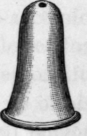
Fig. 20. Bottle Tip.
The separate preparation of each feeding is to be recommended during the first week of life; in cases that are difficult to feed; when whey mixtures are used, and when peptogenic milk powder is employed and it is desirable to continue the digestive action of the pancreatin while the food is passing through the gastro-intestinal canal. In following this plan, some minutes before each feeding hour, so as to avoid hurry, measure the different fluid ingredients of the food in the graduated bottle or glass, add the requisite quantity of milk sugar, mix thoroughly by shaking or by stirring with a spoon, and heat as before.
When feeding, the child must occupy a half-reclining position in the nurse's lap. The bottle should be held by the nurse, at first horizontally, but gradually more and more tilted up as it is emptied, the object being to keep the neck always full and prevent the drawing in and swallowing of air. Ample time, say five, ten or twenty minutes, according to the quantity of food, should be allowed for the meal. It is best to withdraw the bottle occasionally for a brief rest, and after the meal is over, sucking from the empty bottle must not be allowed even for a moment.
e. For children residing in cities, an honest dairyman must be found who will serve sound milk and cream from country cows once every day in winter, and twice during the day in the heat of summer. The farm should be so situated that the consumer may be served not later than twelve hours after milking. The milk of ordinary stock is more suitable than that from Alderney, Durham, or fancy-bred cows, as in these the fat percentage is either too low or too high, varying from 2.88 to 5.21 per cent. The mixed milk of a good herd is to be preferred to that from a single animal. It is less likely to be affected by peculiarities of feeding, and less liable to variation from alterations in health or different stages of lactation.
The care of the herd and of the milk is of great consequence. The cows should be subjected to the tuberculin test, their condition of health should be guaranteed by careful and regular inspection by a competent veterinarian, and the milk of any animal failing to pass should not be mixed with that from healthy animals. The cows must not be fed upon swill or the refuse of breweries, glucose factories, or any other fermented food. They must not be allowed to drink stagnant water, and must not be heated or worried before being milked. The pasture must be free from noxious weeds, and the barn and yard and the animals themselves must be neat. The udder should be washed before the milking, and the milkers and dairy workers should be healthy and their hands and clothing should be kept clean. At the same time careful aseptic precautions must be observed with cans, pails, and every implement with which the milk comes in contact.
The milk must be at once thoroughly cooled. This is best accomplished by placing the can in a tank of cold spring-water, or in ice-water, the water being of the same depth as the milk in the can. It is well to keep the water in the tank flowing; indeed, this is necessary unless ice-water be used. The can should remain uncovered during the cooling and the milk should be gently stirred. The temperature should be reduced to 45° F. within an hour, and the can must remain in the cold water keeping the milk at 50°F. until the time for delivering.
In summer, when ready for delivery, the top should be placed in position and a cloth wet in cold water spread over the can, or refrigerator cans may be used. At no season should the milk be frozen, and, on the other hand, no buyer should receive milk having a temperature over 65°F.
The plan of "bottling" cow's milk and serving n glass jars having air-tight tops is very much better, and has been adopted almost uniformly, now that the importance of securing a pure milk supply for infants has been recognized and insisted upon. The milk so delivered should be kept at a temperature of 50°F. by placing the jars in a refrigerator until the time comes to make up the daily food mixture. When the milk and cream are not served in sealed glass jars, it is well to provide two sets of small cans, one set to be thoroughly cleansed and sterilized by boiling water while the other is taken away by the milkman to bring back the next supply. When this arrives in the morning, or in the morning and evening in hot weather, the milk should be strained through a thick layer of absorbent cotton, or cheese cloth, into separate and absolutely clean earthenware or glass vessels with secure tops, and these put at once into a refrigerator reserved exclusively for them. This may stand in some convenient spot near the nursery, but not in it, and especially not in an adjoining bath-room. With a good refrigerator there is no difficulty in keeping milk at about 50°F. and perfectly sweet for twenty-four hours in winter and for twelve hours in summer, except on intensely hot days; then it may be necessary to Pasteurize the whole of the supply when received, in order to prevent change.
Continue to:


My Books

