


Artificial feeding. Part 11
Description
This section is from the book "Hygiene Of The Nursery", by Louis Starr. Also available from Amazon: Hygiene of the nursery.
Artificial feeding. Part 11
As milk exists in the healthy cow's udder it is aseptic, but during milking and subsequent handling and transportation it often becomes contaminated by various foreign materials, both organic and inorganic, which either are apt to set up some injurious change in the fluid before ingestion, or give rise to various disturbances after entering the alimentary canal. Again, if the cows themselves be unhealthy, their milk may carry disease germs. The germs most frequently present are the bacteria potent in the production of diarrhceal disorders; the bacillus tuberculosis; and the germs of cholera, diphtheria, scarlet and typhoid fevers, all of which are readily taken up by and flourish in milk at ordinary temperatures. To deprive these accidentally introduced organic impurities of their activity the milk must be subjected to sterilization. It must be insisted here that this process is a preventive, and in no sense a therapeutic measure; that it is not to be recommended when one can be sure of the purity of the milk supplied and of the conditions for its preservation; and that milk so treated must be modified according to the age and demands of the individual case in the usual way. Sterilization may be conducted either at a high or low temperature.
Sterilization at a High Temperature (212°F). - Several admirable implements have been devised for conducting the process; one of the most simple, made after a design by the author, is shown in Fig. 21.
This apparatus is made of tin, and consists of an oblong case provided with a well-fitting cover, and having a movable perforated false bottom (d), which stands a short distance above the true one and has attached a framework capable of holding ten six-ounce nursing bottles. On the outside of the case is a row of supports (b) for holding bottles inverted while drying, and at the proper distance below these a gradually inclining gutter (c) for carrying off the drip. A movable water-bath (a) is hung to the side; in this each bottle of food may be heated at the time of administration.
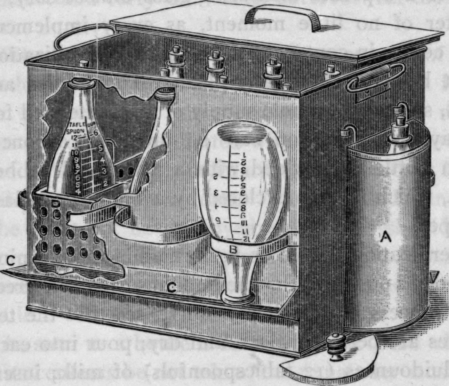
Fig. 21. - Author's Sterilizer.
The bottles are made of flint glass and are graduated; the graduated markings being especially convenient for measurement and rendering the use of a separate measuring-glass unnecessary, a matter of no little moment, as every implement that comes in contact with the milk in sterilization must be kept chemically clean. Ten bottles are used, so that the whole supply of milk intended for a day's consumption can be prepared at once. Each bottle is provided with a perforated rubber cork, which in turn is closed by a well-fitting glass stopper.
Sterilization should be performed in the morning as soon as possible after the milk has been delivered. The process is as follows: First, see that the ten bottles are perfectly clean and dry; pour into each six fluidounces (12 tablespoonfuls) of milk; insert the perforated rubber corks, without the glass stoppers, however; remove the false bottom and place the bottles in the frame; pour into the case enough water to fill it to the height of about two inches; replace the false bottom carrying the bottles; adjust lid, and put the whole on the kitchen range. Allow the water to boil, and, by occasionally removing the lid, ascertain that the expansion that immediately precedes boiling has taken place in the milk; then press the glass stoppers into the perforated corks, and thus hermetically close each bottle. After this, keep the apparatus on the fire and the water boiling for twenty minutes. Finally, remove the false bottom with the bottles; pour out the water, replace, and carry the whole, covered with the lid, to the nursery.
When the hour of feeding arrives, put one of the bottles into the attached water-bath and heat it to the proper point for administration. The milk must, of course, be diluted with filtered water, and receive the additions ordinarily made to adapt it to children of different ages. The tip used - and a tube must not be employed even here - should be thoroughly cleaned, and immersed for a few moments in boiling water before it is attached to the bottle.
As soon as a bottle is emptied - and if the whole of its contents be not taken, the remainder must be thrown away - it is washed in the ordinary manner with a solution of bicarbonate of sodium (one tea-spoonful to a pint of water) and placed in the rack (b) to drain and dry.
Milk sterilized by the above process will remain sound for several days - according to some authorities, as many as eighteen - when the heating is continued for thirty minutes, and still longer if protracted for an hour and a half. It is especially useful in traveling, when fresh milk cannot be obtained; for use in cities during the heat of summer, when milk is most apt to undergo injurious changes; for a temporary change of food for delicate children, or for those suffering from diseases of the stomach or intestinal canal. But the experiments of Leeds show that sterilization at the boiling-point of water causes the following modifications: Casein is rendered less coagulable by rennet, and is acted on slowly and imperfectly by pepsin and pancreatin; proteid matters attach themselves to fat globules, and probably bring about a less perfect assimilation of fat; while milk sugar, by prolonged heating, is completely destroyed. Koplik states that "from the temperature of 167°F. upwards, there is a separation of the serum-albumin of the milk; the casein loses its coagulability to rennet, and at 185°F. amounts of rennet which for the raw condition of the milk are found sufficient to act, cease to be effective." On account of these alterations milk sterilized at a high temperature is difficult to digest, and many infants do not thrive upon it, become constipated, are badly nourished and anaemic, and often develop scurvy; hence the process should never be resorted to except as a temporary expedient.
Continue to:


My Books

