


Artificial feeding. Part 12
Description
This section is from the book "Hygiene Of The Nursery", by Louis Starr. Also available from Amazon: Hygiene of the nursery.
Artificial feeding. Part 12
The problem, therefore, that presents itself in the sterilization of milk for infants' food is to devise a method which shall efficiently destroy the contained germs, and yet in the least possible degree interfere with its ready digestion and its nutritive qualities. This is best accomplished by:
Sterilization at a low temperature, or Pasteuriza-tion. - Hueppe considers that from a physiological standpoint milk is best sterilized under a temperature of 167°F., while other experimenters have shown that temperatures lower than 212°F., if continued for a short time, will destroy a very large proportion of the germs, and will destroy with certainty many pathogenic germs which find their way into milk either from the cow or as external contaminations. The elaborate experiments of Yersin, Granchier, Lidoux-Libard, and Bitter show that the bacillus tuberculosis in milk will be destroyed in ten minutes by an exposure to 167°F., in fifteen minutes to 158°F., and in thirty minutes to 154.5°F. Concerning other bacteria, Van Geuns found that a few seconds' exposure to 140°F. would kill the cholera spirilla, the typhoid bacillus, and the pneumococcus.
It may, therefore, be concluded that a temperature of 155 to 160°F. maintained for thirty minutes will render milk sufficiently germ-free for infant food. It is also certain that a temperature of less than 176°F. produces no alterations in the composition of milk that affect its digestibility.
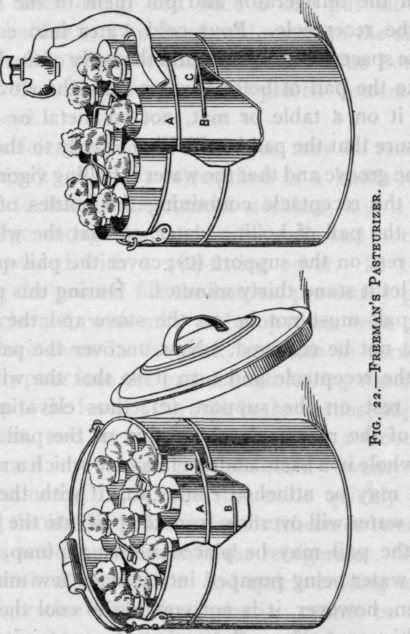
Methods of Pasteurizing milk in bulk have been brought forward both in Germany and in this country, and now the procedure has been reduced to an easily managed system for household use. This depends upon the fact that the temperature of the milk to be treated may be raised to about the desired point (155°-160° F.) by immersing a certain definite quantity of milk in a properly porportioned bulk of boiling water, the source of heat having been removed. A convenient apparatus for nursery use is Dr. Freeman's Pasteurizer (Fig. 22).
The apparatus consists of a pail for water and a receptacle for the bottles of milk. The pail is a simple affair with a cover. Extending around it is a groove for indicating the level to which it is to be filled with water; inside are three supports (c) for holding the receptacle. The receptacle for the bottles consists of a number of hollow cylinders fastened together and surrounded by a wire (a), which rests on the support (c) when the milk is being heated. Below the wire (a) are three short wires (b); these rest on the supports (c) when the receptacle is raised for cooling. The steps of the process are as follows:
Fill the pail to the level of the groove with water, cover it, and put it on the stove to boil, the receptacle for the bottles having been left out. Fill the body of each bottle with milk or some modification of milk in proper proportion for feeding; stopper with a wad of cotton-batting and put in a refrigerator. If all the bottles which the receptacle holds are not needed, fill the remaining cylinders with cold water. When the water in the pail on the stove boils thoroughly, take the bottles of milk from the refrigerator and put them in the spaces in the receptacle. Pour cold water into each of these spaces so as to surround the body of the bottle. Take the pail of boiling water from the stove and put it on a table or mat, not on metal or stone. Be sure that the pail is still filled exactly to the level of the groove and that the water is boiling vigorously. Put the receptacle containing the bottles of milk into the pail of boiling water, so that the wire (a) will rest on the support (c); cover the pail quickly and let it stand thirty minutes. During this period the pail must not be on the stove and the cover must not be removed. Now uncover the pail and lift the receptacle and turn it so that the wire (b) will rest on the support (c), thus elevating the top of the receptacle above that of the pail. Put the whole in a basin under a faucet to which a rubber pipe may be attached connecting it with the pail. The water will overflow from the pail into the basin. Or the pail may be placed under a pump, fresh cold water being pumped into it every few minutes. When, however, it is not possible to cool the milk in this way, place the receptacle containing the bottles in iced water, or stand the bottles on wood in a refrigerator. To warm the milk for use, put the bottle containing it in a vessel of cold water on the stove, and leave it until it is warm. Use a fresh bottle for each feeding. Wash the bottles thoroughly after using, and once a day put all the empty bottles in a kettle of cold water on the stove and let this water boil for an hour. The bottles should then be taken out and placed bottom up until used.
A sufficiently perfect apparatus may be readily improvised. All that is required is a bottle-rack similar to that of the Arnold sterilizer, and a tin pail large enough to receive the rack and bottles and provided with a well-fitting cover. In conducting the process fill the bottles, previously perfectly cleaned, with milk and stop them with cotton; place them in the rack, and this in turn in the pail; pour into the pail enough boiling water to come up to the level of the milk in the bottles; adjust the cover, and let the whole stand on a wooden table until the water becomes cool - twenty to thirty minutes; lastly, cool the milk quickly by placing the bottles in ice-water for fifteen or twenty minutes and then transfer to the refrigerator. The importance of immediate and quick cooling and of refrigeration after Pasteurization cannot be too strongly insisted upon, for if the milk be allowed to remain warm, or, being left about carelessly, again becomes warm after the sterilization, any germs that may find entrance multiply even more rapidly than in raw milk and it quickly becomes a more dangerous food than if it had never been subjected to the process. The mother must remember that Pasteurization is never to be employed when clean milk can be obtained; that its object is simply to render dirty milk safe, and that it does not insure against further deterioration or do away with the necessity of keeping the milk properly iced, and of securely stopping the bottles with cotton to prevent the re-entrance of germs. When thus carefully handled, pasteurized milk will keep perfectly sound and sweet for twenty-four hours at least. Its advantage as a food lies in its sterility, and, like ordinary milk, it must be modified by the addition of water, cream, and milk sugar to meet the special demands of each case.
Continue to:


My Books

