


3. Carbohydrate Metabolism
Description
This section is from the book "Chemistry Of Enzymes In Cancer", by Franz Bergel. Also available from Amazon: Chemistry Of Enzymes In Cancer.
3. Carbohydrate Metabolism
Some aspects of deviations from normal tissues in the glycolytic and respiratory behaviour have been considered before, when the Warburg hypothesis was discussed, together with more recent contributions by Quastel 204 (energetics of amino-acid incorporation) and by Sahasrabudhe 221 (role of pentose shunt). What kind of enzymes or related biocatalysts are involved in these metabolic changes which, so it is believed, have taken place in neoplastic tissues, in some cases to a larger extent than in others? In view of the numerous tables of metabolic pathways in reviews and textbooks (see references 22, 83, 266), the writer abstains from repeating such diagrams on these pages. But a table in condensed form is presented (Fig. 14), so that the reader can trace the place and action of an enzyme which was found to be altered in its level of activity in tumor tissues as compared with its behaviour under normal conditions. One has to take into account, as promulgated on several occasions, that the carbohydrate scheme is not an accumulation of isolated events, but is closely interconnected with amino-acid, protein, fat or lipids and nucleotide metabolism. The situation is certainly a complex one because, as in the case of many enzymes discussed before, different parts or organs of the body may have differing concentrations of integrated enzymic systems 83 and —a fact particularly prominent with the energy producing 'carbohydrate' ones— these systems can be localised in certain sub-cellular structures. The components of the biocatalytical chain of oxidative metabolism are fixed to the mitochondria, whereas the enzymes of the glycolytic route seem to be free in the cellular fluid.83 This alone could account for some of the more carefully observed differences in the metabolic pathways of neoplastic and healthy cells, if one assumes, for instance, some change in the mitochondrial particles. Apart from this speculation which touches on more biological aspects of cytology, deficiencies and excess of certain enzymes have been claimed particularly for tumors of the liver, where a major part of the body's processes of carbohydrate breakdown and build-up (glycogenesis) takes place.
Looking first at glycolysis, one finds that a number of correlated enzymes in neoplastic livers in mice and rats in comparison with normal, regenerating, embryonic or newborn livers, as established in a series of investigations by Weber and Cantero, were either markedly diminished or absent (see Fig. 14): glucose-6-phos-phatase,251 fructose-1,6-diphosphatase,255 phosphoglucomutase 258 (Fig. 14). While the two phosphatases could contribute to a reversal of the glycolytic breakdown and their absence therefore might cause an apparent increase in glycolytic efficiency, the lower activity level of the third enzyme could bring about a reduction of glycogenesis.* Indeed this process has been found to be distinctly reduced in neoplastic tissues such as in hepatomas, probably due also to a deficiency in phosphorylase* (Fig. 14). According to Hadjiolov and Dancheva,122 primary hepatoma of the rat, produced with DAB, showed only one third of the phosphorylase activity level of the normal liver, a deficiency which could to only a small extent be remedied by the addition of AMP. A similar state of metabolic affairs was described by Nirenberg189 who discovered that a number of mouse tumors in ascites form, hepatoma, Ehrlich carcinoma, lymphocytic leukemia, etc. had markedly decreased phosphorylase activity, particularly in the direction from glycogen towards glucose-1-phosphate. Strangely enough in some tumor cells the system activating inactive phosphorylase (so-called dephosphophosphorylase) was present but the dephosphophosphorylase was not. All this indicates, as Olson190 expressed some time ago, that the carbohydrate metabolism, particularly in hepatomas, is functioning in such a manner that glucose is continuously taken away from its storage as glycogen and metabolised to lactic acid. While Olson proposed that phosphohexose isomerase activity may be the one which had increased, Raker 207 recently during the Jesse Greenstein Memorial Symposium claimed that the activities of phospho-glycerate kinase of the glycolytic sequence (Fig. 14), requiring ADP, and of the enzyme controlling the step glyceraldehyde phosphate to 1,3-diphosphoglyceric acid, requiring DPN and iP, were considerably higher in neoplastic tissues. A similar apparent rise in activity level was noted by Weber and Cantero 252 in the Novikoff hepatoma with glucose-6-phosphate dehydrogenase (TPN dependent) which controls the entry into the pentose shunt. If the latter situation should obtain with a number of neoplastic tissues, then the proposal by Sahasrabudhe,221 based also on previous work,146,244 that this shunt was preponderant in tumors would be a logical one (see Fig. 14).
*The dual role of phosphorylase in the synthesis and breakdown of glycogen has become somewhat doubtful during recent years, since the synthesis seems to be controlled, at least in parts, by an enzyme system that incorporates UDP-glucose into glycogen as reviewed by Strominger. So far nothing is known about the activity levels of this system in tumors.
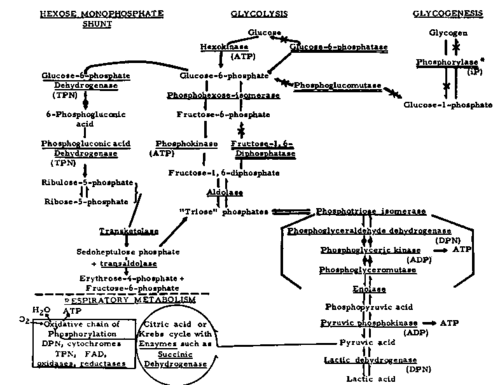
Fig. 14. Carbohydrate metabolism and enzymes ( *Activity decreased or absent in certain tumors, Φ activity increased, enzymes underlined or doubly underlined). *See footnote on glycogenesis.
Turning to the oxidative metabolism, the impairment of which, it will be remembered, forms part of Warburg's postulate and was the subject of a battle of arguments 69,190,199,250,260 which has not quite subsided yet, the situation with regard to enzymic activities of the Krebs cycle and to the hydrogen-electron transport of oxidative phosphorylation is not as clear cut as one might wish. Going back to a symposium on carbohydrate metabolism in 1951 201 and following the matter through in the literature to 1959, one gains the impression from more or less vigorously and more or less continuously expressed interpretations of experimental results, that the respiratory systems in tumors are functioning relatively well, but may be, as mentioned before, without the reserves of normal tissue. While, for instance, Weinhouse261 warned biochemists recently that alterations in cellular activities of tumors might in fact represent simply post-neoplastic changes of cancerous cells having lost their function, Potter who, as mentioned before, has always defended the existence of a state of imbalance, produced evidence for deficiency in TPNH-cytochrome c reductase (Reyna-farje and Potter 214) in Novikoff hepatoma. In addition he found that the enzyme responsible for the hydrogen transfer TPNH + DPNi^TPN -+- DPNH, transhydrogenase, was present only to a negligible extent in hepatoma homogenate and cell fractions. Although the situation with regards to these bio-catalysts is generally very complex, in that their fixation on mitochondria and microsomes might be of a different nature and moreover depend on hormonal interplay (steroid hormones,234 thyroid hormones 214), their important role in respiratory metabolism (see Fig. 14) links them closely with other enzyme systems and electron-hydrogen carriers of the Krebs cycle and of the oxidative phosphorylation chain. There, low levels of cytochrome c, cytochrome c oxidase and of the composite succinic oxidase system in liver tumors have been summarily reported by Greenstein in his classical book on the Biochemistry of Cancer.110 However, as demanded by several authors, further work will have to be done to clarify more extensively the true state of the respiratory enzyme systems in a variety of tumors and comparable proliferating normal tissues and take into account the rapidly increasing knowledge of oxidative phosphorylation 170 where the role of quinone derivatives as possible cofactors is gaining greater significance. Further consideration to coenzymes and metal activators in tumors from a more general point of view will be given below.
Continue to:


My Books

