


Benzosulphinidum - Benzosulphinidi - Benzosulphinide. U. S. P
Description
This section is from the book "A Text-Book Of Materia Medica, Pharmacology And Therapeutics", by George F. Butler. Also available from Amazon: A text-book of materia medica, pharmacology and therapeutics.
Benzosulphinidum - Benzosulphinidi - Benzosulphinide. U. S. P
(Saccharin.)
Definition. - An anhydride of orthosulphamide benzoic acid, C6H4S02.CO.NH. It is variously known as glucosimide, saccharol, saccharinol, saccharinose, agucarine, etc.
Description and Properties. - Its derivation from toluol (from which it is usually made) is shown by the following formulas:

Toluol.
o-Toluolsulphonic-acid, o-Toluolsulphamide.

o-sulphamide-benzoic acid.
Anhydride of o-sulphamide-benzoic acid (Saccharin).
Saccharin was discovered in 1879 by Ira Remsen and C. Fahlberg. It is a white, crystalline powder, nearly odorless, having an intensely sweet taste even in dilute solutions. The sweet taste may be recognized in a dilution of I: 100,000, as compared with cane-sugar, I: 200. Soluble in 250 parts of water and in 25 parts of alcohol; more so in boiling water (1: 24). It behaves like a strong acid and dissolves readily in alkalies; the sodium salt is known as soluble saccharin or crystallose.
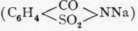
The Liquor Saccharini of the National Formulary is a solution of saccharin in sodium bicarbonate and alcohol. There are a number of preparations on the market, such as anlidiabetin, which contain saccharin (Hunt).
Dose. - Average dose: 3 grains (0.200 Gm. = 200 milligrammes. (U. S. P.) Dulcin or zucrol, another very sweet substance, is para-phenetolcarbamid; saxin is a similar product.
Physiological Action. - In a neutral or alkaline medium, saccharin acts as an antiseptic. Internally it exerts no notable influence. It is said that when mixed with food it interferes with the action of saliva upon starch, and it is thought to retard the action of the other digestive ferments. The drug is not decomposed in the body, and is eliminated by the kidneys unchanged, increasing the amount of chlorides excreted in the urine, which fluid is so influenced by the drug that it does not so readily undergo fermentation.
Therapeutics. - Externally and Locally. - Saccharin is used as a mouth-wash, being especially beneficial in aphthoe. Felici, of Rome, highly recommends the application of a solution of saccharin in ozena.
Internally. - The principal use of the drug is as a substitute for sugar in cases of diabetes. It is sometimes useful as an antiseptic in cystitis. It also acts as benzoic acid in limiting intestinal putrefaction as well.
The drug is extensively used in various elixirs, syrups, etc., to overcome the bitterness of quinine and other bitter alkaloids.
Administration. - Saccharin should be given in solution, or in tablets which may be dissolved singly in a cup of coffee.
Peabody recommends the following formulae:
| Saccharin, | 10.0; |
Sodium carbonate, | 11.0; | |
Aquae, | q. s. 100.0. |

Dose for tea, coffee, etc., to be determined by experiment.
| Saccharin, | 45 grains; |
Sodium carbonate, | 30 grains; | |
Mannite, | 10 ounces. |

Divide in 100 equal parts and use as lump sugar for sweetening purposes.
Continue to:


My Books

