


Introduction To Part III
Description
This section is from the book "Practical Materia Medica And Prescription Writing", by Oscar W. Bethea. Also available from Amazon: Practical Materia Medica and Prescription Writing.
Introduction To Part III
In the following pages, fifty prescriptions are given so arranged as to illustrate the common errors of prescription writing. In each instance, also, the same prescription is shown, written just as it should be for delivery to the pharmacist. These prescriptions are selected from many thousands, and the intention is not only to point out pitfalls to the prescriber, but to give formulae of therapeutic merit; to offer (with due apologies) a substantial formulary of stock prescriptions with the hope that the students in this important field may daily build to this modest foundation, carefully working out every detail of each addition, until they are able to meet any emergency with all credit.
It is earnestly urged that the student read each incorrect prescription with the criticisms and then try to write it correctly, afterward comparing his finished product with the correct copy given.
Prescribed for a persistent cough with slight or no evident lesions.
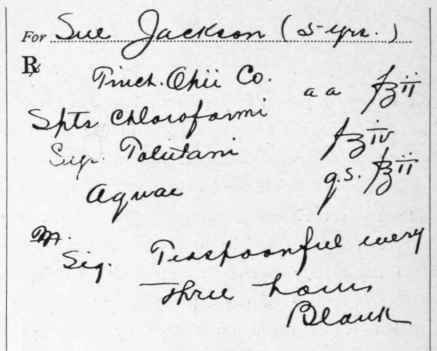
General arrangement is imperfect.
Tincture of opium compound is not the proper name for the remedy wanted.
Spts. is not considered a good abbreviation for Spiritus.
The camphor and oil of anise in the paregoric, and the chloroform in the spirit of chloroform, would be thrown out of solution.
Final i is best made j in numerals.
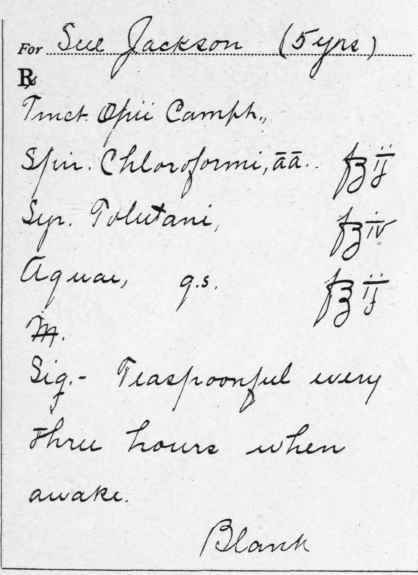
Note the expression "when awake." Directions are usually understood to either mean during the day or during the entire twenty-four hours, regardless. Many do not approve of waking patients for medicine except under pressing circumstances, but these directions instruct a dose to be given when the little patient is awakened by a paroxysm of coughing.
Sodium bromide is often a good addition to this preparation.
For a"dry"cough with some bronchial involvement and fever.
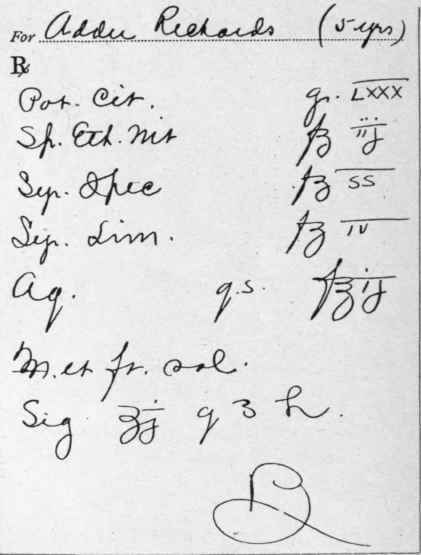
Compare the appearance of the short abbreviations with more complete writing.
Ether is not the correct writing of the official word.
It is unnecessary to instruct the druggist to make a solution; he could not make anything else by mixing these ingredients.
What would the patient think if the druggist carried out his orders and wrote the above directions on the label?
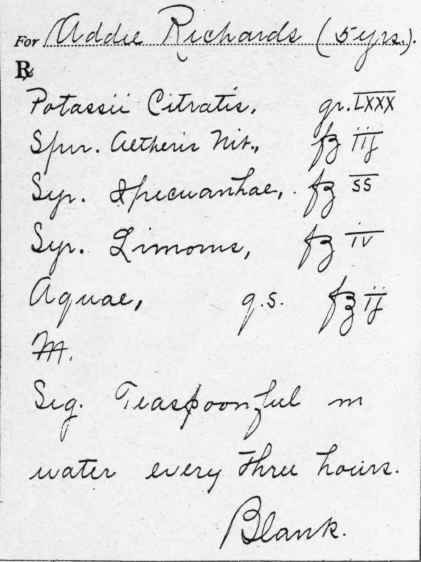
As this is an expectorant mixture it is not often indicated unless the child is old enough to expectorate.
The spirit of nitrous ether is often omitted if there is no fever.
Even a small dose of ipecac will frequently cause nausea; so the pre-scriber should be on his guard.
Frequently used during the paroxysmal stage of whooping-cough.
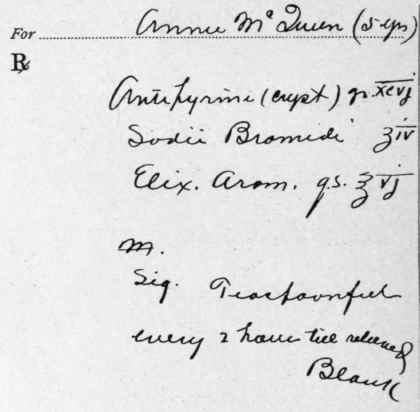
Margins should be observed.
Antipyrine does not have the genitive ending i. It only comes in crystalline form.
The aromatic elixir would appear better written more completely, as the name above it is long.
The character calls for weight and not volume.
The total quantity is too much for this class of remedy.
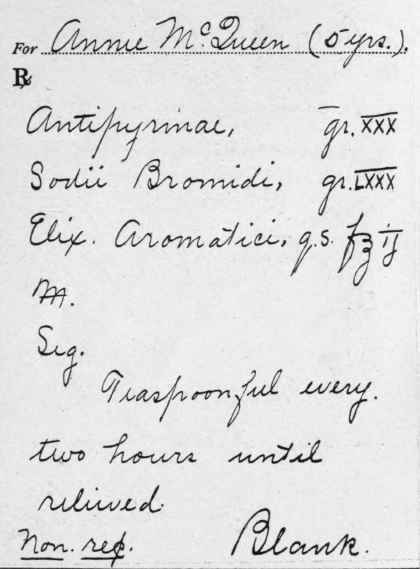
As this is only to be used to control the paroxysms, a small amount should be ordered.
Instructions are given that the prescription is not to be refilled, else the family may use it too long or in subsequent cases of cough when it would be inadvisable.
Tincture of belladonna leaves is frequently added to the above.
This should be given in water.
Prescribed for cough.
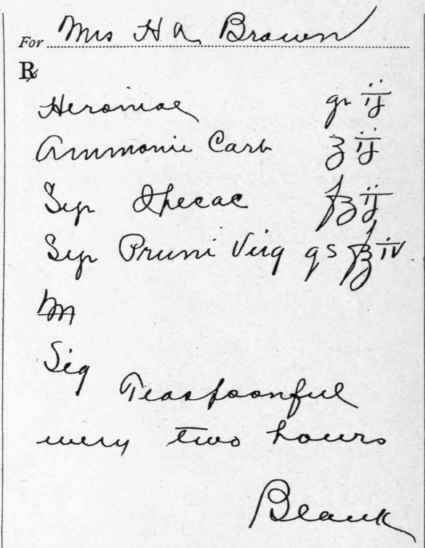
Heroine is very sparingly soluble and not often stocked. The salt should be used, and under the proper name.
A carbonate is incompatible with the free acetic acid in syrup of ipecac.
The abbreviation Ipecac. is too well understood by the laity, and nausea often occurs from the psychic effect of even a small dose.
Periods should follow abbreviations.

Syrup of ipecac. contains free acetic acid; but in this instance the amount is small as compared with the carbonate.
The carbonate can be used in this combination with the diacetylmorphine and wild cherry alone, or apomorphine hydrochloride in about 1/60-grain doses.
The full expectorant dose of the syrup of ipecac. (15 minims) is often not well tolerated.
Used in treating a "dry cough."

Unusual proper names should be plainly written.
The salt of apomorphine should be used, and the above dose will frequently produce nausea.
The proper name for lemon juice is not used.
If an error is made or a word erased for any reason, a new prescription should be written.
A cough medicine is usually better administered at frequent intervals.
Syrup of Lemon has been replaced by the Syrup of Citric Acid.

When ordering expectorants, as apomorphine hydrochloride, ipecac, etc., even in small doses, it is well to advise the nurse as to the possibility of nausea, and to reduce the dose if necessary, otherwise they may not only produce an undesired result, but it leads to a doubt as to the knowledge and judgment of the physician.
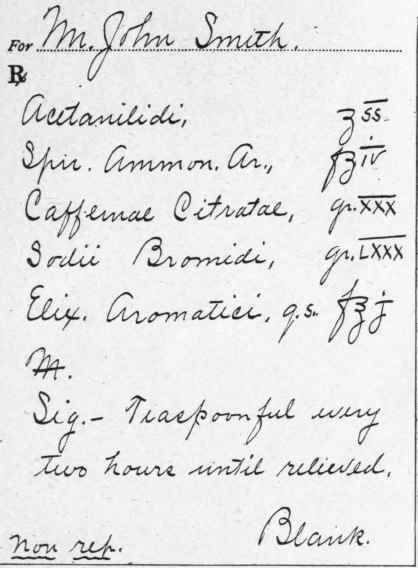
Prescribed for the headache, hiccough, etc., following acute alcoholism.
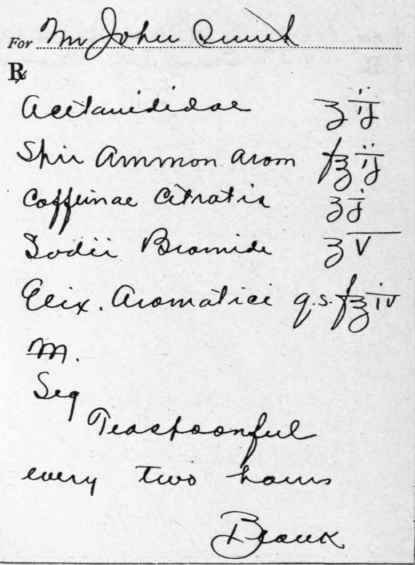
The quantity is too large for an acute condition, as headache. Acetanilid does not take the ending ae. Citrated caffeine is not a salt.
As a remedy of this type is only given until symptoms are relieved, it should be so specified.
This should be taken in water.
Continue to:


My Books

