


Canning Methods
Description
This section is from the book "Food And Health: An Elementary Textbook Of Home Making", by Helen Kinne, Anna M. Cooley. Also available from Amazon: Food And Health: An Elementary Textbook Of Home Making.
Canning Methods
Method 1. (Material cooked before it is put into the can.) This is a good method for berries, and for fruit that will be served as a sauce. Proceed in the preparation and finishing according to the general directions. Cook the fruit gently for half an hour. Use as little water as possible. No sugar is required in the canning process, but the flavor is better if a small amount is used in the beginning - a half cup of sugar to a pound of fruit is enough.
Method 2. (Material cooked in the can.) This is the better method for whole fruit and halves. Select firm, well-shaped fruit for this method, rejecting the mellow and soft fruit. Pack the cans tightly with the fruit, and pour in hot water with sugar dissolved in it, a half cup to the quart can. More sugar can be used, if so desired. Set the jars in a boiler on a rack, and surround them with warm water, to a height that will not allow the water to boil into the cans.
Set the cover on each jar, but do not fasten them. Cover the boiler closely, bring the water to a boil, and allow it to boil for an hour. At the end of this time, with a fork test the fruit for tenderness; pour in more sirup if it is necessary. Remove the jars when the water has cooled sufficiently, and adjust the covers. Cold water is sometimes used at the beginning, but this makes the process longer.
Apparatus is constructed for this method of canning, but the ordinary boiler answers the purpose.
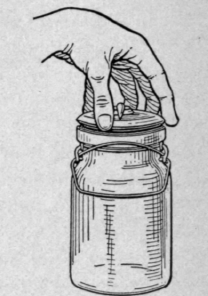
Courtesy of New York State College of Agriculture at Cornell University.
Fig. 51. - Testing the tightness of the rubbers and the fastenings, after the jars have been filled and have stood on their tops for a day.
Why should we dry fruit and vegetables? This is an old-time method, and still a good one. It is easy; a little can be done at a time; the dried food keeps well in a dry place, and has a good flavor.
Dry pitted cherries on a plate, near the fire or in the oven when the fire is going out. Do berries in this way, too.
Sliced apples can be dried in the sun, covered with netting or wire screening to keep out flies.
Many people do not know that dried sweet corn is quite as good as or better than canned corn. Cut off the kernels from the cob and dry, while the sweet corn is quite tender. In the winter make "succotash" the Indian name for "corn and beans," or "beans and corn."
More about the canning clubs. Here are some recipes for canning vegetables, used in the club work. Vegetables need longer cooking than fruit; and it is a good plan to cook them for two or three days in succes-sion, two or three hours at a time.
1 Courtesy of Mrs. Jane S. McKimmon, State Agent in Home Demonstration Work, North Carolina.
The picture (Fig. 44) shows a large canner that is used out of doors. Even if there is no canning club in a town, such a canner is very convenient when preserving for a large family, and it soon pays for the first cost.

Fig. 52. - A tin can may be capped with round capping steel.

Fig. 53. - A tin can may also be tipped with soldering iron and solder.
Some one asked Miss Travers whether it paid to can. Would it not be better to buy canned goods? Her answer was that where there is a plenty of fruit and vege-tables on the place, it costs less money to can. When you have learned how, the labor is not too great.
Continue to:


My Books

