


Chapter I. Introductory
Description
This section is from the book "Food And Health: An Elementary Textbook Of Home Making", by Helen Kinne, Anna M. Cooley. Also available from Amazon: Food And Health: An Elementary Textbook Of Home Making.
Chapter I. Introductory
What are some of the important facts about food and sanitation that a girl may learn, useful to herself and in her home?
When the cool weather of autumn comes again, Marjorie Allen and her friends are glad to have school days returning, too; for then there are so many interesting things to talk over, to think about, and to do with the other pupils. There are the teacher to be welcomed and the new schoolbooks with their new subjects to be studied. The girls in and about Pleasant Valley have a club for sociability and for work. This is the time of year for them to be making plans for the winter. What time, then, or what reason is there for studying such a commonplace matter as food?
"We all know enough about food," some schoolgirl is saying, "and mother does the cooking anyway; so why bother about it in school?"
Marjorie Allen, however, is a wide-awake girl, who has read in the farm journal at home some interesting articles about food, and has noticed that the Department of Agriculture at Washington, D. C, and the University in her own state have printed bulletins for the farmer's wife about nutrition, cookery, and housekeeping. There are other pamphlets, too, for girls, explaining canning clubs, and bread and sewing contests. These pamphlets and books, also on the same subjects, have helped Marjorie to understand that there must be something to study; else why are books written and printed? Moreover, Marjorie is an unselfish girl, ready to help her Mother when she can; and so she is glad to find among the new books for the year's study one or two about homemaking.
What do we know about food? We cannot answer the question at the beginning of this chapter in full, without studying and thinking and working. Perhaps not until we reach the end of the last chapter can we tell what are the important, useful facts about food. But it is true that each girl knows something about food, at least enough to be able to decide upon what she likes. Probably she has been told that some foods are more wholesome than others. Even the living creatures about us have some instinct that guides them to foods desirable for them. Have you ever seen a squirrel eating a toadstool that you would not dare to taste?

Fig. i. - Marjorie Allen.
Why do we take food? It is interesting to notice what the lower animals are eating; for some kinds of food we share with them, and what food does for them it does for us. There are the calves, who live at first upon milk, like the baby at home. We can see how much they have all grown through the summer. The awkward, long-legged fowl running about with such energy are very different from the balls of yellow down that came from the shell in the spring. They have lived upon grain chiefly, but see what they have gained in weight! One astonishing thing about the young wild birds is their rapid growth; and, although angleworms would seem a disagreeable diet to you, the young robins like them as much as you do mutton chops or roast beef.
Food for growth. One fact, then, about food is this : it gives us material for our bodies, for making bones, muscle, fat, blood, hair, and teeth. But more important still is the fact that some foods build our bodies better than others. The picture (Fig. 2) shows that there is a difference in the feeding of animals; for these pigs are the same age, and belong to one family, but they have eaten different kinds of food.
When the Pleasant Valley pupils looked at this picture, John Stark was eager to tell the story of a prize pig raised by his cousin in the next town. This is the story:
Frank Ross, who belongs to a pig club, had a contest with his uncle. From the same litter they selected two pigs as nearly alike as possible.
Frank followed the directions given by the U. S. Department of Agriculture, and his uncle treated the other pig as he had always done. This is what happened:
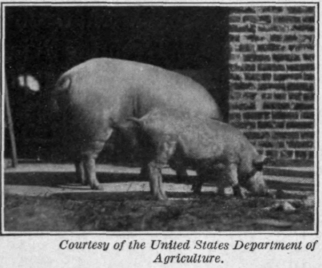
Fig. 2. - Litter mates.
Weight | Cost of Food | Selling Price | |
Frank's pig............................ | 520 lb. | $15.54 | $58.00 |
Uncle's pig............................. | 65 lb | 5.00 | 8.00 |
Think over what we have just said about the calf and the chicken, and you can name two kinds of food that are good body builders. There are no wild creatures near Pleasant Valley that live upon flesh, except the hawks among the birds; but where foxes are still found they thrive upon meat food, and, of course, the young lion of hot countries grows upon a flesh diet.
Food for life and work. Food plays another part that we can understand when we recall what happens to people who starve in times of famine or war. The body becomes weak, unfit for work, and all movements finally stop. Sit perfectly still for a moment. Are all parts of your body quiet? No! Your eyelids are winking, you are breathing, your heart is beating; and there are other movements which you cannot feel, such as the constant flow of the blood. Touch your own hand, - how warm it is! Your clothing makes you warm only by keeping in the heat of your body. What, then, is the source of this heat? You can give the answer yourself, can you not? It is your food that gives you body warmth and power to work. All the foods already mentioned give this energy. What facts about the baby and calf and young robin prove this? The sugar and the fat in the milk are two substances that furnish the energy, and for this reason they are called fuel foods. Another substance found in milk and meat is both a body builder and a fuel food. This sub-stance you will study in Lesson 4.
Water and mineral matter. Water is another important part of our food and drink. Still there is something else, that we cannot see, which serves as food for the body. When wood is thoroughly burned, you know that it leaves ash. Food materials do the same thing when they are burned as completely. This white or gray ash does not burn because it is made up of mineral substances, lime, iron, and many others. These are most important for our bodies. Both water and the mineral substances help in body-building. We shall learn more about them later on.
Other interesting facts about food. You can make your own list; for surely facts about preparing food so that it is delicious to eat, facts about serving it daintily, and knowledge of how to keep it clean, even of how to raise and sell it, and of how to buy it, will occur to you as worth knowing. One small book cannot contain all this information, but at least this book may help you to make a beginning.
The year's work. The heading of this chapter states our large problem for study during the year.
The projects, or pieces of practical work, for us are the school luncheon, the home supper, breakfast, and dinner. As we study each meal in the different chapters, we shall learn about the food materials and the dishes prepared from them suitable for each meal. Some of these dishes can be made at school, and most of them are useful for the home table.
Exercises And Problems
1. Make a list of the foods you know, under grain, vegetables, meat foods, sugar, fats.
2. Can you give a fact that shows the egg to be a food that builds the body and gives energy?
3. Why is the body sometimes likened to an engine?
4. Can you tell how it is different from an engine?
5. Explain why milk is a food as well as a drink.
Continue to:


My Books

