


Lesson 5. Bread A Staple Food
Description
This section is from the book "Food And Health: An Elementary Textbook Of Home Making", by Helen Kinne, Anna M. Cooley. Also available from Amazon: Food And Health: An Elementary Textbook Of Home Making.
Lesson 5. Bread A Staple Food
Bread is a staple food for the school luncheon and for all meals. If you cannot make it at school, make it at home and have a bread contest at school. How can we plan for this bread contest?
One day in fall, when the Pleasant Valley Luncheon Club was eating sandwiches under the trees, one of the girls remarked : "Isn't it funny that our sandwiches look so different ! I don't mean what is inside, but the bread itself. It is different colors, and the holes are different sizes, and some of the bread is crumbly and some is moist. Isn't it queer that bread isn't just the same always !"
"My mother didn't have luck with her bread this week," Marjorie Allen said. John Alden replied, "My father says, 'Don't talk about luck: that's a lazy man's excuse!'"
"Well," Marjorie began, her face flushing, - but Barbara Frietchie said quickly: "It's late for our county fair, but why can't we have a bread contest here? Everybody says it's an accomplishment to make good bread. Didn't you read about a contest last week in the 'Pleasant Valley News'?"
"Yes, indeed," they all said,"we'll ask Miss James !'
"A good idea," said the teacher, "and just the time, for we are beginning percentage, and this is where the boys can help."
But John Stark looked very determined. "If there is going to be a bread contest, I am in it. My brother is a mining engineer, and last time he was at home, he learned how to make yeast bread, Mother's way. He said bread often is pretty poor, where he stays."
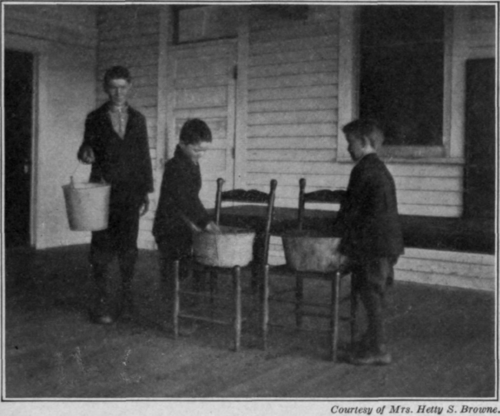
Fig. 22. - "Who says boys can't cook? "
This is the way the club planned their contests. Miss James thought it better to wait until the instructor in household economics came from the State College to talk to the Woman's Club and to visit the school.
When Miss James received a letter saying that Miss making the bread from the materials that the club had supplied. She explained that hers was a good and exact recipe, though probably no better than many of those familiar to the mothers of Pleasant Valley. The mothers had been invited to the school; and many of them were present and enjoyed the demonstration and the lecture. They helped by asking practical questions.
Travers would be there on a certain date, each pupil who wished to engage in the contest made a loaf by the rule used at home, and brought it to school to be judged on the day of the visit. Miss Travers used a score put on the blackboard, and explained that, for an accurate contest, all the loaves should be made by one recipe. She gave a demonstration of her own rule,
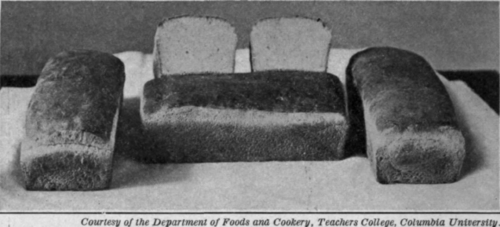
Fig. 23. - A loaf of this shape and size bakes evenly.
A bread score. This is the Bread Score as Miss Travers explained it. Do you understand it?
BREAD SCORE CARD1 | ||
I. General Appearance . | . . . | . 15% |
1. Shape. . | 2.5% | |
2. Size . . | 2.5% | |
3. Crust. . | 10.0% | |
(a) Color | ||
(b) Smoothness | ||
II. Internal Appearance | . . . | 55% |
1. Depth of crust . . . | 10% | |
2. Texture (lightness). | 15% | |
3. Crumb . . . | 30% | |
Moisture . (a) . (25 %) Elasticity | ||
(b) Color . . ( 5 %) | ||
III. Flavor. . . . . . | ... | 30% |
100% | ||
If you read it carefully you can see that all the points mentioned are important, and that the different per . cents show the importance of the points when compared with each other.
What are the points in good bread? Notice the shape of the loaves in the picture (Fig. 23). A loaf of this shape and size bakes evenly. The crust should be a golden brown and tender rather than hard and tough. The color of the crumb - the inside of the loaf - should be creamy rather than snow white; the holes, small and evenly distributed; and when the crumb is pressed between the thumb and finger, it should be soft and springy, but not doughy. Some people like a rather open, dry bread, and others a closer and moister grain; but it must be baked through to the very center, in any case. And the flavor - who can describe exactly the sweet, almost nutty taste of good bread, free from a taint of yeast or sourness ! We all enjoy it when it is perfect. It is indeed a science and an art to make it so.
1 Courtesy of Department of Foods and Cookery, Teachers College, Columbia University. See, also, Bulletin 25, University of Illinois.

Fig. 24. - 1 has a poor shape and texture; 2, good shape and texture; 3 has a poor shape.
What is the value of white bread as food? Even before scientists explained to us the true value of bread, the human race had learned to prize bread made from ground wheat. Bread is called the "staff of life," as you know. Bread made from other grains is useful and palatable. In the pioneer days of America, "brown" bread was made largely from corn and rye meal; and we enjoy this kind of bread even now. We may have whole wheat, or graham, or rye alone; but white flour bread is our main dependence.1
Continue to:


My Books

